Dry-Docking and the Critical Instant
StabilityHow a vessel loses stability as she settles on the keel blocks: the upthrust P, the critical period and critical instant, and the virtual loss of GM. How to prepare for docking and undocking, with and without damage. A classic MCA Master oral and stability question.
Last reviewed 1 Nov 2026 · From a professional captain's years of study notes · Organised with AI and checked against current regulations · How we write
On this page (12)
Read first: flotation, centres and metacentric height and free surface effect. This topic uses G, M, GM, trim and MCTC.
Why dry-docking is a stability problem
In short: afloat, the water holds the ship up all along her length. In dry dock, the water is pumped out and the keel blocks take over. While she passes from water to blocks, part of her weight sits on one small point at the stern. That upthrust P cuts her effective GM. If GM goes negative before the side shores are set, she can heel over and fall off the blocks.
- The stages: enter the dock (small trim by the stern, upright) → dock gate shut, pumping starts → stern lands on the blocks → critical period (stern on the blocks, bow still afloat) → critical instant (she takes the blocks overall) → shores set, dock pumped dry.
- Undocking is the same film run backwards: the most dangerous moment comes again just before she floats free.
- The MCA expects you to explain the need for an acceptable trim and adequate GM when dry-docking, and to define critical period and critical moment (MCA Master (Yachts) Stability syllabus 2.4.2.4–2.4.2.5).
The docking plan
In short: the docking plan is the ship’s own drawing for the dock master. It shows where the blocks can go and what must be kept clear (MCA Master (Yachts) Stability syllabus 2.4.2.2).
- What it shows:
- hull profile, keel line and main dimensions, including the overhangs fore and aft;
- positions of keel blocks and bilge (side) blocks;
- transverse bulkheads and other strength members, so blocks and shores bear on strong structure;
- hull openings to keep clear of blocks: sea chests, drain plugs, echo sounder and log transducers, bow thruster tunnels, stabiliser fins, anodes.
- The dock master builds the blocks from it before the ship arrives. Send it to the yard early with the list of work.
- Supports and lifting gear must line up with the vessel’s main strength members (MCA Master (Yachts) Stability syllabus 2.4.2.8). A block under an unsupported plate can dent or crack the hull.
- Change of dock = check again: block positions, block load and the dock floor’s limits.
Preparing the yacht and the dock
In short: arrive upright, with a small trim by the stern, enough GM to cover the loss at the critical instant, and no slack tanks. Record every tank on arrival (MCA Master (Yachts) Stability syllabus 2.4.2.3).
- Stability:
- work out the docking condition: displacement, draughts, trim, KG, GM, and the loss of GM at the critical instant (see below);
- no list: a ship that lands listed puts all the load on one edge of the blocks;
- trim small and by the stern, within the dock’s limit: the bigger the trim, the bigger P;
- tanks full or empty, never slack: free surface adds to the loss of GM;
- heavy weights low and out of the overhangs; nothing loose that can shift.
- Records: take and keep all tank soundings and a list of weights on board. You need them to undock in the same condition.
- On deck: tenders, cranes, davits and gangways stowed and secured; anchors and cables ready as the yard asks.
- Services: agree with the yard on shore power, fire main, cooling water, sewage and fire watch. Plan for fire safety during hot work.
- The dock: blocks built and checked against the docking plan, side shores ready, dock floor clear.
- During pumping: the dock slows the pumps as the stern nears the blocks. Watch the ship stays upright and centred.
The upthrust P and the critical period
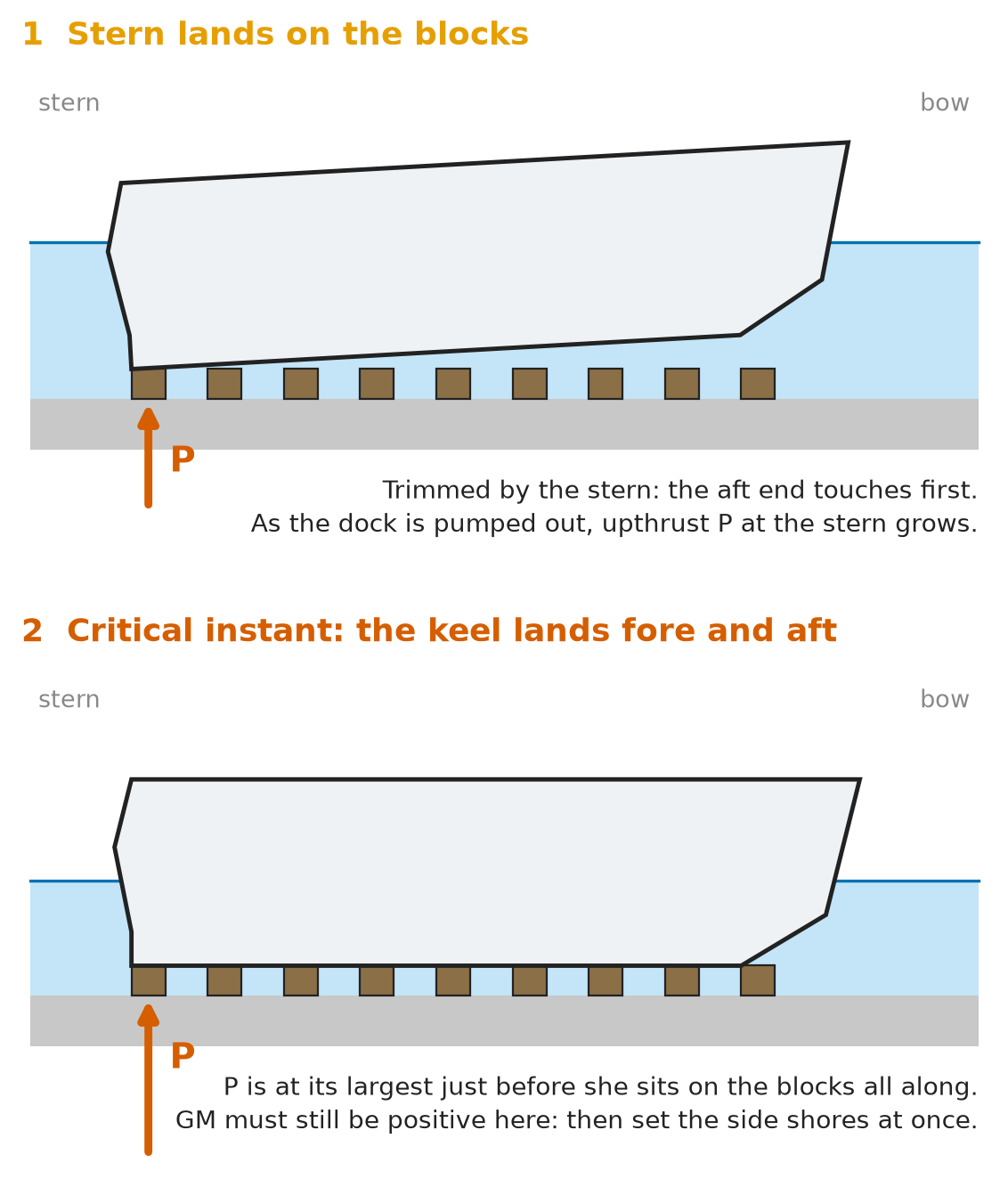
In short: the critical period runs from the moment the stern touches the blocks to the moment she takes the blocks overall. During it, the blocks push up at the stern with a force P that grows as the water falls.
- When the stern lands, the water level keeps dropping. The stern cannot go down, so the ship trims by the head about the stern: the stern trim slowly disappears.
- The force at the stern is P, in tonnes. It equals the weight now taken by the blocks, so the water carries only W − P.
- P is largest at the end of the critical period, when all the original trim has gone.
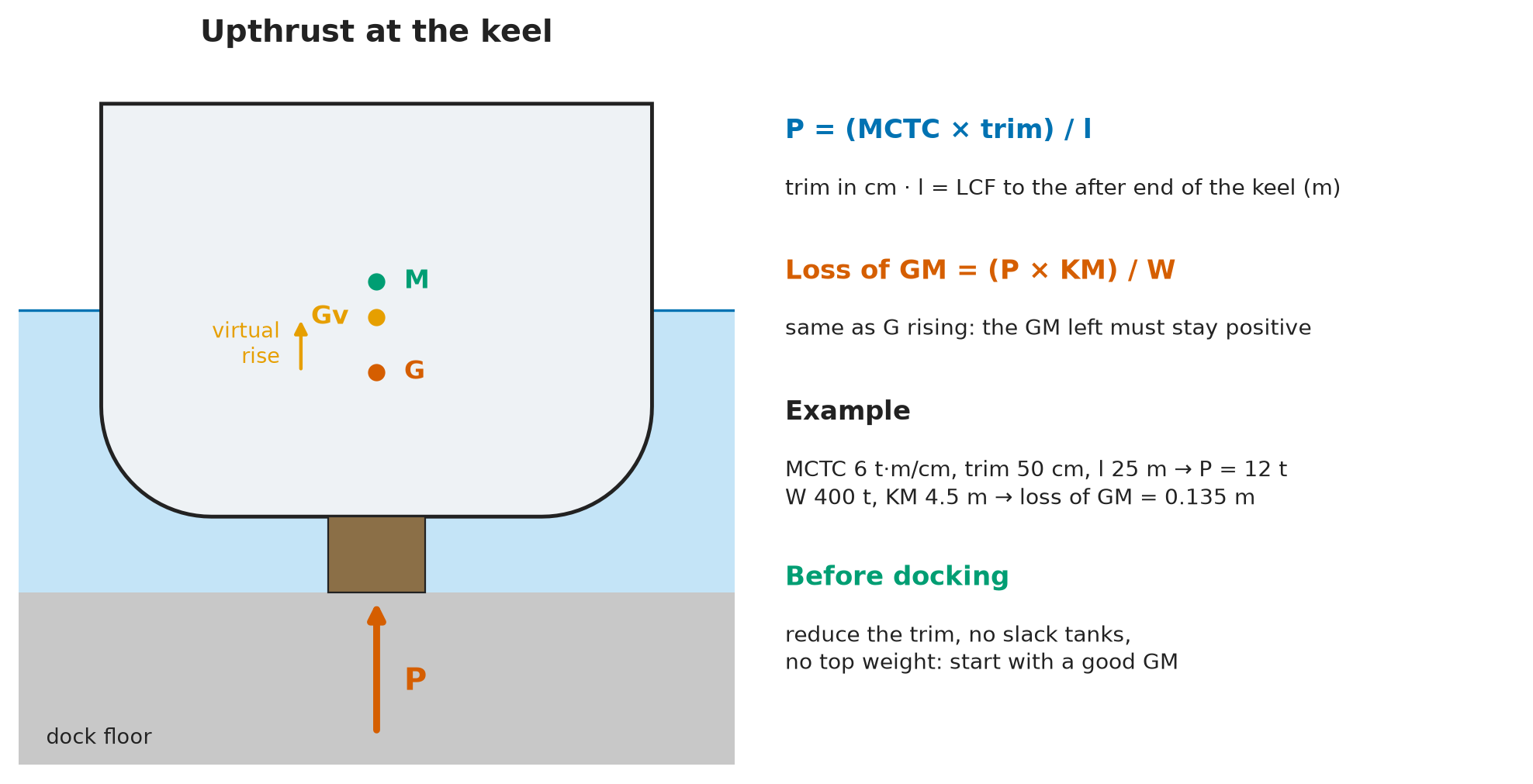
- Find P from the change of trim, taking moments about the centre of flotation (LCF):
- P = MCTC × change of trim (cm) ÷ l
- MCTC in t·m/cm; l = distance in metres from the LCF to the point where P acts (the after end of the keel, often taken as the after perpendicular).
- Check: P is also the loss of displacement, so it equals TPC × the fall in draught at the LCF.
- MCA wording: explain the meaning of P force and its effect on stability (MCA Master (Yachts) Stability syllabus 2.4.2.6).
The critical instant and the loss of GM
In short: the critical instant is the moment the ship takes the blocks overall: keel touching the blocks fore and aft. P is at its maximum and the effective GM at its minimum. GM must still be positive here.
- Why GM falls: an upward force at the keel acts like taking a weight off at keel level. That makes G rise virtually (or M fall), so the effective GM gets smaller.
- Two standard ways to find the virtual loss of GM (both used in the textbooks):
- Method 1: loss = P × KM ÷ W
- Method 2: loss = P × KG ÷ (W − P)
- Effective GM = initial GM − loss. The two methods give slightly different numbers; use the one your examiner or textbook uses and show the working.
- After the critical instant, the dock goes on pumping. P keeps growing (up to the full weight), so the effective GM keeps falling. That is why the side shores go in at once, working from aft forward, as soon as she is on the blocks overall.
- Danger sign: she starts to lean as the bow comes down. Stop pumping, flood the dock back if needed, and correct before going on.
Worked example: GM at the critical instant
- Vessel 1,200 t, trim 0.60 m by the stern (60 cm). MCTC 15 t·m/cm. LCF 22 m forward of the after end of the keel. KM 6.00 m, KG 5.20 m, so GM 0.80 m.
- P = 15 × 60 ÷ 22 = 40.9 t.
- Method 1: loss = 40.9 × 6.00 ÷ 1,200 = 0.20 m. Effective GM = 0.80 − 0.20 = 0.60 m.
- Method 2: loss = 40.9 × 5.20 ÷ 1,159.1 = 0.18 m. Effective GM = 0.62 m.
- Same ship with 1.20 m trim: P doubles to 81.8 t and the loss doubles to about 0.41 m (method 1). Double the trim, double the loss.
Keeping GM positive
In short: keep P small and GM big. Small trim, low G, no free surface, shores early.
- Small trim by the stern: P is proportional to the trim. A little trim lets the stern land first so the ship can be lined up over the blocks; a lot of trim gives a big P.
- Lower G before docking: weights down, top weight off, low tanks full.
- No slack tanks: press them up or empty them.
- Upright: correct any list before entering.
- Use your stability booklet data (hydrostatics, MCTC, LCF, KM) for the calculation.
- If the calculation shows too little GM: reduce trim (ballast forward or move weights forward), add low ballast, or ask the yard for a different block arrangement.
Undocking
In short: float her out in the same condition she came in. Put back the arrival tank soundings and weights, then check for leaks as the water rises (MCA Master (Yachts) Stability syllabus 2.4.2.7).
- Why: the stability you calculated for docking is only valid for that condition. Any weight added, removed or moved in dock (new equipment, tanks emptied for work, fuel moved) changes KG, trim and list.
- Keep a log of every weight change in dock. Before flooding, put tanks back to the arrival soundings, or work out a new stability condition.
- Hull check before flooding: all drain plugs back in, sea valves and sea chests closed and boxed up, transducers and anodes fitted, rudder and propeller work finished, paint dry.
- As the dock floods: crew in the engine room and tank spaces check every opening for leaks. Stop flooding if water comes in.
- The critical instant comes again in reverse, just before she lifts off the blocks: GM must be positive. Shores are taken away only when she is ready to float.
- Start sea-water-cooled machinery only when she is afloat and the inlets are under water.
Docking a damaged vessel
In short: damage can bring list, trim by the head, lost buoyancy and free surface. All of them make docking riskier. Work out the damaged stability first and agree a plan with the dock master (MCA Master (yachts less than 3000 GT) oral syllabus 3.2.4).
- After collision, grounding or flooding the ship may be listed, trimmed the wrong way, lower in the water and with less GM.
- Before docking:
- calculate the damaged condition: draughts, list, trim, GM including free surface;
- reduce list and trim where you can (pump out, temporary repairs, move weights);
- give the dock master the damage details: where, how big, which compartments are flooded;
- check the keel and bottom for distortion: the dock may need special blocks or block heights.
- As the dock is pumped out, water in compartments open to the sea drains out too. The weight of the ship changes; follow it.
- Expect a bigger P if she lands with a large trim, and less margin of GM. Set shores early; pump slowly.
Slipping and lifting
In short: yachts often leave the water on a slipway or a lift rather than in a dry dock. The same ideas apply: support on strong structure, stability while the load passes from water to supports (MCA Master (Yachts) Stability syllabus 2.4.2.1).
- Slipway: the yacht sits on a cradle and is hauled up an inclined slip. The first point of contact takes an upthrust, just like the stern on the keel blocks.
- Lifting: a travel hoist (slings) or a ship lift (a platform raised out of the water). Slings go at the marked sling points, clear of shafts, propellers, fins and transducers.
- Supports and lifting gear must bear on the main strength members: keel, bulkheads, frames (MCA Master (Yachts) Stability syllabus 2.4.2.8).
- Check the vessel’s weight against the lift’s safe working load. Tanks full or empty, nothing loose.
⚡ Flashcards
Test yourself, one card at a timeQ1Why is dry-docking a stability problem?
AnswerAs the water is pumped out, the blocks push up at the stern (P). This cuts the effective GM; if it goes negative before the shores are set, she can fall off the blocks.
Common trapTrap: thinking stability only matters at sea.
Q2What is a docking plan and what does it show?
AnswerThe ship’s drawing for the dock master: keel line, block positions, bulkheads and strength members, hull openings (sea chests, drain plugs, transducers), overhangs.
Common trapTrap: forgetting it must reach the yard before arrival.
Q3How do you prepare the vessel for dry-docking?
AnswerUpright, small trim by the stern, enough GM for the critical instant, tanks full or empty, weights secured and out of the overhangs, all soundings recorded.
Common trapTrap: arriving with slack tanks or a big trim.
Q4What is the critical period?
AnswerFrom the moment the stern touches the blocks to the moment she takes the blocks overall. P grows all the way through it.
Common trapTrap: mixing it up with the critical instant (the end of the period).
Q5How do you calculate P?
AnswerP = MCTC × change of trim (cm) ÷ l, where l = distance (m) from the LCF to the after end of the keel. Check: TPC × fall in draught at the LCF.
Common trapTrap: using trim in metres with MCTC in t·m/cm.
Q6What is the critical instant and what must you check?
AnswerThe moment she takes the blocks overall, fore and aft. P is maximum, effective GM minimum: GM must stay positive.
Common trapTrap: thinking the danger is over once the stern lands.
Q7How do you find the virtual loss of GM?
AnswerMethod 1: P × KM ÷ W. Method 2: P × KG ÷ (W − P). Effective GM = GM − loss.
Common trapTrap: forgetting that GM keeps falling after the critical instant: shores in at once.
Q8How do you keep GM positive when docking?
AnswerSmall trim (P is proportional to trim), low G, no free surface, upright, shores set as soon as she is on the blocks overall.
Common trapTrap: docking with a large stern trim: double the trim, double the loss.
Q9What do you check before and during undocking?
AnswerSame condition as on arrival (tank soundings, weights), drain plugs in, sea valves closed, then check every opening for leaks as the dock floods.
Common trapTrap: undocking after weight changes in dock without a new stability check.
Q10What changes when docking a damaged vessel?
AnswerList, trim by the head, lost buoyancy and free surface: calculate the damaged stability, reduce list and trim, give damage details to the dock master, pump slowly, shores early.
Common trapTrap: treating it as a normal docking.
Q11What matters when slipping or lifting a yacht?
AnswerSlings or supports on the main strength members, at the marked sling points, clear of shafts, fins and transducers; weight within the lift’s SWL.
Common trapTrap: slinging under a propeller shaft or a transducer.
📚 Resources
Books
- Ship Stability for Masters and Mates — Bryan Barrass and D. R. Derrett, 7th edition (Butterworth-Heinemann, 2012) — chapter 41, “Drydocking and Stability – Procedures and Calculations”
Official sites
- GOV.UK — Master (Yachts) Stability examination syllabus — 2.4.2 Dry-docking
- GOV.UK — Master (yachts less than 3000 GT) oral examination syllabus — 3.2.4 dry-docking and undocking, with and without damage
Exam focus — MCA
Typical questions: “What is the critical period, and what is the critical instant?” · “What is P, and how does it affect stability?” · “How would you prepare your yacht for dry-docking?” · “What is on a docking plan?” · “What precautions do you take before undocking, and with a damaged vessel?” What the examiner wants: critical period = stern on the blocks until she takes the blocks overall; critical instant = taking the blocks overall, P maximum, GM minimum, GM must stay positive. P = MCTC × trim ÷ l, acting like a weight removed at the keel. Arrive upright with a small stern trim, no slack tanks, soundings recorded; shores set at once. Undock in the arrival condition and check for leaks; with damage, calculate the damaged condition and brief the dock master.