List, Loll and Heel
StabilityThe three ways a ship can lean: a list (G off the centreline, positive GM), a loll (G above M, negative GM) and a heel (a temporary tilt from wind, waves or turning). How to tell them apart on board and how to correct each one safely. Mistaking loll for list can capsize a ship, and examiners always ask.
Last reviewed 1 Nov 2026 · From a professional captain's years of study notes · Organised with AI and checked against current regulations · How we write
On this page (10)
Read first: flotation, centres and metacentric height and good and poor stability. This topic builds on G, M and GM.
Three ways to lean
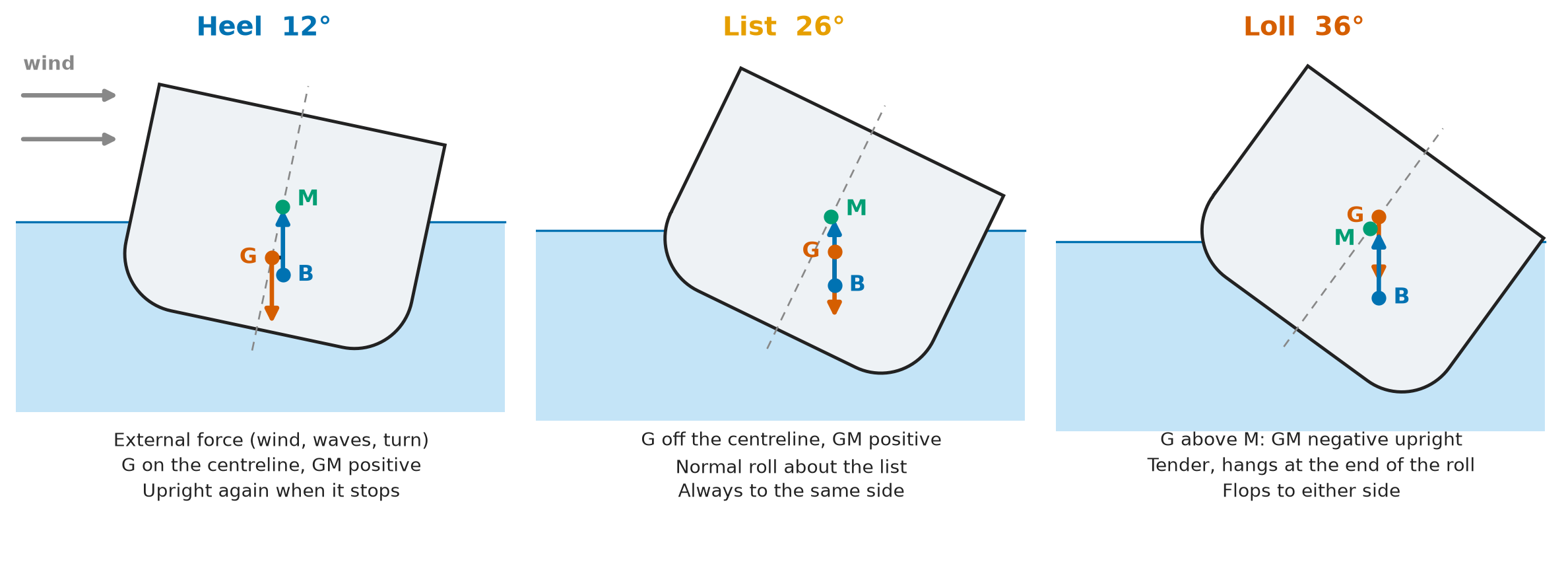
In short: a ship can lean for three different reasons. List = weight off the centreline. Loll = no stability upright. Heel = an outside force. Same look, very different cure.
| Cause | GM | Which side | Lasts | |
|---|---|---|---|---|
| List | G off the centreline (uneven weight) | Positive | Always the same side | Until you move the weight |
| Loll | G above M | Negative | Either side: she can flop over | Until you lower G |
| Heel | Wind, waves, turning | Any | Away from the force | Stops when the force stops |
- All three are a transverse lean (port or starboard). A fore-and-aft lean is trim, not heel.
- On a GZ curve every inclination on the bottom axis is called “angle of heel”, whatever the cause.
- The MCA stability syllabus asks you to distinguish between list and loll (MCA Master (Yachts) Stability syllabus 2.4.1.6).
Angle of list
In short: a list comes from weight off the centreline. G moves sideways, GM stays positive, and the ship is stable at her listed angle.
- Causes: cargo or stores loaded on one side, fuel or water used from one side only, a slack tank draining to one side, a leak on one side.
- G moves off the centreline towards the extra weight. The ship heels until B is right under the new G. She then floats there in equilibrium.
- She still rolls normally, but about the listed position, and she always comes back to the same side.
- The size of the list depends on the shift of G and on GM: tan list = GG₁ ÷ GM, with GG₁ = weight × distance moved ÷ displacement (small angles). The MCA syllabus asks you to calculate it (MCA Master (Yachts) Stability syllabus 2.2.1.3–2.2.1.4).
- The same weight gives a bigger list when GM is small. A big list for a small weight is a warning that GM is low.
Worked example: a list from moving one weight
- Displacement 1,000 t, GM 0.50 m. A 10 t tender is moved 6 m to port.
- GG₁ = 10 × 6 ÷ 1,000 = 0.06 m. tan list = 0.06 ÷ 0.50 = 0.12, so the list is about 7° to port.
- Same move with GM 0.25 m: tan list = 0.24, list about 13.5°. Half the GM, about double the list.
Angle of loll
In short: loll happens when G rises above M. GM is negative, so the ship has no stability upright. She leans over until she finds a little stability, and floats at the angle where GZ = 0.
- Upright she is unstable: any small push makes her heel. As she heels, the shape of the underwater hull changes and B moves out. At some angle B comes back under G: righting lever GZ = 0. That is the angle of loll.
- She can loll to either side. In a seaway she can hang to port, then flop over and hang to starboard. Wind or waves can flip her suddenly, which is quite unlike a normal roll (Wärtsilä Encyclopedia, “Angle of loll”).
- At the angle of loll she looks stable, but the margin is tiny. Any further rise of G, and she capsizes. Very dangerous: act at once.
- Typical causes, all of which raise G or cut GM:
- top weight loaded (deck cargo, tenders, stores high up);
- low tanks used up (fuel or water from the double bottom) without ballasting;
- free surface in slack tanks, or flooding after damage (Wikipedia, “Angle of loll”);
- weight added high up at sea: ice on the superstructure, water trapped on deck, deck cargo soaking up water.
- Watch the wording: loll is negative GM, not “neutral” GM. Neutral equilibrium is GM = 0.
Angle of heel
In short: heel is a temporary transverse lean caused by an outside force. When the force stops, the ship comes back upright.
- Forces that heel a ship: wind on the beam, turning (the centrifugal effect in the turn), waves, a tow line pulling to one side.
- G does not move and GM does not change. The ship is pushed over and her righting moment pushes back.
- The 2008 IS Code checks heel from a steady wind and gusts (the weather criterion) and, for passenger ships, heel when turning (IMO MSC.267(85), 2008 IS Code Part A).
- On the bridge: a list or a loll adds to any heel. A ship listed to starboard that turns to port heels further to starboard. With small GM, slow down before a large alteration of course.
- Common trap: heel is not a longitudinal movement. Fore-and-aft is trim.
Telling list from loll on board
In short: a list leans always to the same side and the ship rolls normally. A loll makes her more and more tender, she hangs on one side, then on the other.
- Signs of loll:
- the ship becomes increasingly tender: long, slow, lazy rolls;
- she hangs at an angle, then flops over and hangs on the other side;
- the lean can change side after a small push: a gust, a wave, a turn.
- Signs of list:
- normal motion, rolling about the listed position;
- always the same side;
- the angle matches a weight you can find (a tank, cargo, a tender).
- Alongside: ask what was loaded, discharged or used just before. Deck cargo loaded? Double-bottom tanks pumped out or used? Ballast changed? A tank left slack?
- Check the soundings of all tanks: a hidden slack tank or a leak changes the answer.
- If in doubt, treat it as loll. The cure for a list (moving weight across the ship) is dangerous with loll.
Correcting a list
In short: first rule out loll. Then put back the balance with an equal and opposite moment.
- Make sure it is a list: positive GM, always the same side, a known cause.
- Then:
- remove weight from the low side; or
- add weight on the high side; or
- shift weight from the low side to the high side.
- Size the correction with the same formula: the moment you add must cancel weight × distance of the cause.
- Find the cause first: if the list is growing, think of a leak or a tank filling by itself, not just poor loading.
Correcting loll
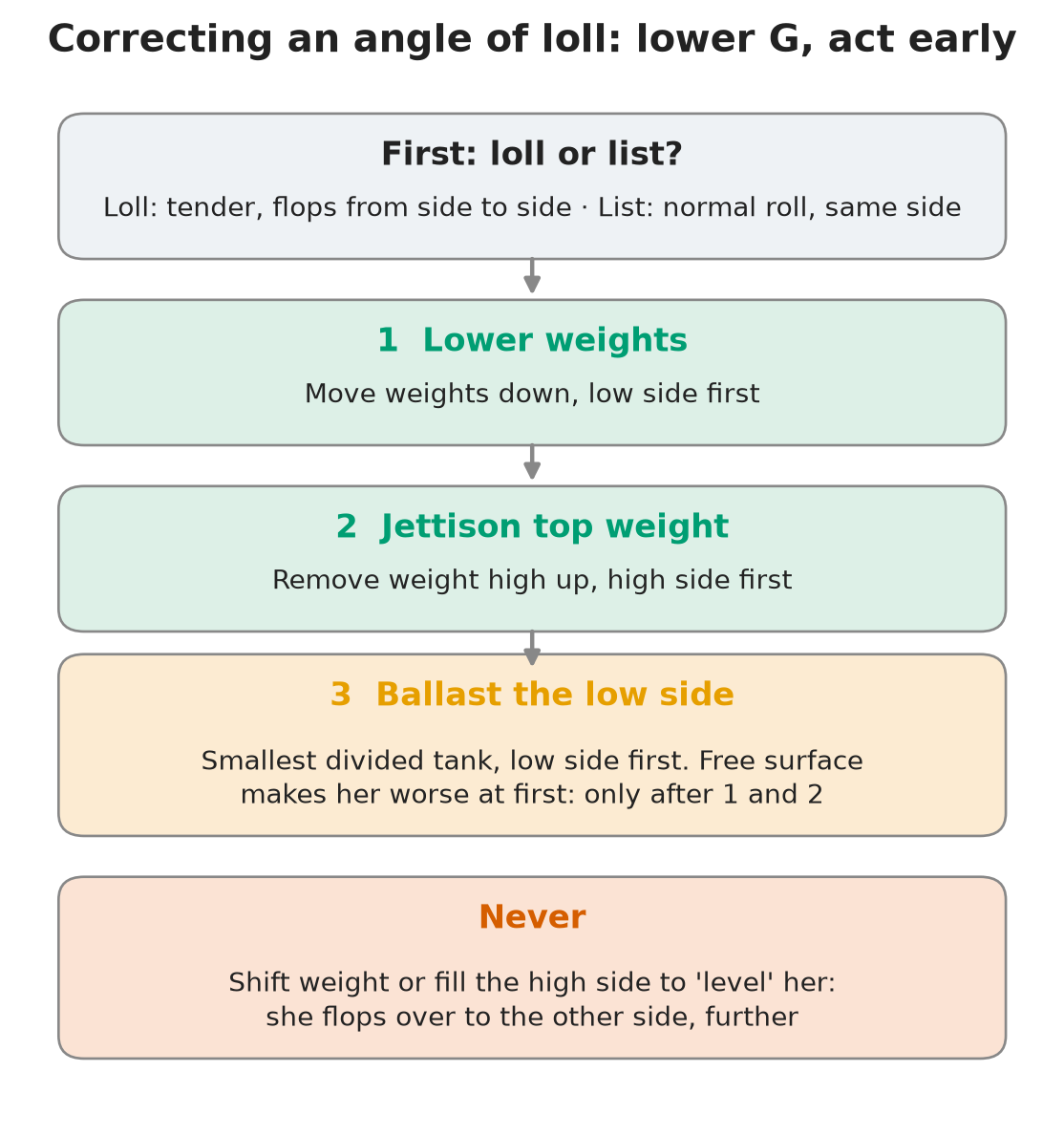
In short: lower G with no sideways moments. Never move weight across the ship. Act early.
- Moving weight across a lolling ship does not help: G is still above M. She may flop over and hang at the same angle on the other side, or further.
- Use the steps in this order:
- Move weights down, starting on the low side.
- Remove or jettison top weight, starting on the high side.
- Ballast low tanks (double bottom), starting on the low side. Use small or subdivided tanks, one at a time, and press each one up.
- Why this order: steps 1 and 2 lower G straight away. Every step is chosen so that she stays on the side she already leans to and never swings across.
- Why ballast comes last: it is fast, but a tank being filled is slack at first. Its free surface raises G (virtually) before the added low weight lowers it, so the loll first gets worse. The effect soon passes and the heel then falls quickly (Wärtsilä Encyclopedia, “Angle of loll”).
- A tank divided at the centreline helps: fill only the half on the low side (MCA Master (Yachts) Stability syllabus 2.4.1.5).
- Cut existing free surface as well: few slack tanks, the rest pressed up or empty.
- Act early. Loll is the warning that GM is already negative. One more rise of G (fuel used, ice, water on deck) and she can capsize.
⚡ Flashcards
Test yourself, one card at a timeQ1What is the difference between list, loll and heel?
AnswerList: G off the centreline, GM positive. Loll: G above M, GM negative. Heel: outside force (wind, waves, turning), temporary.
Common trapTrap: calling a fore-and-aft lean “heel”. That is trim.
Q2What causes a list, and is the ship stable?
AnswerWeight off the centreline moves G sideways. GM stays positive: stable at the listed angle. tan list = GG₁ ÷ GM.
Common trapTrap: forgetting that a small GM makes the same weight give a bigger list.
Q3What is an angle of loll?
AnswerG above M, GM negative: unstable upright. She heels until GZ = 0 and floats there, to either side.
Common trapTrap: “loll = neutral GM”. Loll is negative GM; neutral is GM = 0.
Q4What is an angle of heel?
AnswerA temporary transverse lean from an outside force (wind on the beam, turning, waves). She returns upright when the force stops.
Common trapTrap: heel is not longitudinal, and G does not move.
Q5How do you tell loll from list on board?
AnswerLoll: more and more tender, hangs on one side then the other. List: normal motion, always the same side. Alongside: check what was loaded or used just before.
Common trapTrap: treating a loll as a list. If in doubt, treat it as loll.
Q6How do you correct a list?
AnswerFirst rule out loll. Then an equal and opposite moment: remove weight low side, add weight high side, or shift weight across.
Common trapTrap: ignoring a growing list: it may be a leak.
Q7How do you correct an angle of loll?
AnswerLower G, no sideways moments: 1) move weights down, low side first; 2) jettison top weight, high side first; 3) ballast low tanks, low side first, one at a time.
Common trapTrap: moving weight across the ship: she flops to the other side.
Q8Why is ballasting the last step when correcting loll?
AnswerA tank being filled is slack: its free surface makes the loll worse at first. Steps 1 and 2 lower G at once. Act early.
Common trapTrap: filling several tanks at once, or starting on the high side.
📚 Resources
Videos
- NS301 - Comparison of Angle of List and Angle of Loll — DeckPrep (YouTube)
Books
- Ship Stability for Masters and Mates — Bryan Barrass and D. R. Derrett, 7th edition (Butterworth-Heinemann, 2012)
Regulations
- IMO MSC.267(85) — International Code on Intact Stability, 2008 (2008 IS Code): Part A criteria, including the weather criterion
- MCA MSIS 43 — Intact stability: instructions for surveyors (2008 IS Code with explanatory notes)
Official sites
- GOV.UK — Master (Yachts) Stability examination syllabus — 2.2.1 list, 2.4.1 negative GM and loll
- Wärtsilä Encyclopedia — Angle of loll
- Wikipedia — Angle of loll
Exam focus — MCA
Typical questions: “What is the difference between list and loll?” · “Your vessel is lying at an angle: how do you know if it is list or loll?” · “How would you correct an angle of loll? In what order, and why?” · “Why must you not shift weight across the ship to correct loll?” · “What is an angle of heel?” What the examiner wants: list = G off the centreline with positive GM; loll = G above M, negative GM, can flop to either side; heel = temporary, transverse, from an outside force. The signs on board (tender, hangs one side then the other) and checking what was loaded or used. For loll: lower G without sideways moments, in order (weights down, top weight off, ballast low side first), the free surface warning when ballasting, and act early.