Stability Booklet and Inclining Experiment
StabilityWhat the approved stability information booklet contains, which vessels must carry one, and how the inclining experiment finds the lightship weight, KG and LCG that every loading calculation starts from. A classic MCA oral question for yacht and workboat masters.
Last reviewed 1 Nov 2026 · From a professional captain's years of study notes · Organised with AI and checked against current regulations · How we write
On this page (10)
Read first: flotation, centres and metacentric height, the GZ curve and free surface effect. This topic shows where the numbers behind G, GM and GZ come from.
What the stability booklet is
In short: the Stability Information Booklet (SIB) is the approved book that tells the master how stable the vessel is in each loading condition, and how to check any new one.
- It is written for the master. It turns the naval architect’s work into tables, curves and plain instructions.
- It is approved by the flag Administration or a body acting for it. A UK workboat booklet is stamped “APPROVED FORM AND CONTENT” (Workboat Code Ed. 3, 12B.6.5).
- It is kept on board. If a small boat cannot carry it, it must be available to the crew ashore (Workboat Code Ed. 3, 12B.6.1–12B.6.2).
- Everything in it starts from one set of numbers: the lightship weight and centre of gravity, found by the inclining experiment.
- On the bridge: before you load anything unusual (a crane lift, deck cargo, extra fuel), you open the booklet, work out the new KG and check it against the limits.
Who must carry an approved booklet
In short: under the Workboat Code, a booklet approved by the Certifying Authority is needed for vessels that go far offshore, carry many people or heavy cargo, lift, tow big objects, or work as seagoing pilot boats (Workboat Code Ed. 3, 12.1.1.3).
- Area category of operation 0 or 1. Category 1 = up to 150 NM from a safe haven; category 0 = unrestricted. Category 2 stops at 60 NM (Workboat Code Ed. 3, 3.10.1). So “operating more than 60 NM from a safe haven” means a booklet.
- Vessels carrying 16 or more persons. Note: short summaries often say “more than 16 passengers”; the Code text says 16 or more persons, so go by the Code.
- Vessels carrying cargo over 1,000 kg.
- Vessels carrying cargo that can create a free surface (for example liquid or loose cargo).
- Vessels fitted with a lifting device, including dredgers. A person-retrieval system, the vessel’s own anchor gear or tender davits do not count if they do not harm stability.
- Vessels towing an object of more than twice their own displacement (not when towing alongside or pushing/pulling as one unit).
- Seagoing pilot boats.
- Also: a vessel working where there is a risk of icing needs a booklet with icing allowances, or must keep out of those areas in winter (Workboat Code Ed. 3, 12.1.1.6).
- Large yachts (24 m load line length and over) and SOLAS ships always carry an approved booklet (REG Yacht Code Part A, 11.10).
What is inside the booklet
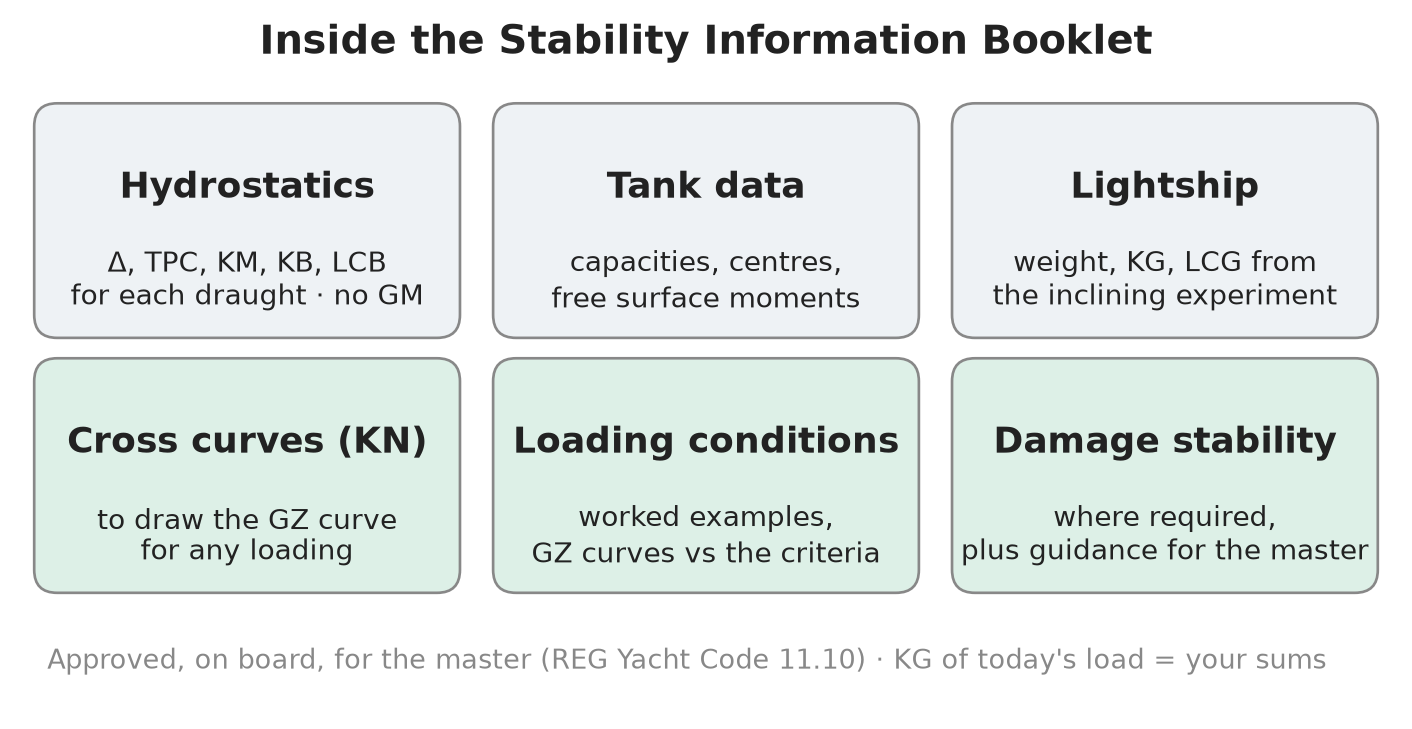
In short: who the vessel is, lightship data, hydrostatics, tanks and free surface moments, cross curves (KN), ready-worked loading conditions with GZ curves, limiting KG, damage stability where required, and notes to the master.
- General particulars: name, official number, builder, dimensions, assigned freeboard, summer draught and displacement, area of operation, numbers of crew and passengers (MCA model booklet MSF2231).
- Lightship weight and its centre of gravity: KG (VCG) and LCG, with the inclining experiment report as an appendix and a lightship history of later changes.
- Hydrostatic particulars for a range of draughts: displacement, KB, KM, TPC, MCTC, LCB, LCF. They do not give GM: GM = KM − KG, and KG changes with every loading.
- Longitudinal stability: MCTC and LCF let you work out trim and draughts fore and aft.
- Tank data: capacities, centres of gravity and the free surface moment of each tank, so you can correct KG for slack tanks.
- KN tables (cross curves of stability): for each displacement and angle of heel. You find the righting lever with GZ = KN − KG × sin θ.
- Loading conditions with their curves of statical stability (GZ curves). A workboat booklet shows at least loaded departure with 100% consumables, loaded arrival with 10%, the expected service conditions and lifting conditions (Workboat Code Ed. 3, 12B.3.4). The maximum free surface moments go into the departure condition (12B.3.6).
- Each GZ curve is checked against the criteria: areas under the curve, GZ at 30°, angle of maximum GZ, minimum GM. For a workboat: area ≥ 0.055 m·rad to 30°, ≥ 0.09 m·rad to 40°, ≥ 0.03 m·rad between 30° and 40°, GZ ≥ 0.20 m at 30° or more, max GZ at ≥ 25°, GM ≥ 0.35 m after free surface correction (Workboat Code Ed. 3, 12B.3.8).
- Maximum KG (limiting KG) curves: if your KG, corrected for free surface, is below the curve, the criteria are met (MCA model booklet MSF2231).
- Damage stability results, where the vessel has to meet a damage standard.
- Notes to the master: general instructions, precautions against capsize, operating restrictions, shipboard procedures (doors and hatches to close), tank use, downflooding angles, draught marks and freeboard mark, and a blank form to work out a new loading condition.
The inclining experiment: what it finds
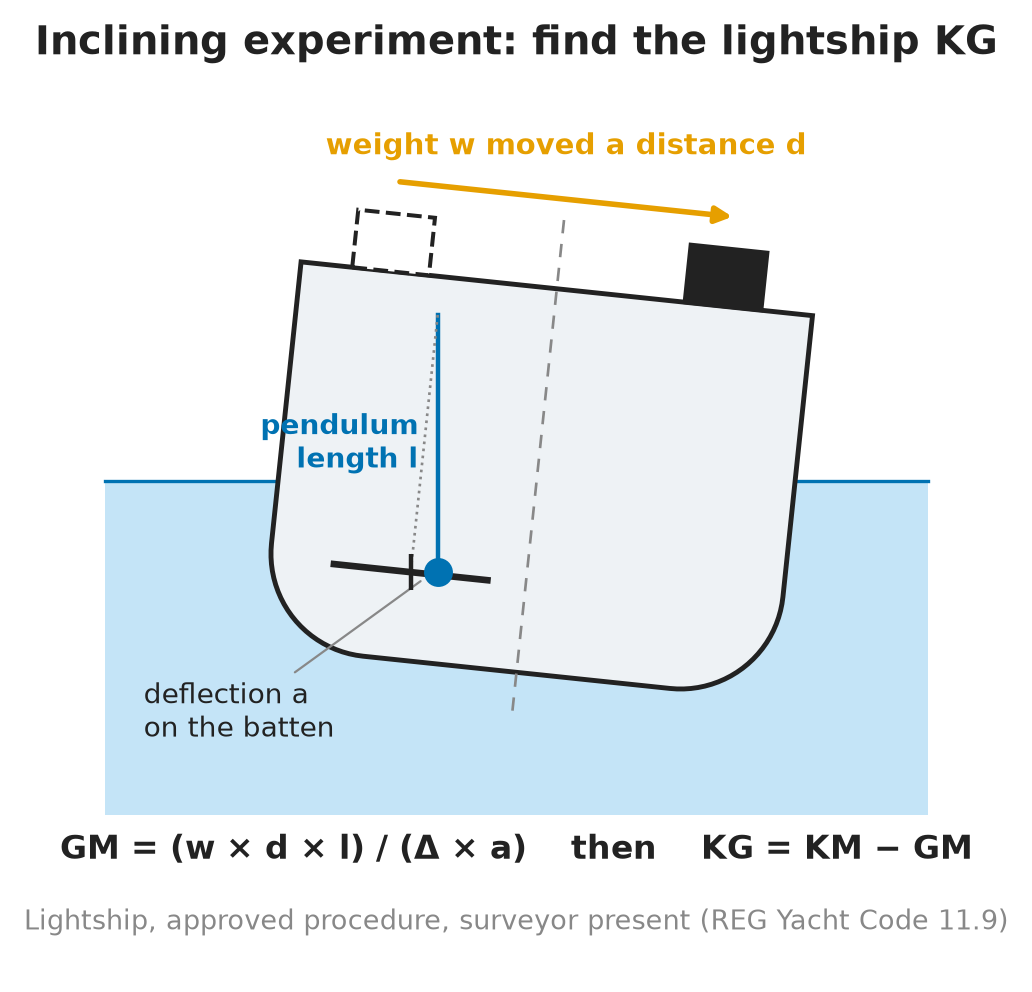
In short: you shift a known weight a known distance across the ship, measure the angle of heel with pendulums, and calculate GM. From GM and KM you get KG, and from that the lightship KG.
- Why: KG cannot be measured with a tape. It is the one centre the master never knows from the drawings alone, and every stability calculation starts from the lightship KG.
- A weight w moved a distance d across the deck moves G sideways by w × d ÷ Δ. The ship heels until the new G is under M.
- GM = (w × d) ÷ (Δ × tan θ).
- tan θ = pendulum deflection ÷ pendulum length.
- Then KG = KM − GM, with KM from the hydrostatics at the draught and trim measured during the test.
- The result is the KG of the ship as inclined. It still has to be corrected to the lightship condition (see below).
- Lightship weight, KG and LCG of a monohull must come from an inclining experiment (Workboat Code Ed. 3, 12B.3.1; REG Yacht Code Part A, 11.9).
Worked example
- Displacement as inclined 1,000 t. A 4 t weight is moved 12 m across the deck.
- Pendulum length 5 m, deflection 0.15 m: tan θ = 0.15 ÷ 5 = 0.03 (about 1.7°).
- GM = (4 × 12) ÷ (1,000 × 0.03) = 48 ÷ 30 = 1.60 m.
- KM from the hydrostatics = 5.20 m, so KG as inclined = 5.20 − 1.60 = 3.60 m.
Running an inclining test
In short: a nearly complete, clean, upright ship, floating freely in calm water, with few people on board, few slack tanks, certified weights, at least two pendulums and at least 8 weight shifts — all witnessed by the surveyor.
- Witness: done to an approved standard in the presence of the Administration (REG Yacht Code Part A, 11.9). On a towing workboat: by a competent person with an independent witness approved by the Certifying Authority (Workboat Code Ed. 3, 12B.5.2). The builder or owner runs the test; the surveyor checks preparation, moorings and data (MCA inclining test guidance notes, 3.1).
- State of the ship: at least 98% complete, with a list of items still to add, remove or move; clean and dry bilges; loose gear secured in its sea position; snow and ice removed (MCA guidance, 2.3, 3.2.3).
- Tanks: as few tanks with liquid as possible — as a guide, liquids under 25% of the lightweight. Tanks are either pressed full or empty; slack tanks limited to one pair, of simple rectangular shape. Cross-connections closed. Contents checked by sounding (MCA guidance, 2.4). Without an agreed allowance, a slack tank gets no free surface correction.
- Trim and list: no trim by the head, no large trim by the stern; initial list no more than ½° (MCA guidance, 2.5–2.6). If you need a refresher on why a list matters, see that topic.
- Place and weather: ideally a wet dock, at slack water, no risk of grounding; little wind and calm water; gangway lifted, mooring lines slack and led fore and aft, shore cables kept slack (MCA guidance, 2.1.5, 2.7–2.8, 3.2).
- People: as few as possible, each in a fixed place during every reading (MCA guidance, 3.2.1).
- Weights: enough to heel about 2° each side (up to 3° on small ships), never over 4°. Usually 4 weights, 2 each side, checked on a weighbridge. People are not acceptable as weights, and pumping water between wing tanks is not acceptable either (MCA guidance, 3.3).
- Pendulums: at least two, long, in sheltered places, bob damped in a trough of liquid (oil damps better than water). Aim for a deflection of at least 35 mm per shift. One pendulum may be replaced by a stabilograph, a U-tube water level or a calibrated electronic inclinometer (MCA guidance, 3.4; Workboat Code Ed. 3, 12B.3.1).
- Weight shifts: preferably 8, never fewer than 6, moved straight athwartships, with zero checks halfway and at the end (MCA guidance, 3.7.1; Workboat Code Ed. 3: minimum 8, 12B.3.1).
- Check plot: heeling moment against tan θ should give a straight line. A point off the line means a reading to repeat (MCA guidance, 3.7.3).
- Draughts and water: read draughts both sides, forward and aft, and freeboards amidships to find hog or sag. Measure water density with a hydrometer at the same time (MCA guidance, 3.5).
From the inclined condition to lightship
In short: start from the ship as inclined, then take away what should not be there and add what is missing. The result is the lightship displacement, KG and LCG.
- Displacement as inclined comes from the measured draughts, trim, hog/sag and the water density.
- KG as inclined = KM − GM. If slack tanks were allowed, the measured GM is a fluid GM: add back the free surface correction to get the solid KG.
- Deduct the inclining weights, liquids in tanks, people, tools and any other items that are not part of the light ship.
- Add any items still to be fitted, at their centres of gravity.
- Report: all readings, the plot, the condition as inclined, every weight added, removed or moved, and the lightship results (MCA guidance, 3.8.1).
- A provisional booklet based on the report goes on board before the maiden voyage; a copy of the inclining report goes into the approved booklet (MCA guidance, 3.8.3–3.8.4).
- A workboat may add a margin for growth of up to 5% of the lightship weight, placed at the higher of the deck centre or lightship VCG. It must never be used to carry more cargo (Workboat Code Ed. 3, 12B.3.3).
- Exception: a very stiff vessel such as a multihull, where VCG is less than one third of GM, gives poor inclining results. Its lightship weight is found by a displacement check or by weighing, and VCG by a careful weight estimate with a margin — never below the main deck (Workboat Code Ed. 3, 12B.3.2).
Sister ships, lightweight checks and alterations
In short: a sister ship may skip the inclining test if a lightweight check shows her within 2% of displacement and 1% (of length) in LCG. After alterations, recalculate; re-incline if the limits are passed.
- Lightweight check: measure draughts and density to find lightship displacement and LCG, without heeling the ship. It cannot give KG.
- Sister ship: same yard, same plans; under the Workboat Code also built within 5 years of the lead vessel (Workboat Code Ed. 3, 12B.3.10).
- Limits: displacement within 2%, LCG within 1% (of LBP for workboats; of L under SOLAS). Inside the limits, use the measured weight and LCG with the lead ship’s KG (or the calculated one, whichever is higher). Outside: incline (Workboat Code Ed. 3, 12B.3.10; MCA guidance, 4 and 6.5).
- In a series of 3 or more sisters the surveyor may ask for another inclining test to catch small changes that add up (MCA guidance, 4.1).
- Large yachts: sister ships may get a lightweight check; alterations are recorded against the margin kept in the booklet (REG Yacht Code Part A, 11.9). A major conversion means a complete reassessment of stability (REG Yacht Code Part A, 11.10).
- Workboats: after a modification the owner tells the Certifying Authority, which may do a lightship or freeboard check; a significant change means a full new stability analysis (Workboat Code Ed. 3, 12.1.1.7).
- SOLAS ships: alterations that materially affect the stability information mean amended information for the master, and re-inclining if needed. Passenger ships get a lightweight survey at least every 5 years; re-incline if displacement changes by more than 2% or LCG by more than 1% of L (SOLAS II-1/5.4–5.5).
- The explanatory notes add: re-incline if VCG changes by more than 1%; inside those limits, amend the booklet if displacement changes by more than 1%, LCG by 0.5% of L or VCG by 0.5% (IMO MSC.1/Circ.1362/Rev.1, quoting MSC.429(98)/Rev.1 and Rev.2).
- A ship coming onto the UK register is inclined again unless an earlier, properly witnessed report is accepted (MCA guidance, 5.1). Records of who witnessed the test — flag, classification society or the builder’s naval architect — matter here.
⚡ Flashcards
Test yourself, one card at a timeQ1What is the stability information booklet and who is it for?
AnswerThe approved book that gives the master the vessel’s stability in each loading condition and how to check a new one. Kept on board.
Common trapTrap: thinking it is only for the surveyor. It is the master’s working tool.
Q2Under the Workboat Code, which vessels must carry an approved stability booklet?
AnswerArea category 0 or 1 (beyond 60 NM); 16 or more persons; cargo over 1,000 kg or cargo with free surface; lifting device; towing over twice own displacement; seagoing pilot boats (12.1.1.3).
Common trapTrap: “more than 16 passengers” — the Code says 16 or more persons.
Q3What information would you find inside the stability booklet?
AnswerParticulars; lightship weight, KG and LCG; hydrostatics; trim data; tank capacities and free surface moments; KN tables; loading conditions with GZ curves; limiting KG; damage stability; notes to the master; inclining report.
Common trapTrap: forgetting the free surface moments and the notes to the master.
Q4What is the inclining experiment for, and what is the formula?
AnswerTo find GM, then KG, of the ship as inclined, and from it the lightship KG. GM = w × d ÷ (Δ × tan θ); tan θ = deflection ÷ pendulum length; KG = KM − GM.
Common trapTrap: thinking the hydrostatic tables give GM. They give KM only.
Q5What conditions do you need for a good inclining test?
AnswerShip 98% complete, clean; tanks full or empty (one slack pair at most); list ≤ ½°; calm, slack water, moorings slack, gangway up; few people in fixed places; heel about 2° each side, never over 4°.
Common trapTrap: using people as weights, or moving water between wing tanks.
Q6How many pendulums and weight shifts?
AnswerAt least 2 pendulums (one may be a stabilograph, U-tube or electronic inclinometer); deflection ≥ 35 mm; at least 8 shifts (never under 6); plot should be a straight line.
Common trapTrap: forgetting to measure the water density with the draughts.
Q7How do you get from the inclined condition to lightship?
AnswerDisplacement from draughts and density; KG = KM − GM (correct for agreed slack tanks); deduct test weights, liquids and people; add items still to fit.
Common trapTrap: taking the inclined KG as the lightship KG.
Q8When can a sister ship skip the inclining test?
AnswerWhen a lightweight check shows displacement within 2% and LCG within 1% of the lead ship. Otherwise incline.
Common trapTrap: a lightweight check gives weight and LCG, not KG.
Q9When must a SOLAS ship be re-inclined?
AnswerWhen alterations (or the 5-yearly lightweight survey on passenger ships) show displacement change over 2%, LCG over 1% of L, or VCG over 1% (SOLAS II-1/5.4–5.5 and explanatory notes).
Common trapTrap: smaller changes (1% Δ, 0.5% L LCG, 0.5% VCG) still need an amended booklet.
Q10What does the REG Yacht Code say about lightship and the booklet?
Answer11.9: lightship weight, KG and LCG from an inclining experiment witnessed by the Administration; sisters may get a lightweight check; alterations logged against the margin. 11.10: approved SIB for the master on the model booklet; major conversion = full reassessment.
Common trapTrap: thinking alterations need no record if the yacht “feels” the same.
📚 Resources
Videos
- Inclining Test Explained | Intact Stability Code Procedures | Chief Mate — Sailor’s Compass (YouTube)
- Ship Stability _ a typical Inclining Test Procedure for vessel - Naval architect for all — Naval Architect For All (YouTube)
Books
- Ship Stability for Masters and Mates — Bryan Barrass and D. R. Derrett, 7th edition (Butterworth-Heinemann, 2012)
Regulations
- MCA — The Workboat Code Edition 3 — section 12 Stability (12.1.1.3 who needs a booklet; 12B.3 intact stability and inclining; 12B.6 approval)
- Red Ensign Group Yacht Code Part A, July 2024 edition — 11.9 lightship and inclining; 11.10 stability information booklet
- IMO MSC.1/Circ.1362/Rev.1 — Unified interpretation of SOLAS II-1/5.4 and 5.5 — re-inclining limits (copy on the Hong Kong Marine Department site)
Exam focus — MCA
Typical questions: “Which vessels must carry a stability booklet?” · “What would you find inside the stability book?” · “What is an inclining experiment and how is it done?” · “Why don’t the hydrostatic tables give you GM?” · “You have added a crane / a tender / a hot tub: what do you do about stability?” What the examiner wants: the Workboat Code list (category 0/1, 16 or more persons, cargo over 1,000 kg, lifting, towing, pilot boats); a confident tour of the booklet (lightship, hydrostatics, tanks with free surface moments, KN, loading conditions with GZ curves, notes to the master); the inclining principle with GM = w × d ÷ (Δ × tan θ) and KG = KM − GM; the key test conditions; and that alterations are recorded and may need a lightweight check or a new inclining test.