The GZ Curve and Intact Stability Criteria
StabilityHow to read the GZ curve (righting lever against angle of heel), what an angle of loll is, and the intact and damage stability criteria of the REG Yacht Code and the 2008 IS Code. Examiners expect you to sketch the curve, name its features and quote the minimum figures.
Last reviewed 1 Nov 2026 · From a professional captain's years of study notes · Organised with AI and checked against current regulations · How we write
On this page (9)
Read first: flotation, centres and metacentric height and stiff and tender vessels. This topic builds on G, B, M and GM.
What the GZ curve is
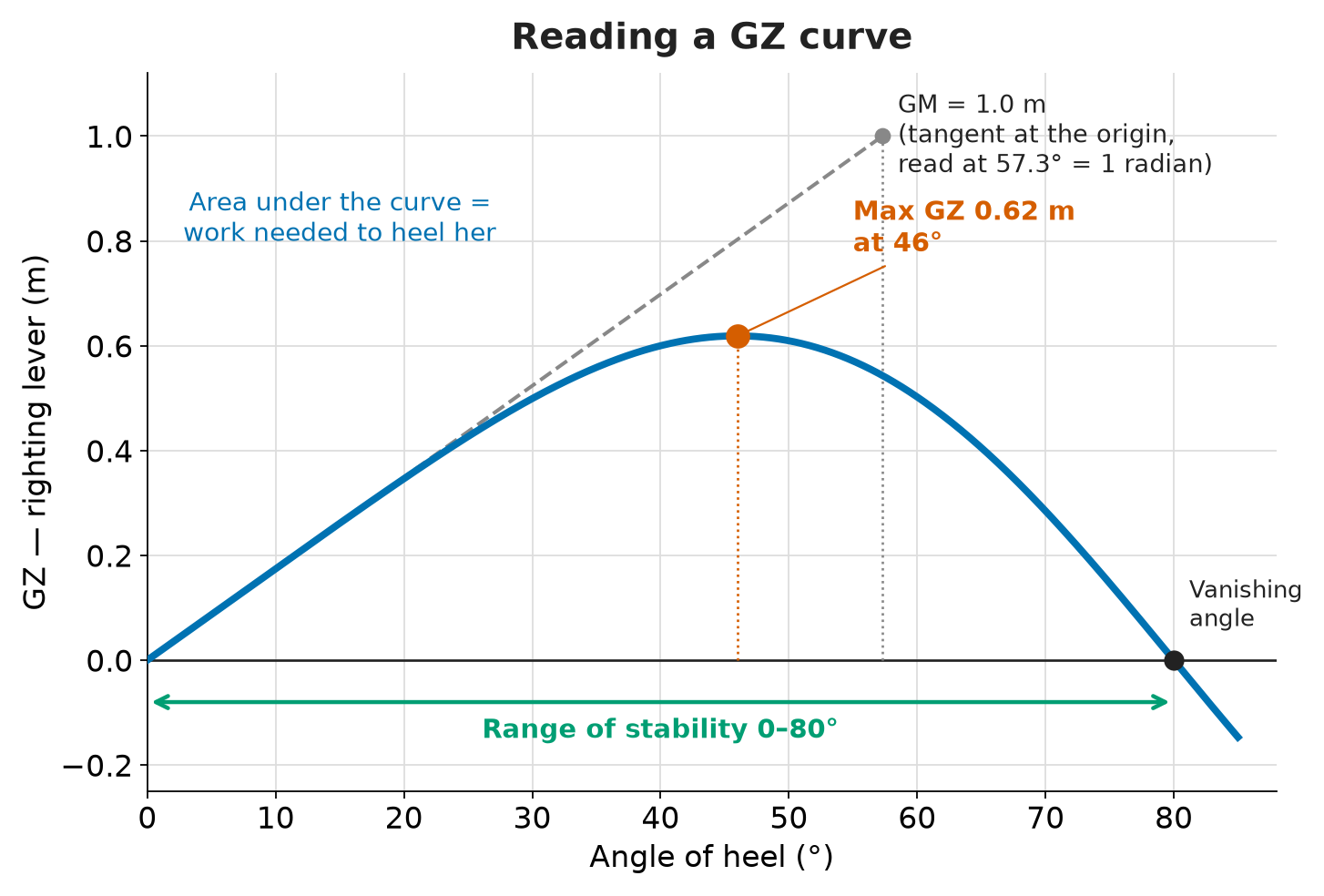
In short: the GZ curve shows the righting lever (GZ) for every angle of heel, for one loading condition. Bigger GZ = more force to bring the ship back upright.
- GZ = the righting lever: the horizontal distance between the centre of gravity G and the line of the buoyancy force through B when the ship heels.
- Righting moment = displacement × GZ (MCA General Ship Knowledge syllabus 2.2.2.3).
- The curve is drawn for one displacement and one KG. Change the loading and you get a new curve.
- Horizontal axis: angle of heel (°). Vertical axis: GZ (m).
- GM describes only small angles (initial stability). The GZ curve describes the ship’s behaviour at large angles.
- The stability booklet holds the curves of statical stability (GZ curves) for the ship’s standard loading conditions, with the lightship weight and its vertical centre of gravity.
- GZ curves must be produced for the loading conditions in which the yacht operates, to show that the criteria are met (REG Yacht Code Part A, 11.1(4)).
- On the bridge: before you lift the tender with the crane, take on fuel or fill the pool, check the loading condition against the stability booklet or the approved loading computer.
Reading the curve
In short: one curve, six things to name. Examiners want you to sketch it and label it (MCA Master Yachts Stability syllabus 2.3.1.1).
- Initial GM: draw the tangent to the curve at the origin. Go up from 57.3° (1 radian): the height where the tangent cuts that line is GM. A steep start = big GM.
- Maximum GZ and the angle at which it occurs: the biggest righting lever the ship can produce.
- Angle of deck edge immersion: roughly where the curve changes from curving up to curving down (the point of inflection). After this the waterplane shrinks and GZ grows more slowly.
- Range of positive stability: all the angles at which GZ is positive, from upright to the angle of vanishing stability.
- Angle of vanishing stability: where the curve crosses zero again. Heel past it and the ship capsizes.
- Dynamical stability: the area under the curve (m·rad). It measures the work needed to heel the ship to a given angle. This is what the surveyor checks against the criteria.
- Static vs dynamic: static stability is the lever (GZ) at one angle; dynamical stability is the energy (area) up to that angle (MCA Master Yachts Stability syllabus 2.3.1.7).
- Down-flooding angle (θf): the heel at which openings that cannot be closed weathertight go under water. The criteria stop counting area at this angle if it comes before 40° (IMO MSC.267(85) Part A 2.2.1).
How loading changes the shape
In short: raise G and the whole curve shrinks. More freeboard stretches it; more beam steepens the start.
- Stiff vessel (large GM): steep start, big GZ values. Tender vessel (small GM): flat start, small GZ values.
- Raising G (higher KG): smaller GZ at every angle, smaller maximum GZ, smaller range of stability. Lowering G does the opposite.
- More freeboard: the deck edge goes under later, so maximum GZ comes at a larger angle and the range gets bigger.
- Less freeboard: deck edge and openings immerse sooner; maximum GZ comes earlier and the range is smaller.
- More beam: bigger initial GM (steeper start), but the deck edge immerses at a smaller angle.
- Free surface acts like a rise of G, so slack tanks shrink the curve too. The criteria use GM after free surface correction.
- The MCA Master Yachts Stability syllabus (2.3.1.3–2.3.1.5) asks you to explain these changes.
Angle of loll
In short: a ship with negative GM (G above M) cannot stay upright. She heels until GZ = 0 and floats there: that angle is the angle of loll.
- Upright she is unstable. As she heels, the waterplane gets wider, M rises, and at some angle G and B line up again: GZ = 0.
- Push her further and GZ becomes positive again, so she rests at the loll angle with a small range of stability left.
- A ship at loll may flop from one side to the other: she lolls to port or starboard, never upright.
- List vs loll:
- List = G moved off the centreline by weight (added, removed or shifted). GM is positive. She leans to one side only.
- Loll = negative GM with G on the centreline. She leans to either side and has a long, slow, sluggish roll about the loll angle.
- Common causes: weight high up, a large free surface, ice, water trapped on deck, damaged compartments flooding.
- Danger: the ship looks stable but her reserve is very small. A gust or a wave can capsize her. Act fast.
- How to correct it (lower G):
- first make sure it is loll, not list: no off-centre weight explains the heel;
- remove free surface where you can; take weight off high up;
- fill an empty low tank that is divided at the centreline, low side first, then the other side (MCA Master Yachts Stability syllabus 2.4.1.5). She may lurch at first, because filling adds free surface for a while;
- never move weight across to the high side: she may flop over to the other side to a bigger angle.
Intact stability criteria
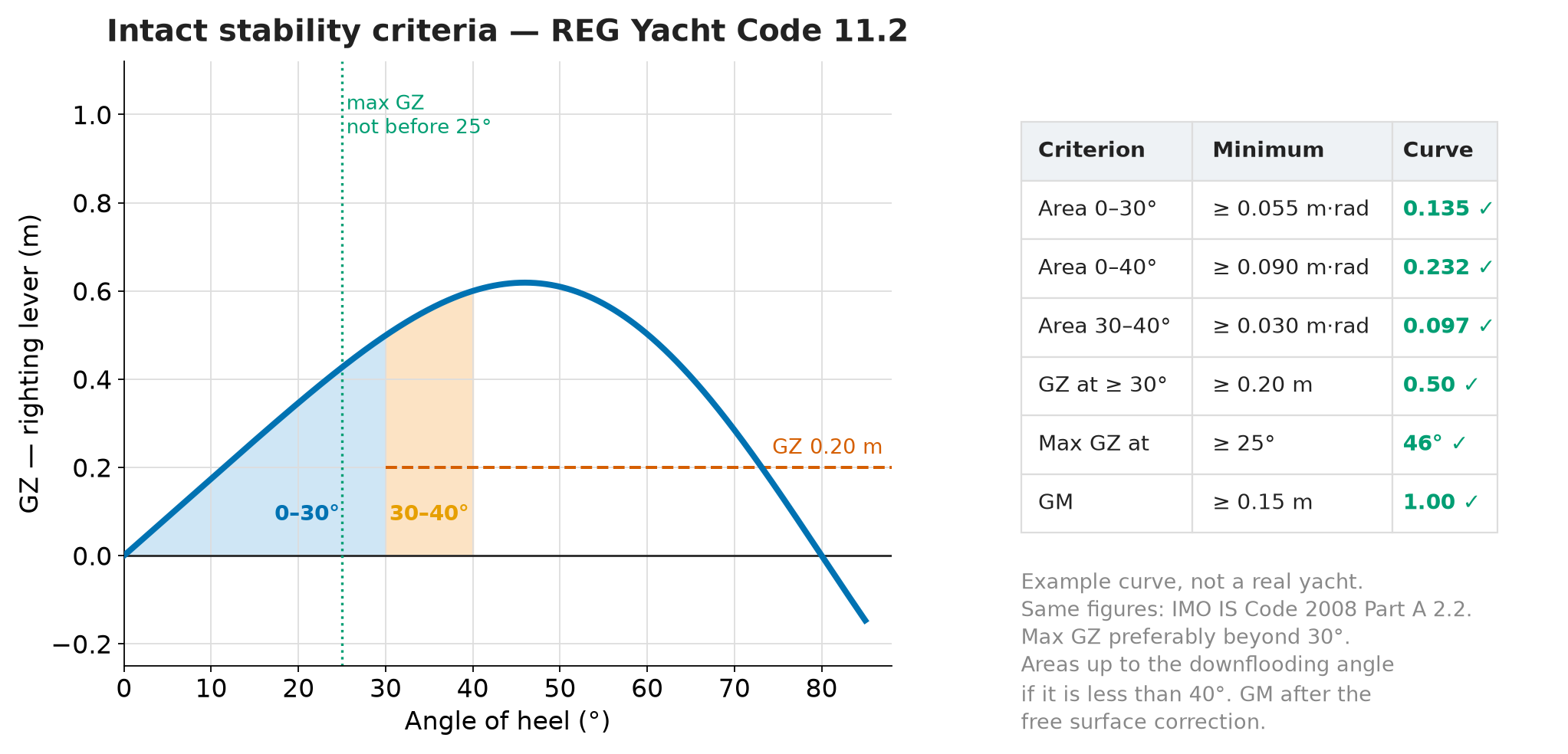
In short: the GZ curve of every seagoing loading condition must pass six minimum figures. Yachts: REG Yacht Code Part A, 11.2(1)(a). Ships: IMO 2008 IS Code, MSC.267(85) Part A 2.2. The figures are the same.
| Criterion | Minimum | Reference |
|---|---|---|
| Area under GZ curve up to 30° | 0.055 m·rad | REG YC 11.2(1)(a)(i) · IS Code 2.2.1 |
| Area up to 40° (or the down-flooding angle if less) | 0.09 m·rad | REG YC 11.2(1)(a)(i) · IS Code 2.2.1 |
| Area between 30° and 40° (or down-flooding angle) | 0.03 m·rad | REG YC 11.2(1)(a)(ii) · IS Code 2.2.1 |
| GZ at an angle of 30° or more | 0.20 m | REG YC 11.2(1)(a)(iii) · IS Code 2.2.2 |
| Angle of maximum GZ | Preferably more than 30°, not less than 25° | REG YC 11.2(1)(a)(iv) · IS Code 2.2.3 |
| Initial GM after free surface correction | 0.15 m | REG YC 11.2(1)(a)(v) · IS Code 2.2.4 |
- Memory aid, in order: 55 – 90 – 30 (areas, thousandths of m·rad), then 0.20 at 30, max at 25+, GM 0.15.
- The 0.15 m minimum GM is sometimes credited to “the load line rules”. Quote the texts that actually state it: REG Yacht Code 11.2(1)(a)(v) and IS Code Part A 2.2.4 (“initial metacentric height GM₀ shall not be less than 0.15 m”).
- If a yacht cannot meet (i)–(v), the Administration may agree alternative but equivalent criteria (REG YC 11.2(1)(a)(vi)).
Short Range Yachts
- If a Short Range Yacht cannot meet the standard criteria, it may use REG YC 11.2(2):
- area up to 15° ≥ 0.07 m·rad when maximum GZ is at 15°; area up to 30° ≥ 0.055 m·rad when maximum GZ is at 30° or more;
- maximum GZ between 15° and 30°: required area = 0.055 + 0.001 × (30° − θmax) m·rad;
- area 30°–40° (or down-flooding angle) ≥ 0.03 m·rad;
- GZ ≥ 0.20 m at 30° or more;
- maximum GZ at not less than 15°;
- GM after free surface correction ≥ 0.15 m.
- REG YC 11.2(3) gives a further set of alternative criteria, with maximum GZ at not less than 20°.
The weather criterion (IS Code)
- Ships under the IS Code must also show they can survive beam wind plus rolling (IMO MSC.267(85) Part A 2.3).
- Under a steady wind, the angle of heel must not exceed 16° or 80% of the angle of deck edge immersion, whichever is less.
- After rolling to windward and a gust (gust lever = 1.5 × steady wind lever), the area of righting energy left (area b) must be at least the area of heeling energy (area a).
Damage stability
In short: the intact criteria are not the whole story. There are minimum standards for the ship after flooding too. For yachts: REG Yacht Code Part A, 11.3.
- Applies to all yachts except Short Range Yachts (for them it is recommended where practicable) (REG YC 11.3(1)).
- Not required for yachts that fully comply with the ICLL conditions of assignment (REG YC 11.3(2)).
- Minor damage is assumed anywhere along the length, but not on a watertight bulkhead; for yachts under 85 m load line length, damage is assumed not to reach any bulkhead, deck or other watertight boundary (REG YC Chapter 11 objective, 11.3(4)).
- With any one compartment flooded, the waterline must stay at least 75 mm below the weather deck, freeboard deck or bulkhead deck (REG YC 11.3(3)).
- Standard permeabilities: stores 60%; stores but not a large quantity 95%; accommodation 95%; machinery 85% (REG YC 11.3(5)).
- Residual stability after damage (REG YC 11.3(6)):
- angle of equilibrium not more than 7°;
- range to the down-flooding angle at least 15° beyond the equilibrium angle;
- maximum GZ within that range at least 100 mm;
- area under the curve at least 0.015 m·rad.
- On the bridge: keep watertight doors and hatches shut at sea. An open door turns two compartments into one and the damage standard no longer holds. See flooding and damage control and heavy weather preparation.
⚡ Flashcards
Test yourself, one card at a timeQ1What is a GZ curve and what does it show?
AnswerThe righting lever GZ plotted against angle of heel, for one loading condition (one displacement, one KG). Righting moment = displacement × GZ.
Common trapTrap: one curve fits every loading. Change the loading and the curve changes.
Q2Sketch a GZ curve and name its main features.
AnswerInitial GM (tangent at origin, read at 57.3°), maximum GZ and its angle, deck edge immersion (inflection), range of positive stability, angle of vanishing stability.
Common trapTrap: reading GM off the curve without using 1 radian = 57.3°.
Q3What does the area under the GZ curve represent?
AnswerDynamical stability: the work needed to heel the ship to that angle (m·rad). The surveyor checks it against the minimum areas.
Common trapTrap: confusing it with static stability (the lever at one angle).
Q4How do KG, freeboard and beam change the GZ curve?
AnswerHigher KG: smaller GZ everywhere, smaller range. More freeboard: bigger range, max GZ later. More beam: steeper start, deck edge immerses sooner.
Common trapTrap: forgetting free surface acts like a rise of G.
Q5What is an angle of loll and how is it different from a list?
AnswerLoll: negative GM; she heels until GZ = 0, to either side, and may flop over. List: G off the centreline with positive GM; one side only.
Common trapTrap: treating loll as list and moving weight to the high side.
Q6How do you correct an angle of loll?
AnswerConfirm it is loll. Lower G: remove free surface and high weights, fill an empty low tank divided at the centreline, low side first.
Common trapTrap: shifting weight across the ship; she can flop to a bigger angle on the other side.
Q7State the intact stability criteria for a yacht (REG Yacht Code 11.2(1)(a)).
AnswerArea ≥ 0.055 m·rad to 30°, ≥ 0.09 to 40° (or θf), ≥ 0.03 between 30° and 40°; GZ ≥ 0.20 m at ≥ 30°; max GZ preferably > 30°, not < 25°; GM ≥ 0.15 m. Memory aid: 55 – 90 – 30, 0.20 at 30, max at 25+, GM 0.15.
Q8What is the minimum GM and where is it written?
Answer0.15 m after free surface correction: REG Yacht Code 11.2(1)(a)(v) and IMO 2008 IS Code Part A 2.2.4.
Common trapTrap: quoting GM before the free surface correction.
Q9What can a Short Range Yacht use if it fails the standard criteria?
AnswerREG YC 11.2(2): 0.07 m·rad to 15° (max GZ at 15°) up to 0.055 to 30°; 0.03 between 30° and 40°; GZ ≥ 0.20 m at ≥ 30°; max GZ ≥ 15°; GM ≥ 0.15 m.
Q10What does the IS Code weather criterion check?
AnswerBeam wind plus rolling (Part A 2.3). Steady-wind heel ≤ 16° or 80% of deck edge immersion, whichever is less; after a gust, area b ≥ area a.
Q11What are the damage stability requirements of the REG Yacht Code?
AnswerOne compartment flooded (minor damage, not on a bulkhead): waterline ≥ 75 mm below the deck; equilibrium ≤ 7°; range ≥ 15° beyond it; max GZ ≥ 100 mm; area ≥ 0.015 m·rad.
Common trapTrap: Short Range Yachts are not required to meet it (only recommended).
📚 Resources
Videos
- NS301 - Comparison of Angle of List and Angle of Loll — DeckPrep (YouTube)
Books
- Ship Stability for Masters and Mates — Bryan Barrass and D. R. Derrett, 7th edition (Butterworth-Heinemann, 2012)
Regulations
- Red Ensign Group Yacht Code, Part A (July 2024 edition) — Chapter 11: 11.2 intact stability, 11.3 damage stability
- IMO MSC.267(85) — International Code on Intact Stability, 2008 (2008 IS Code): Part A 2.2 GZ curve criteria, 2.3 weather criterion
- MCA MSIS43 — Instructions for the guidance of surveyors on intact stability (full text of the 2008 IS Code with MCA notes)
Official sites
- GOV.UK — Stability examination syllabus (Master yachts) — 2.3 GZ curves, 2.4 angle of loll
- Wikipedia — Angle of loll
Exam focus — MCA
Typical questions: “Draw a GZ curve and show me the important points.” · “What does the area under the curve tell the surveyor?” · “What are the minimum stability criteria for your yacht?” · “What is an angle of loll, how is it different from a list, and how would you correct it?” · “What happens to the curve if G rises?” What the examiner wants: a quick, labelled sketch (GM from the tangent at 57.3°, max GZ and its angle, deck edge immersion, range, angle of vanishing stability); the link between area and the work needed to heel the ship; the six criteria with figures and the right reference (REG Yacht Code 11.2, IS Code Part A 2.2), GM 0.15 m after free surface; and for loll, a safe correction: lower G, low side first, never shift weight across.