Cardinal Marks
NavigationThe four IALA cardinal marks — North, East, South and West: what they tell you, their topmarks, colours and white lights, and how to pass them. Reading them fast keeps the ship on the safe side of a danger, and they are a standard MCA oral question.
Last reviewed 1 Nov 2026 · From a professional captain's years of study notes · Organised with AI and checked against current regulations · How we write
On this page (8)
What a cardinal mark tells you
In short: a cardinal mark is a signpost with a compass in it. It tells you on which side of the mark the safe water is.
Read first: IALA Buoyage System and Light Characters (light abbreviations), then Lateral Marks and Preferred Channel. This is the third topic of the Buoyage area.
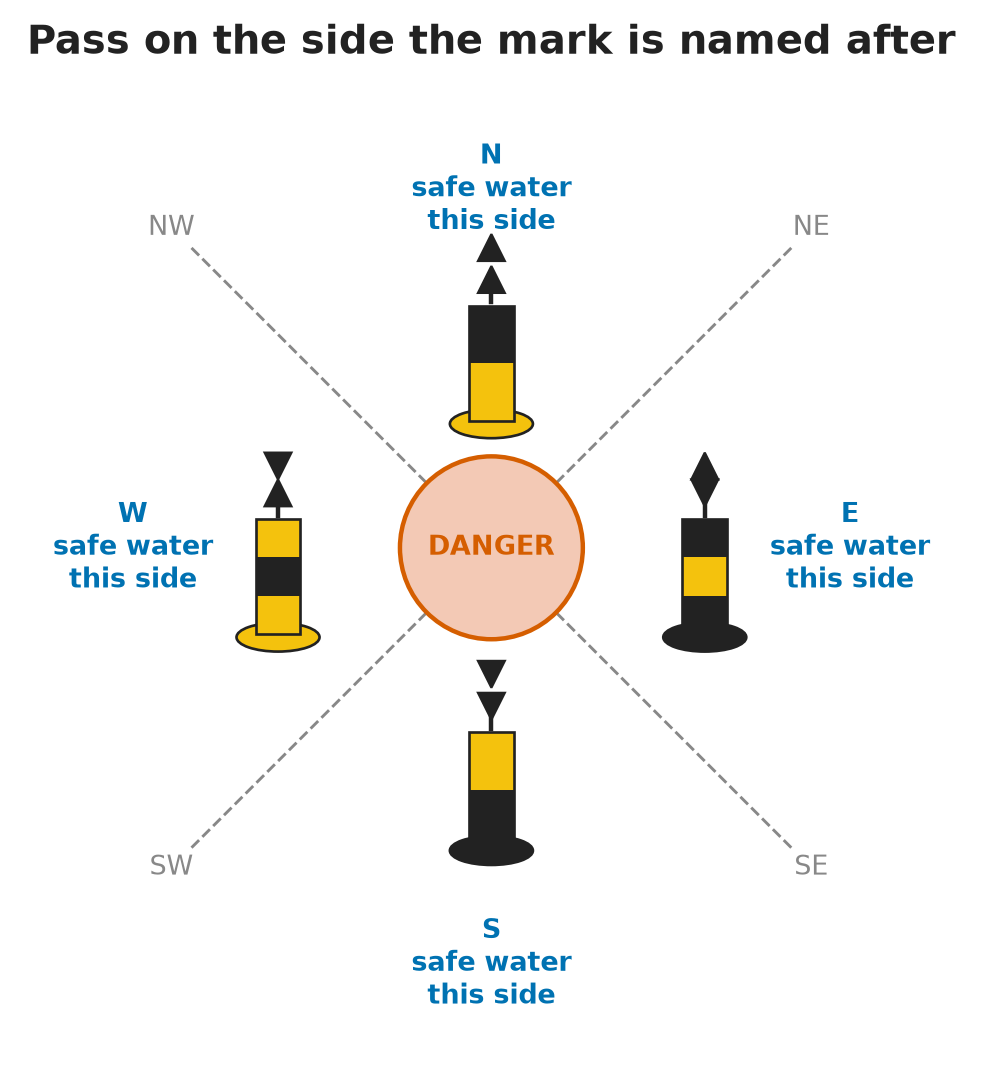
- A cardinal mark is named after the compass quadrant where the safe water lies: North, East, South or West.
- North cardinal = deep water to the north of the mark. East = deep water to the east. South = to the south. West = to the west.
- The danger is on the opposite side. A North cardinal sits on the north side of a shoal: pass north of it.
- Cardinal marks are used with the compass, not with the direction of buoyage. They mean the same thing whichever way you are going.
- They are the same in Region A and Region B.
The four quadrants
- The quadrants are set by true bearings from the point of interest (IALA R1001):
- North quadrant: from NW to NE (315°–045°)
- East quadrant: from NE to SE (045°–135°)
- South quadrant: from SE to SW (135°–225°)
- West quadrant: from SW to NW (225°–315°)
- A mark placed in the North quadrant of a danger is a North cardinal, and so on.
- A large danger may have two, three or all four cardinals round it. Together they draw a box you must stay outside.
What else a cardinal mark can show
- The deepest water in an area.
- The safe side on which to pass a danger.
- A feature in a channel: a bend, a junction, a fork (bifurcation) or the end of a shoal.
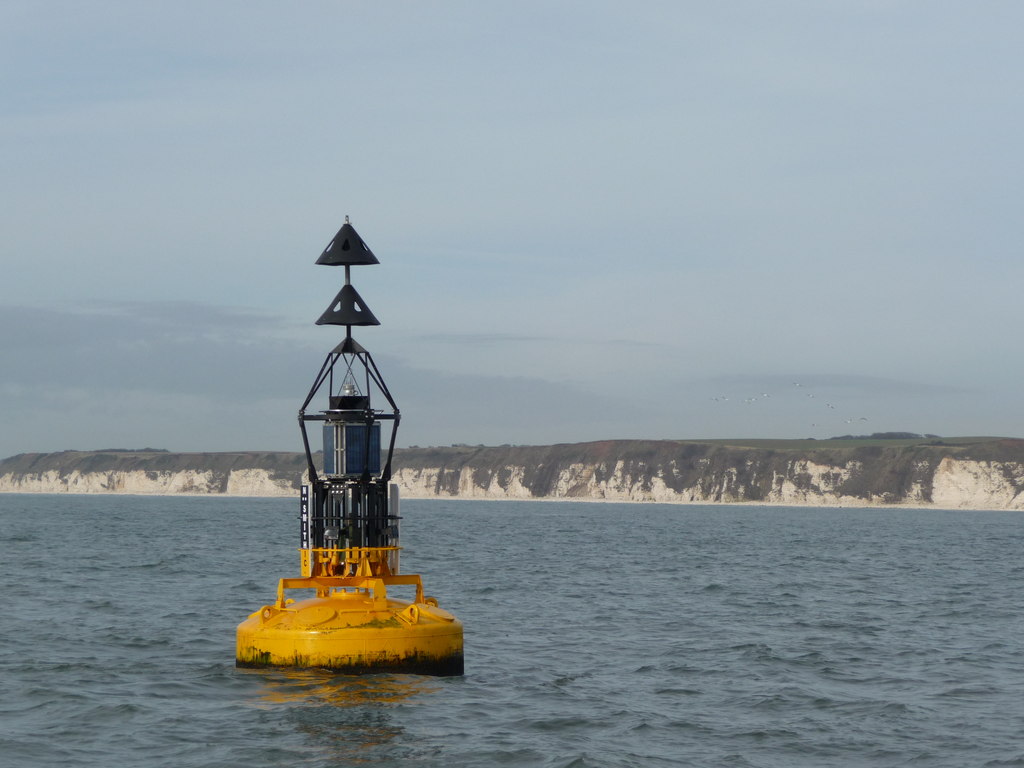
- Shape: usually a pillar or spar. The shape has no meaning; the topmark, colours and light do.
Topmarks and colours
In short: two black cones on top, black and yellow bands below. Where the cones point, the black is.
| Mark | Topmark (two black cones) | Colour (top to bottom) | Chart letters | Safe water |
|---|---|---|---|---|
| North | Both points up | Black above yellow | BY | To the north |
| East | Points apart (base to base) | Black, yellow band, black | BYB | To the east |
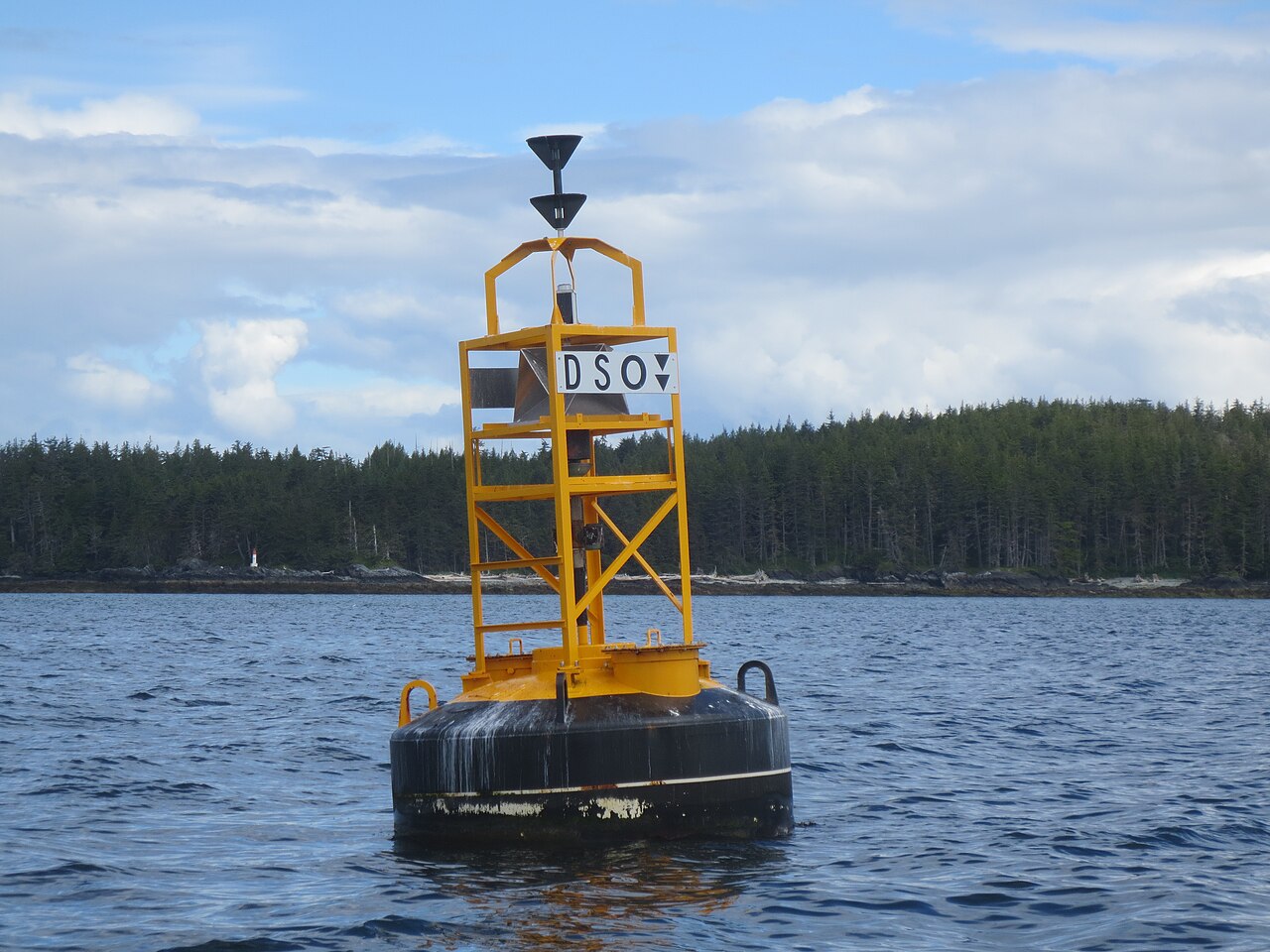
| South | Both points down | Yellow above black | YB | To the south |
| West | Points together (point to point) | Yellow, black band, yellow | YBY | To the west |
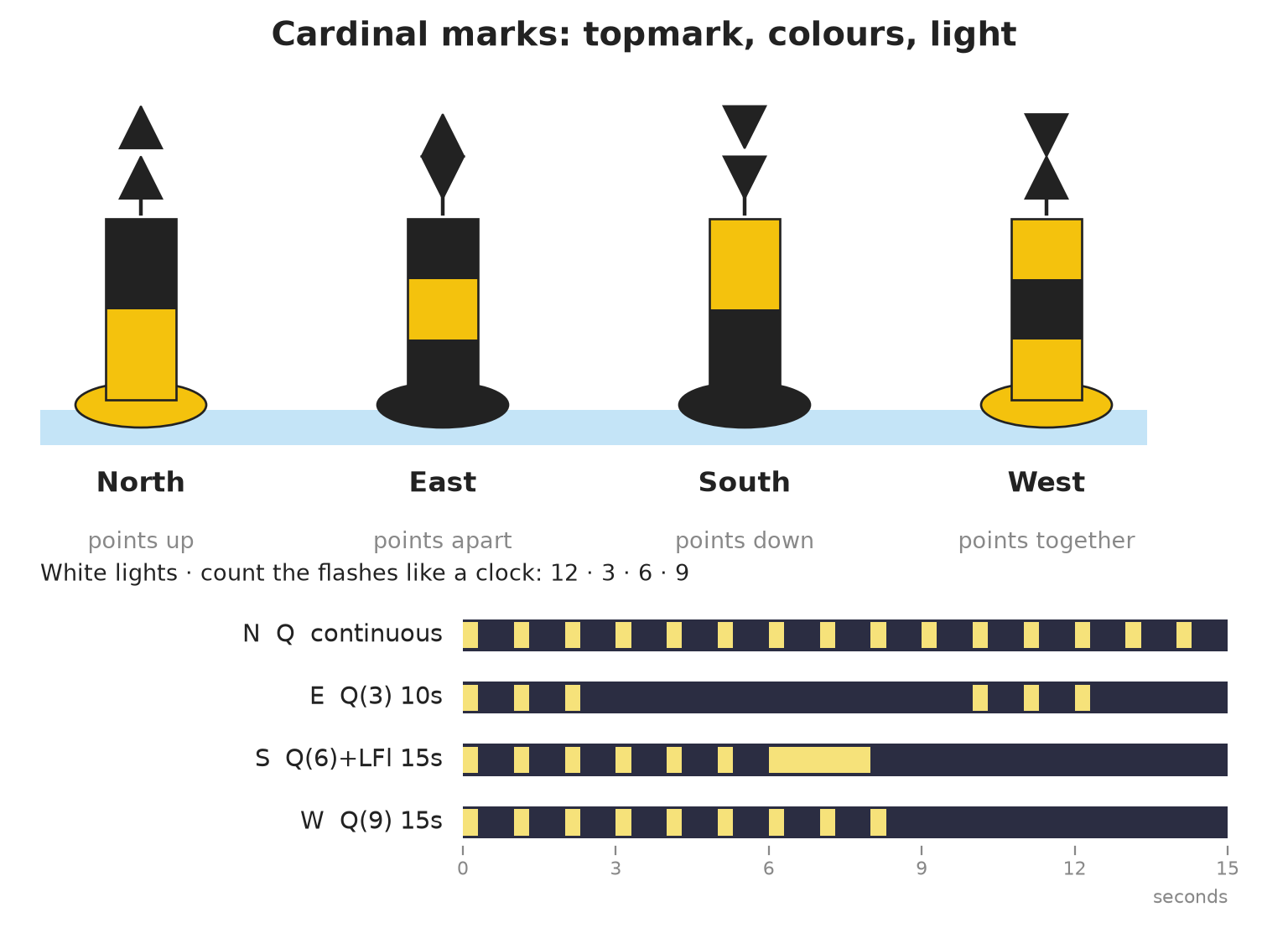
- The colour rule: the black band is where the cones point. Both up = black on top (N). Both down = black at the bottom (S). Pointing out at both ends = black at both ends (E). Pointing into the middle = black in the middle (W).
- Memory hooks: North cones point up like the top of the chart; South point down. East looks like an Egg (or a diamond). West looks like a Wine glass — or a waist, pinched in the middle.
- On the bridge by day: the topmark is often the first thing you can read through binoculars, before the bands. Name the mark from the topmark, then confirm with the colours.
Cardinal lights
In short: every cardinal light is white and quick or very quick. The number of flashes matches the hour on a clock face.
| Mark | Clock | Quick (Q) | Very quick (VQ) |
|---|---|---|---|
| North | 12 o’clock — never stops | Q continuous | VQ continuous |
| East | 3 o’clock | Q(3) 10s | VQ(3) 5s |
| South | 6 o’clock | Q(6)+LFl 15s | VQ(6)+LFl 10s |
| West | 9 o’clock | Q(9) 15s | VQ(9) 10s |
- Speeds: Q = 50 or 60 flashes a minute · VQ = 100 or 120 flashes a minute (IALA R1001).
- Long flash (LFl): at least 2 s. The South cardinal adds it after its 6 flashes so a group of 6 cannot be mistaken for 3 or 9 when the flashes come fast.
- Colour: white only. A red, green or yellow light is never a cardinal mark.
- On the bridge at night: count the flashes in one group and time the period with a stopwatch. If you count “about 9”, wait for the next group before naming the mark.
North and South are easy to swap. One set of revision flashcards once had North as “groups of 6 + 1 long” and South as “groups of 6”. IALA R1001 gives North = continuous Q or VQ and South = 6 + one long flash. The flashcards now agree. Learn it the IALA way: the long flash belongs to South.
Passing cardinal marks on the bridge
In short: translate the mark into a compass side, then into port or starboard for your heading. Never pass between a cardinal mark and its danger.
Steaming North with a North cardinal ahead
- The safe water is north of the mark. You are approaching from the south, so you are on the danger side.
- Stop (or slow right down) at once. Fix your position by every means available and check the chart.
- The water you have just come through was safe: the safe water is right astern. Back out the way you came, then plan a track round the danger.
- Do not try to “just round the mark” — the danger lies between you and the buoy.
- Lesson: a good passage plan never has you meeting a cardinal mark from its danger side. If it happens, your position or the plan is wrong.
Steering 270° and you see a North cardinal
- Safe water is to the north of the mark: you must pass north of it.
- On a heading of 270°, north is on your starboard side. So leave the mark on your port hand.
- Mark fine on the port bow: you are already to the north of it — hold your course and leave it to port with a good margin.
- Mark ahead or on the starboard bow: you are south of it, heading for the danger side. Alter to starboard early and pass north of it.
- General method: name the safe side (N, E, S, W) → compare it with your heading → say aloud “leave it to port” or “leave it to starboard” in the pilotage briefing.
Good habits
- Give cardinal marks a wide berth. The mark shows the quadrant of safe water, not the exact edge of the danger.
- Buoys can drag or be off station. Check the mark against your fixed position, not the other way round.
- If a mark is missing, unlit or not on the chart, slow down, fix by other means and check NP735 and the latest Notices to Mariners.
Cardinal marks on the paper chart and on ECDIS
In short: the MCA syllabus asks you to recognise IALA marks on both a paper chart and an ECDIS. The mark is the same; only the symbol changes.
- Paper chart: a pillar or spar buoy symbol with the two-cone topmark drawn on top, and the colour letters beside it, read top to bottom: BY (N), BYB (E), YB (S), YBY (W).
- A lit mark has a magenta light flare with its character, e.g. “Q”, “VQ(3)5s”, “Q(6)+LFl15s”, “VQ(9)10s”.
- Symbols are listed in INT 1 / Chart 1, Section Q (buoys and beacons).
- ECDIS: an ENC shows cardinal marks with paper-chart (traditional) or simplified symbols, as the operator chooses. Pick the object with the cursor to read the full light.
- On the bridge: when you plan a track past a cardinal mark, check on the chart which quadrant the danger is in and keep a safety margin from the danger itself, not just from the buoy.
⚡ Flashcards
Test yourself, one card at a timeQ1What does a cardinal mark tell you?
AnswerWhere the safe (deep) water is: on the side named by the mark. Pass North of a North cardinal, East of an East cardinal, and so on.
Common trapThe name is not the side of the danger — the danger is on the opposite side.
Q2How are the four cardinal quadrants defined?
AnswerBy true bearings from the point marked: North quadrant between NW and NE, East between NE and SE, South between SE and SW, West between SW and NW (IALA R1001).
Q3Apart from a danger, what else can a cardinal mark show?
AnswerThe deepest water in an area, the safe side to pass a danger, or a feature in a channel: a bend, junction, fork or the end of a shoal.
Q4Are cardinal marks different in IALA Region B?
AnswerNo. Cardinal marks are the same in both regions. Only lateral mark colours change.
Q5Describe the topmarks of the four cardinal marks.
AnswerTwo black cones, one above the other. N: both point up · S: both point down · E: points apart (base to base) · W: points together (point to point). Hooks: E = “Egg”, W = “Wine glass”.
Q6What colours are the four cardinal marks?
AnswerBlack and yellow. The black goes where the cones point: N black over yellow · S yellow over black · E black–yellow–black · W yellow–black–yellow.
Q7Give the lights of the four cardinal marks.
AnswerAlways white, quick (Q) or very quick (VQ). Think of a clock: N continuous · E 3 · S 6 + one long flash · W 9.
Common trapDo not swap North and South: the long flash belongs to South.
Q8Why does the South cardinal add a long flash?
AnswerSo you can tell a group of 6 from a group of 3 or 9 when counting fast flashes at night. The long flash marks the end of the group.
Q9You are steaming North and see a North cardinal right ahead. What do you do?
AnswerYou are on the danger side (south of the mark). Stop, fix your position and check the chart. The safe water you know is right astern.
Common trapDo not carry on and try to round the mark.
Q10You are steering 270° and see a North cardinal. Port or starboard?
AnswerPass north of it. Heading west, north is on your starboard side, so leave the mark on your port hand — alter to starboard if it is ahead or on the starboard bow.
Q11How do you recognise a cardinal mark on a paper chart and on ECDIS?
AnswerPaper: pillar or spar symbol with two cones + colour letters BY, YB, BYB, YBY + magenta light flare, e.g. “Q(6)+LFl15s”. ECDIS: paper-chart or simplified symbols; pick the object to read the light.
📚 Resources
Videos
- Cardinal marks, introduction — SkipperCheck
- Understanding How To Read Cardinal Marks — MarineMax Vacations
Books
- NP735 IALA Maritime Buoyage System — UK Hydrographic Office (ADMIRALTY), 8th edition (2018)
Regulations
- IALA Recommendation R1001 — The IALA Maritime Buoyage System — Edition 2.0 (revised June 2023)
- SOLAS V/13 — establishment and operation of aids to navigation
Official sites
- Cardinal marks — Trinity House
- Canadian Chart 1 — Section Q, IALA buoyage — Canadian Hydrographic Service (cardinal mark chart symbols)
Exam focus — MCA
Typical questions • “Give a full description of a South cardinal” → two black cones pointing down, yellow over black, white Q(6)+LFl 15s or VQ(6)+LFl 10s, safe water to the south. • “Describe the light sequence of every cardinal mark” → white, Q or VQ; N continuous, E 3, S 6 + long flash, W 9, with the periods. • “You are steaming North and there is a North cardinal ahead. What do you do?” → you are on the danger side: stop, fix position, safe water is astern. • “You are on 270° and see a North cardinal — port or starboard?” → pass north of it: leave it to port, alter to starboard if needed. • “Identify this mark” on a paper chart or ECDIS → name, meaning, and the side you pass it. What examiners look for: a fixed order — topmark, colour, light, use — and a clear link from the mark’s name to the side you pass it on your present heading. Never swap the North and South lights.