Emergency Wreck Marking Buoy
NavigationThe IALA emergency wreck mark: the blue-and-yellow buoy laid quickly over a new wreck or other new danger, with its stripes, upright yellow cross, alternating blue/yellow light, racon and AIS. Recognising it at once keeps you off an uncharted wreck, and it is a classic MCA oral question.
Last reviewed 1 Nov 2026 · From a professional captain's years of study notes · Organised with AI and checked against current regulations · How we write
On this page (8)
Purpose: marking a new danger
In short: a ship has just sunk where no chart shows a wreck. The emergency wreck mark goes down fast so nobody else hits it.
Read first: IALA Buoyage System and Light Characters, then Lateral Marks and Preferred Channel, Cardinal Marks, and Isolated Danger, Safe Water and Special Marks. This is the fifth and last topic of the Buoyage area.
- Purpose: marks new wrecks or hazards that are a danger to surface navigation.
- New danger (IALA R1001, 3.2.2): a newly found hazard, natural or man-made, that may not yet be shown in nautical documents and publications. It stays a “new danger” until the authority is satisfied it has been removed, or until the information has been widely promulgated.
- Where it goes: as close to the wreck as possible, or in a pattern around it (Trinity House).
- Why it exists: in the Dover Strait the car carrier Tricolor sank on 14 December 2002 after a collision. Two days later the Nicola hit the wreck. On 1 January 2003 the tanker Vicky, loaded with 77,000 t of gas oil, hit it again. IALA then created a dedicated, unmistakable mark — first IALA Recommendation O-133, now part of the Maritime Buoyage System, IALA R1001.
- Who lays it: the national authority. In the UK, Trinity House has a statutory duty to mark wrecks that are a danger to navigation (Merchant Shipping Act 1995). Costs of locating, marking and dispersing the wreck go to the ship’s insurers.
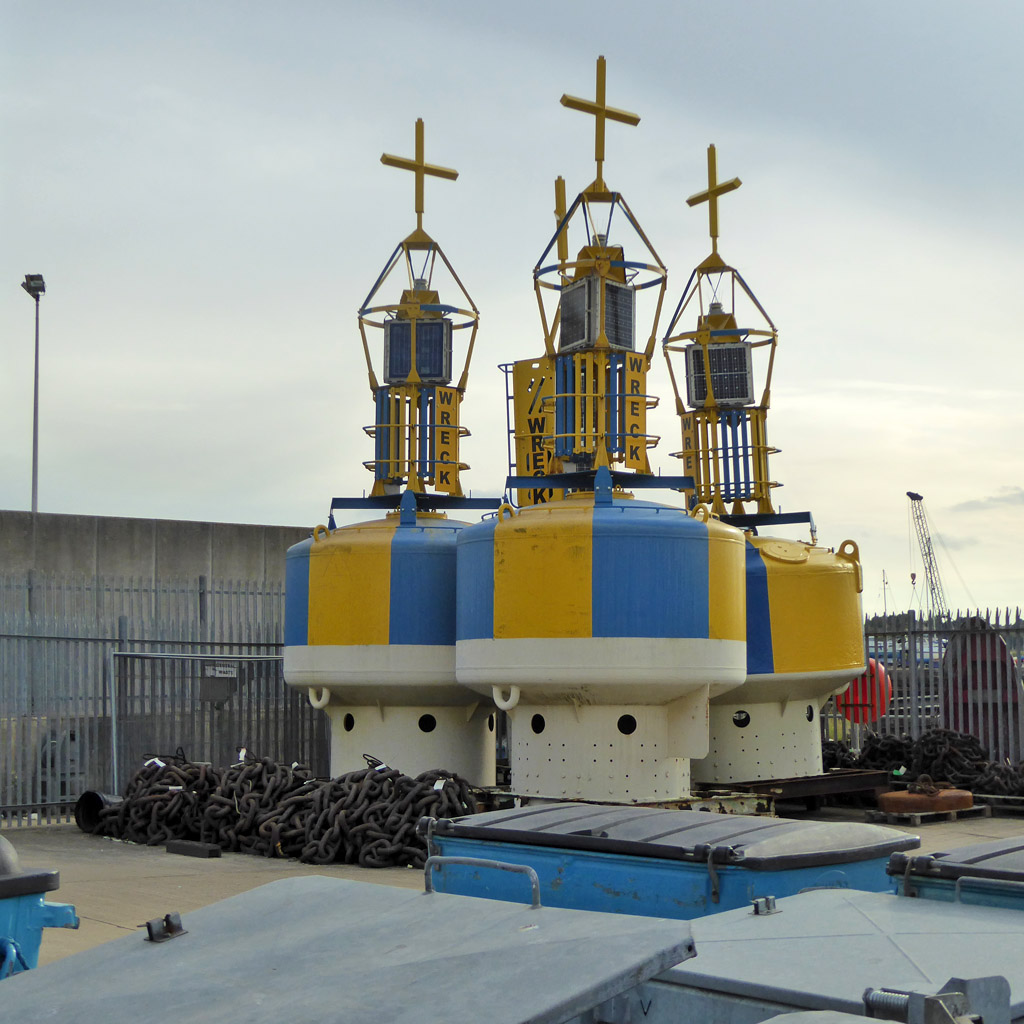
Description by day
In short: the only blue buoy in the IALA system: blue and yellow vertical stripes with an upright yellow cross.
- Colour: blue and yellow vertical stripes, equal in number and size, minimum 4 and maximum 8 stripes (IALA R1001, Table 11).
- Shape: pillar or spar. Size depends on the location.
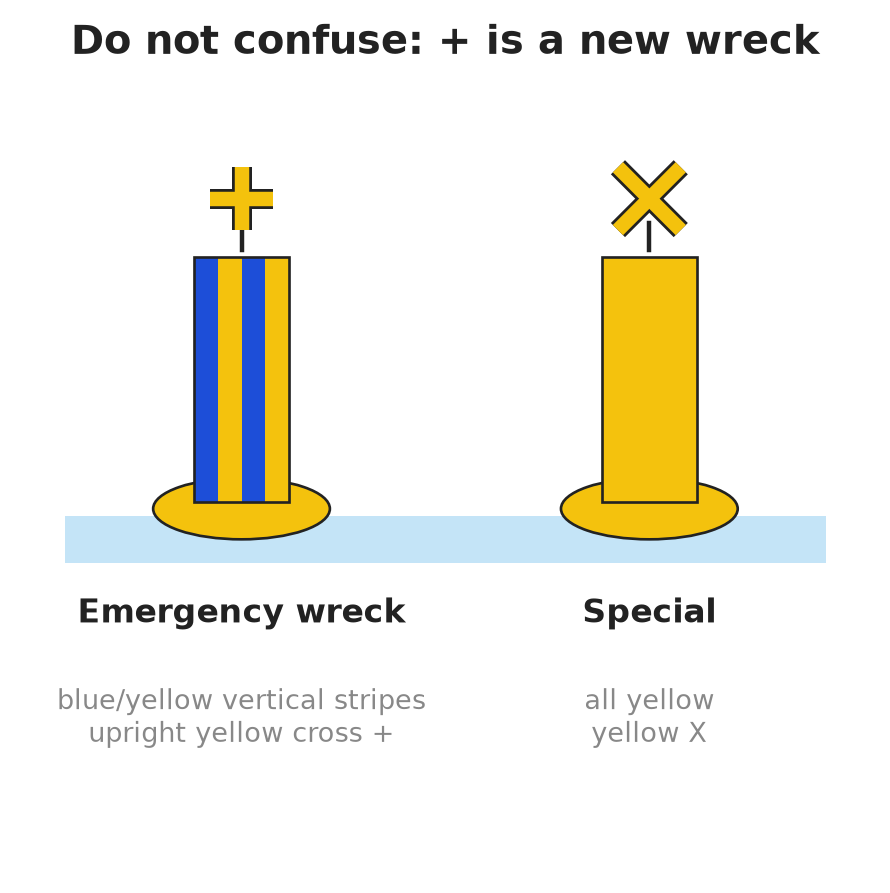
- Topmark (if fitted): a vertical/perpendicular yellow cross — an upright “+”. IALA prefers it three-dimensional, so it looks the same from every direction.
- Memory hook: blue = brand-new. No other IALA mark uses blue.
- Trap: the special mark topmark is a yellow X (diagonal). The wreck mark topmark is a yellow + (upright).
- Both regions: identical in Region A and Region B.
Light, racon and AIS
In short: blue, yellow, blue, yellow — a light you will not see on any other mark.
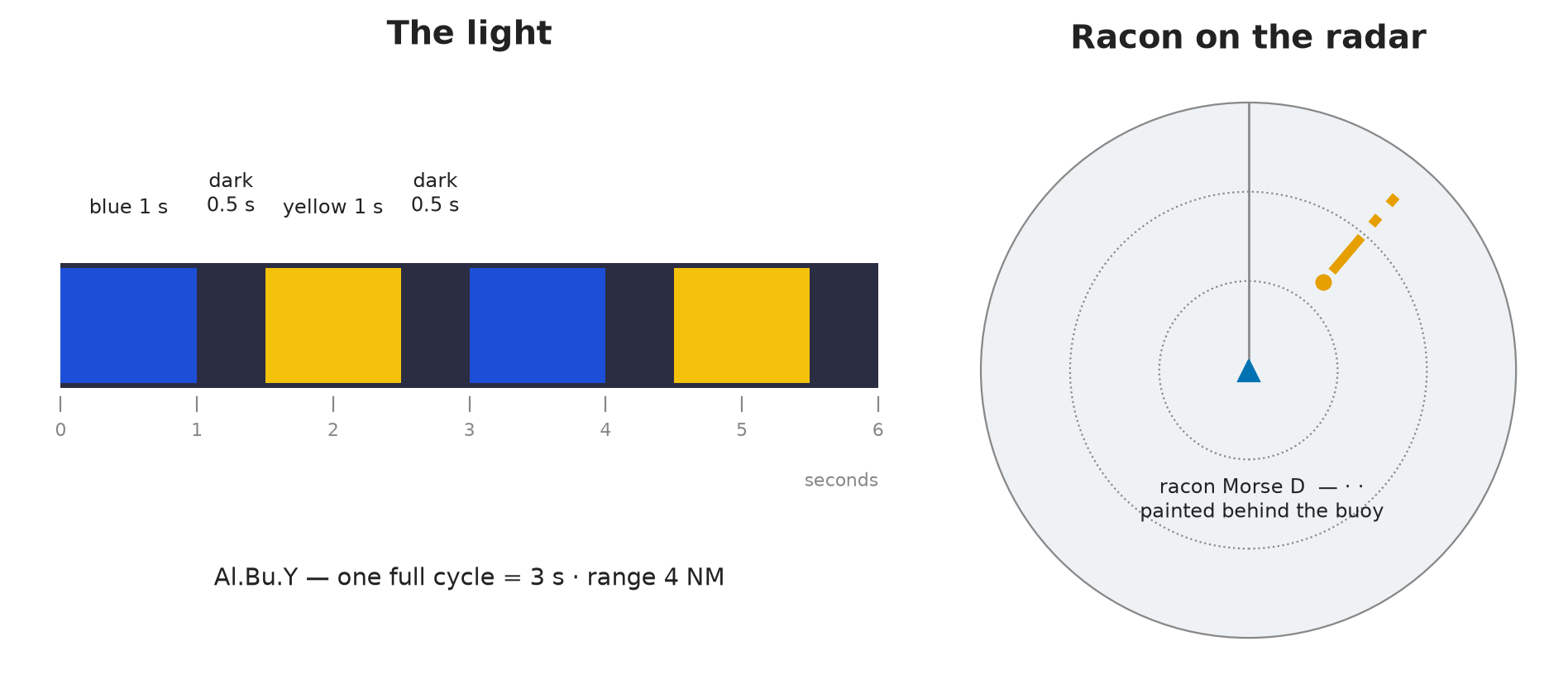
- Light colour: blue and yellow, alternating, always with the same timing.
- Rhythm: 1 s blue → 0.5 s eclipse → 1 s yellow → 0.5 s eclipse (IALA R1001, Table 11). One full cycle therefore lasts 3 s.
- Nominal range: 4 NM (Trinity House).
- Several buoys round one wreck: their lights are synchronised (Trinity House).
- Racon: Morse “D” (— · ·). On the radar it paints as a dash-dot-dot line behind the buoy’s echo, on the bearing of the buoy.
- AIS: an AIS AtoN may be fitted, so the mark shows on AIS, ECDIS and radar overlays (IALA R1001, Table 11).
- On the bridge: a racon “D” or an unexpected AIS AtoN symbol is often your first warning of a new wreck, before you see the light.
How long it stays and duplicate marks
In short: it is a first-response mark. Once the wreck is charted or permanently buoyed, it goes.
- Typical time: Trinity House describes it as a temporary mark, usually for the first 24–72 h after a wreck is found.
- It stays until (Trinity House):
- the wreck is well known and published in nautical publications;
- the wreck has been fully surveyed, with exact position and least depth known;
- a permanent form of marking is in place.
- Other ways to mark a new danger (IALA R1001, 3.2.2): lateral, cardinal or isolated danger marks, or the emergency wreck mark.
- Duplication: if the authority thinks the risk is especially high, at least one of the marks is duplicated.
- The duplicate is identical to its partner in every respect.
- A lighted lateral mark used for this shows VQ or Q.
- It may also carry a racon Morse “D” and an AIS AtoN.
On the bridge: meeting a wreck mark
In short: treat it as an uncharted danger. Find out where the wreck is before you decide how to pass.
- Check the information: the latest navigational warnings (NAVTEX, VHF) and Notices to Mariners give the wreck position. Plot it on the chart or ECDIS.
- No safe side: unlike a cardinal, the mark does not tell you where the safe water is. A big wreck can have several buoys round it.
- Keep a wide berth, and plan your clearing distance from the wreck position, not from the buoy.
- Use every sensor: racon “D” on the radar, the AIS AtoN, and the blue/yellow light by eye.
- Do not confuse:
| Mark | Colour | Topmark | Light |
|---|---|---|---|
| Emergency wreck | Blue and yellow vertical stripes | Upright yellow cross + | Blue/yellow alternating, 1 s + 0.5 s |
| Special | Yellow | Yellow X | Yellow, any rhythm not used for white lights |
| Isolated danger | Black, red band(s) | Two black spheres | White Fl(2) |
⚡ Flashcards
Test yourself, one card at a timeQ1What does an emergency wreck marking buoy tell you?
AnswerA new danger — usually a fresh wreck — that is a danger to surface navigation and is not yet on the chart or in nautical publications.
Common trapIt is not a permanent mark. Old, charted wrecks get cardinal or isolated danger marks.
Q2Describe an emergency wreck marking buoy by day.
AnswerBlue and yellow vertical stripes, equal in number and size: minimum 4, maximum 8. Pillar or spar. Topmark, if fitted: an upright yellow cross (+).
Q3What light does it show?
AnswerAlternating blue and yellow: 1 s blue, 0.5 s dark, 1 s yellow, 0.5 s dark (IALA R1001). Hook: blue is used by no other IALA mark — a blue light at sea means a new wreck.
Q4Which racon and AIS can it carry?
AnswerRacon Morse “D” (— · ·) on the radar screen, and an AIS AtoN. Both optional, but often fitted.
Q5Yellow cross on a yellow-and-blue buoy, or yellow X on a yellow buoy: what is the difference?
AnswerUpright cross + = emergency wreck mark. Diagonal X = special mark.
Common trapCalling the wreck buoy a special mark because of the yellow.
Q6How long does it stay in place?
AnswerUntil the wreck is surveyed (position and least depth known), published in nautical publications, and/or permanently marked (Trinity House). Trinity House describes it as a temporary mark, typically for the first 24–72 h.
Q7What other marks can be used for a new danger, and when is one duplicated?
AnswerLateral, cardinal, isolated danger or an emergency wreck mark. If the risk is especially high, at least one mark is duplicated; the duplicate is identical in every way (IALA R1001). A lighted lateral mark used for a new danger shows Q or VQ.
Q8At night you see a light flashing blue then yellow ahead. What do you do?
AnswerIt is an emergency wreck mark. Slow down if needed, check the latest navigational warnings and Notices to Mariners for the wreck position, and pass with a wide berth.
Common trapAssuming a safe side: there is no fixed side, as with a cardinal.
Q9Is the emergency wreck mark different in IALA Region B?
AnswerNo. It is the same in both regions.
📚 Resources
Books
- NP735 IALA Maritime Buoyage System — UK Hydrographic Office (ADMIRALTY), 8th edition (2018)
Regulations
- IALA Recommendation R1001 — The IALA Maritime Buoyage System — Edition 2.0 (June 2023): section 2.6 Emergency Wreck Mark, section 3.2.2 Marking of new dangers
- SOLAS V/13 — establishment and operation of aids to navigation
Official sites
- Emergency Wreck Marking buoys — Trinity House
- Wreck marking — Trinity House
Exam focus — MCA
Typical questions • “Describe an emergency wreck marking buoy” → blue and yellow vertical stripes (4–8), pillar or spar, upright yellow cross, alternating blue/yellow light 1 s + 0.5 s, racon “D”, AIS. • “You see a blue and yellow light ahead at night — what is it and what do you do?” → new wreck; check navigational warnings and NtMs, plot it, keep a wide berth. • “How long does it stay?” → until the wreck is surveyed, published and/or permanently marked. • “How else can a new danger be marked?” → lateral, cardinal or isolated danger marks; duplicated if the risk is high; lighted lateral shows Q or VQ. What examiners look for: the same order as for every buoy — colour, shape, topmark, light — plus the racon letter “D” and the bridge action. Do not mix up the upright cross with the special mark’s X.