IALA Buoyage System and Light Characters
NavigationHow the IALA Maritime Buoyage System works worldwide: Regions A and B, the direction of buoyage, and how to read the light character of every mark. It is the base for identifying any buoy by day or night, on a paper chart or ECDIS, and a standard MCA oral question.
Last reviewed 1 Nov 2026 · From a professional captain's years of study notes · Organised with AI and checked against current regulations · How we write
On this page (8)
The IALA system and its two regions
In short: one worldwide system, six kinds of mark, two regions that differ only in the colours of the lateral marks.
Start here. This is the first topic of the Buoyage area. Read it before Lateral Marks and Preferred Channel, Cardinal Marks, Isolated Danger, Safe Water and Special Marks, and Emergency Wreck Marking Buoy.
- IALA is the international body of lighthouse and aids-to-navigation authorities. Its Maritime Buoyage System is set out in IALA Recommendation R1001 (Edition 2.0, revised 2023).
- SOLAS V/13 asks governments to take IALA recommendations into account when they set up aids to navigation.
- The UK introduced System A in 1977 (Trinity House). Systems A and B were merged into one system with two regions in 1980.
- On the bridge, the reference book is NP735 IALA Maritime Buoyage System (UKHO). Use it to check any mark you are unsure of. It sits with the recommended, not compulsory, bridge publications.
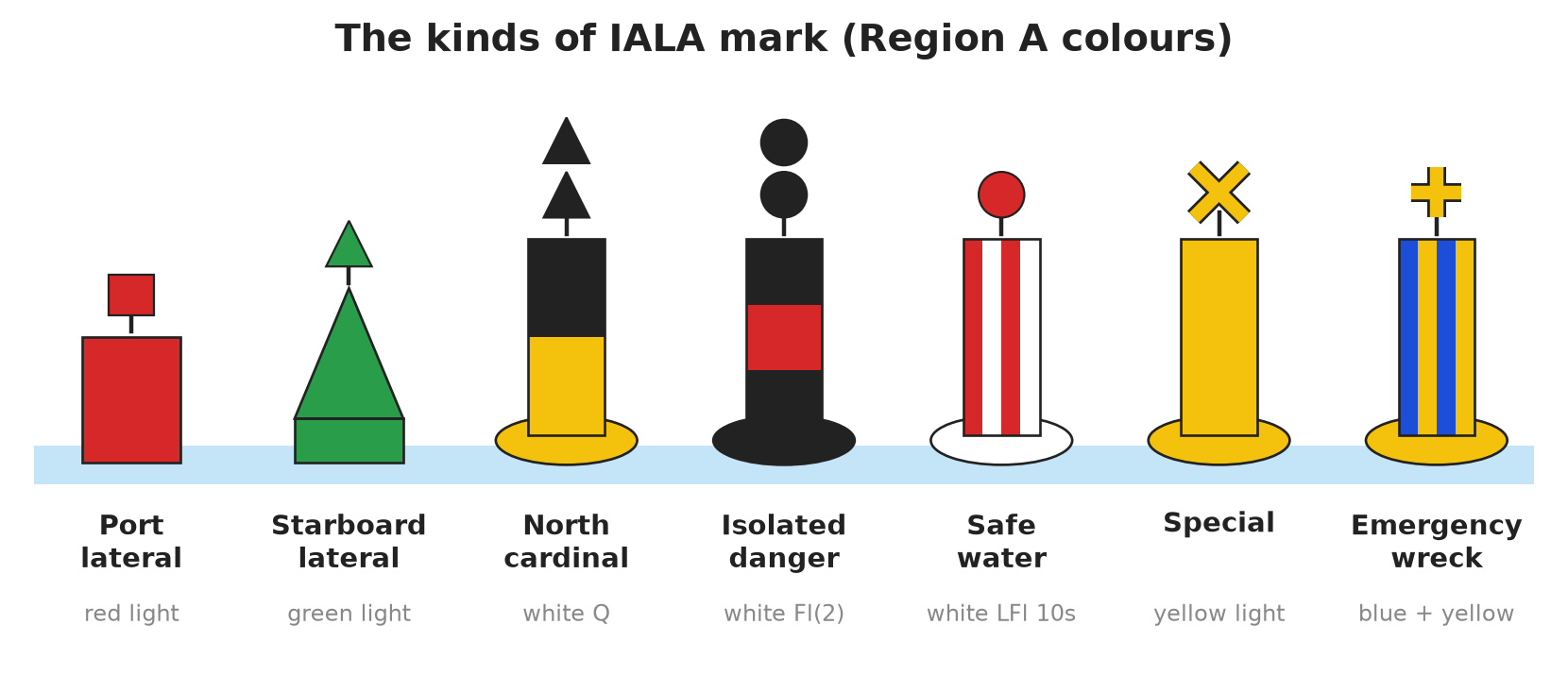
Six kinds of mark
- Lateral marks — port and starboard sides of a channel (plus preferred channel marks).
- Cardinal marks — where the safe water is: N, E, S or W of the mark.
- Isolated danger mark — a small danger with navigable water all round.
- Safe water mark — navigable water all round: landfall, fairway or mid-channel.
- Special marks — an area or feature, not a navigation danger (cables, pipelines, recreation zones, ODAS, firing ranges).
- Emergency wreck marking buoy — a new wreck not yet on the charts.
By day you identify a mark by colour, shape and topmark. By night, by light colour and rhythm. The system is built so a mark can still be identified if its light fails or its topmark is lost.
Region A and Region B
| Region A | Region B | |
|---|---|---|
| Where | Europe, Africa, Australia, most of Asia (incl. Malta and the UK) | North, Central and South America, Japan, South Korea, the Philippines |
| Port-hand mark (entering) | Red, can shape, red light | Green, can shape, green light |
| Starboard-hand mark (entering) | Green, cone shape, green light | Red, cone shape, red light |
| Memory hook | “There is no red port left” — red to port | “Red Right Returning” — red to starboard coming in |
- Same in both regions: the shapes of lateral marks (can to port, cone to starboard) and every other kind of mark.
- The only difference: lateral colours, and so lateral light colours, are reversed.
- On the bridge: before arriving in a Region B country (for example a yacht crossing from the Med to Florida), brief the bridge team: from now on, red marks are left to starboard when entering.
Direction of buoyage
In short: lateral marks only make sense with a direction. Find it on the chart, then leave the marks on the correct side.
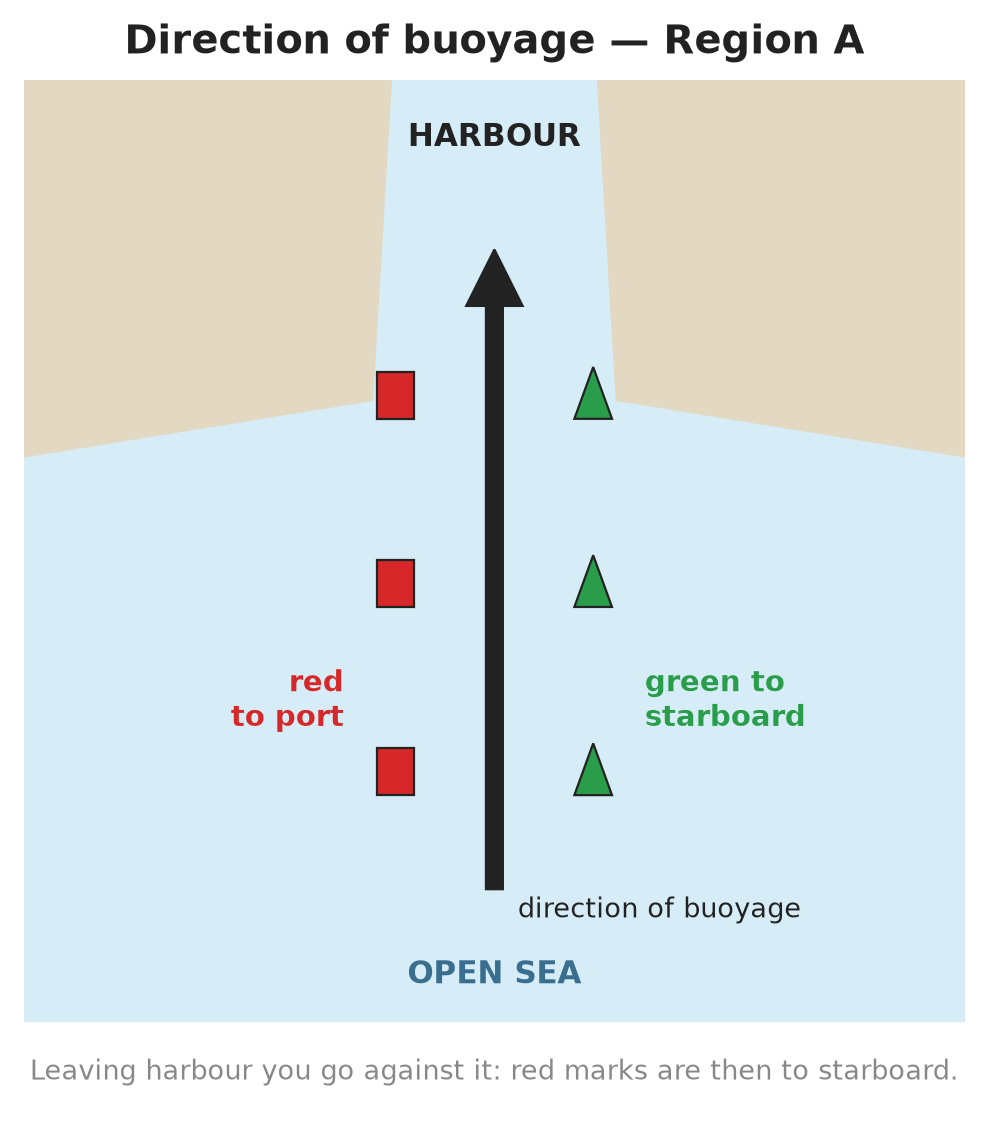
- Port and starboard lateral marks are named as seen by a ship going with the direction of buoyage (IALA R1001).
- Local direction: the direction a ship takes when approaching a harbour, river or estuary from seaward.
- General direction: elsewhere it is set by the authorities, generally clockwise round land masses.
- Where to find it: on the chart, shown by a magenta arrow symbol where the direction is not obvious, and in sailing directions.
- Why it matters: it tells you which side to leave every lateral mark. Get it wrong and you leave the marks on the wrong side, straight onto the danger they mark.
- On the bridge: when you leave harbour you are going against the buoyage. In Region A the red marks are then on your starboard side.
Light characters — reading the rhythm
In short: every light is described by its colour, its rhythm and its period. Learn the abbreviations once and you can read any chart.
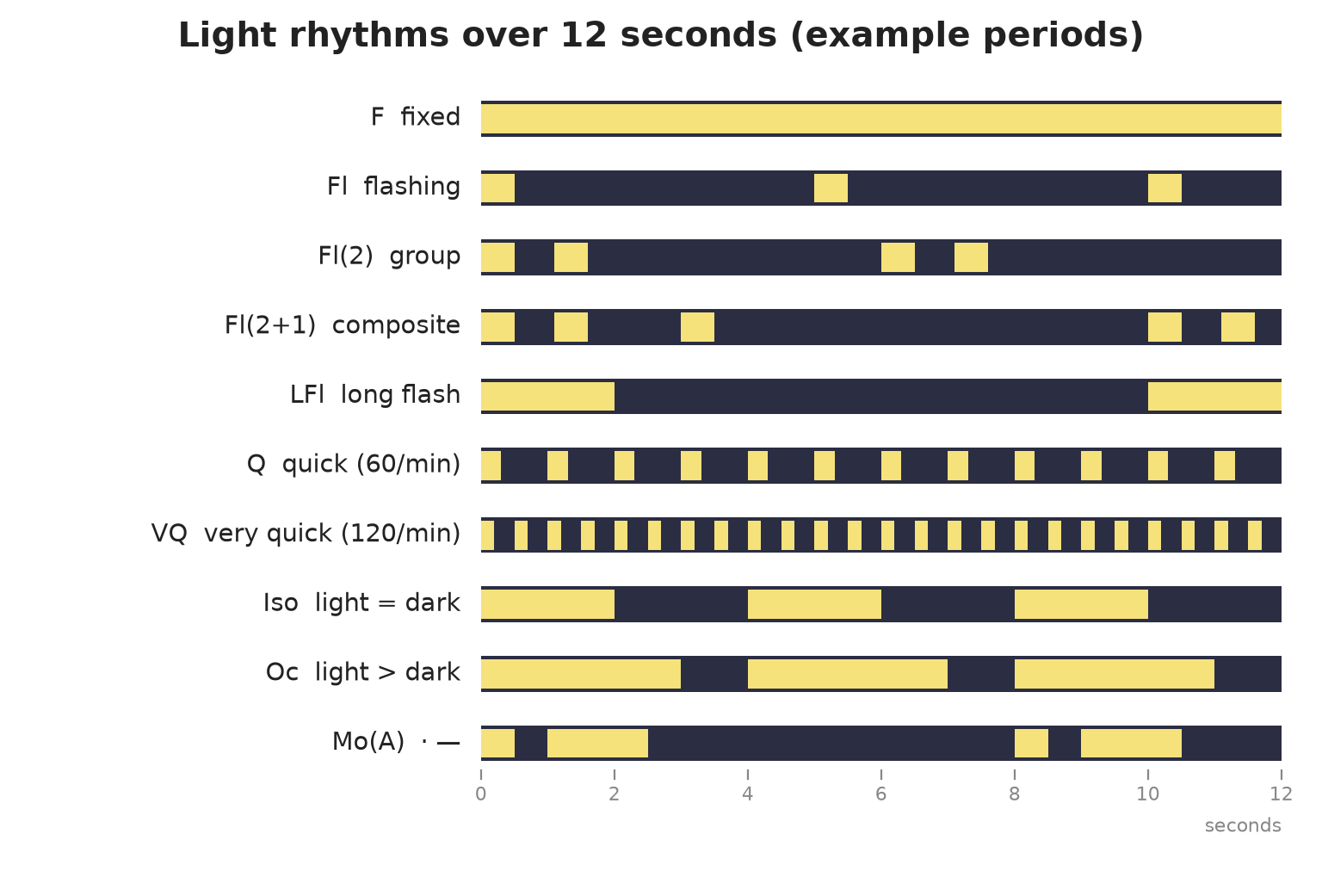
| Abbreviation | Name | What you see |
|---|---|---|
| F | Fixed | A steady, continuous light |
| Fl | Flashing | Light shorter than dark; slower than quick |
| Fl(2) | Group flashing | Flashes in groups, here groups of 2 |
| Fl(2+1) | Composite group flashing | A group of 2, then 1 — preferred channel marks |
| LFl | Long flash | One flash lasting at least 2 s |
| Q | Quick | 50 or 60 flashes a minute |
| VQ | Very quick | 100 or 120 flashes a minute |
| UQ | Ultra quick | 160 or more flashes a minute |
| Q(6)+LFl | Group quick + long flash | 6 quick flashes, then one long flash — South cardinal |
| Iso | Isophase | Light and dark exactly equal |
| Oc | Occulting | Light longer than dark: a steady light with short eclipses |
| Mo(A) | Morse code | The letter A: short, long |
| Al | Alternating | The light changes colour, e.g. Al.Bu.Y |
- Colour: no letter = white. R = red, G = green, Y = yellow, Bu = blue.
- Period: the time in seconds from the start of one sequence to the start of the next. “Fl(2)R.6s” = 2 red flashes, repeating every 6 s.
- Lighthouses add the height of the light and its nominal range, e.g. “Fl(3)10s 25m 18M”. Buoys usually show only colour, rhythm and period.
- On the bridge at night: note the colour first, then count the flashes and time the period with a stopwatch. Only then compare with the chart. Never “make the light fit” what you expect.
The light of every mark
In short: the colour tells you the family — red or green = lateral, white = cardinal, isolated danger or safe water, yellow = special, blue and yellow = new wreck. The rhythm tells you which mark.
| Mark | Light colour | Rhythm (NP735 / IALA R1001) | Memory hook |
|---|---|---|---|
| Port lateral | Red (A) / green (B) | Any except Fl(2+1), e.g. Fl R 5s | Colour = mark colour |
| Starboard lateral | Green (A) / red (B) | Any except Fl(2+1), e.g. Fl(2) G 6s | Colour = mark colour |
| Preferred channel | Colour of the main band | Fl(2+1) | The only 2+1 rhythm |
| North cardinal | White | Q or VQ, continuous | 12 o’clock: never stops |
| East cardinal | White | Q(3) 10s or VQ(3) 5s | 3 o’clock |
| South cardinal | White | Q(6)+LFl 15s or VQ(6)+LFl 10s | 6 o’clock + long flash |
| West cardinal | White | Q(9) 15s or VQ(9) 10s | 9 o’clock |
| Isolated danger | White | Fl(2) | Two spheres, two flashes |
| Safe water | White | Iso, Oc, LFl 10s or Mo(A) | One sphere, a calm light |
| Special | Yellow | Any rhythm not used for white lights, e.g. Fl Y | Yellow mark, yellow light |
| Emergency wreck | Blue and yellow | Al.Bu.Y: blue 1 s, dark 0.5 s, yellow 1 s, dark 0.5 s | New wreck = new colour (blue) |
North and South are easy to swap. Some revision material has written North as “6 + 1 long” and South as “6”. That is wrong. IALA: North = continuous quick or very quick, South = 6 + one long flash. The long flash is there so you can tell the 6 apart from the 3 and the 9 when counting fast flashes.
- Lateral lights: “continuous or flashing” — any rhythm the authority chooses, except the 2+1 reserved for preferred channel marks.
- Safe water: revision guides often give only one or two rhythms (one says LFl 10s; another says Mo(A), Iso or Oc). IALA allows all four — learn all four. A safe water mark can be passed on either side; a common habit is to keep it on your port hand, so you stay on the starboard side of the fairway.
- Special marks: the yellow light uses a rhythm that cannot be mistaken for a white mark. Uses — mnemonic CROFTS: channel, recreation zones, ODAS, firing ranges, submerged cables (and pipelines).
- Wreck marks: blue is the colour only this mark uses. Full detail in the Emergency Wreck Marking Buoy topic.
Recognising marks on a paper chart and on ECDIS
In short: the MCA syllabus asks you to recognise IALA A and B marks and state their meaning on both a paper chart and an ECDIS. The mark is the same; only the symbol changes.
Paper chart
- The buoy symbol is drawn in its shape (can, cone, pillar, spar, sphere), with the topmark on top.
- Colour letters under the symbol read top to bottom: BY = black over yellow (North cardinal) · YB = South · BYB = East · YBY = West · BRB = isolated danger · RW = safe water · Y = special.
- Cardinal colours follow the topmark cones: the black band is where the cone points go (both up = black on top; both down = black at the bottom).
- A lit buoy carries a magenta light flare, with the light character written beside it, e.g. “Q(6)+LFl15s” or “Fl(2)R.6s”.
- Symbols and abbreviations are listed in the chart key, INT 1 (section Q for buoys and beacons).
ECDIS
- An ENC can show buoys with “paper chart” (traditional) symbols or “simplified” symbols. The operator chooses; the meaning does not change.
- Lights are shown with light flares. To read the full character (colour, rhythm, period), pick the object with the cursor.
- Do not assume the region: read the colour of the lateral mark on the chart, then apply the direction of buoyage.
- On the bridge: if a mark on the water does not match the chart or ECDIS, slow down, fix your position by other means and check NP735 and the latest Notices to Mariners.
⚡ Flashcards
Test yourself, one card at a timeQ1What are the two IALA buoyage regions, and which countries use Region B?
AnswerRegion B: North, Central and South America, Japan, South Korea and the Philippines. Region A: the rest of the world (Europe, Africa, Australia, most of Asia).
Common trapJapan, Korea and the Philippines are B, not A.
Q2What is the difference between Region A and Region B?
AnswerOnly the lateral marks: same shapes, colours swapped. A: red can to port when entering. B: green can to port — “red right returning”.
Common trapCardinal, isolated danger, safe water, special and wreck marks are the same in both regions.
Q3Which publication describes the buoyage system on the bridge?
AnswerNP735 IALA Maritime Buoyage System (UKHO), based on IALA Recommendation R1001. A recommended reference, not a compulsory one.
Q4Where do you find the direction of buoyage, and why does it matter?
AnswerOn the chart (magenta arrow symbol) and in sailing directions. It decides which side you leave each lateral mark. Default: from seaward into a harbour; along coasts, usually clockwise round land masses.
Q5How do you read "Fl(3)G.10s" on a chart?
AnswerA group of 3 green flashes; the whole sequence repeats every 10 s (the period). No colour letter = white light.
Q6Flashing, occulting, isophase, long flash: what is the difference?
AnswerFl = light shorter than dark · Oc = light longer than dark · Iso = light and dark equal · LFl = one flash of at least 2 s.
Common trapOcculting is not “occasional”: the light is mostly on, with short eclipses.
Q7Quick and very quick: how fast?
AnswerQ = 50 or 60 flashes a minute · VQ = 100 or 120 a minute · UQ = 160 or more.
Q8Light rhythms of the four cardinal marks?
AnswerAll white. Think of a clock: N = continuous Q or VQ · E = 3 · S = 6 + one long flash · W = 9.
Common trapDo not swap North and South: the long flash belongs to South.
Q9Lights of the isolated danger, safe water, special and wreck marks?
AnswerIsolated danger: Fl(2) white · Safe water: white Iso, Oc, LFl 10s or Mo(A) · Special: yellow, any rhythm not used by white marks · Wreck: blue and yellow alternating.
Q10Lights of lateral and preferred-channel marks?
AnswerLateral: the colour of the mark (red or green), any rhythm except Fl(2+1). Preferred channel: Fl(2+1), in the colour of the main band.
Q11Can you recognise the same mark on a paper chart and on ECDIS?
AnswerPaper: shape + colour letters (e.g. BY, BRB) + magenta light flare with the light character. ECDIS: “paper chart” or “simplified” symbols; pick the object to read the full light.
📚 Resources
Videos
- IALA BUOYAGE SYSTEM PART 1, Region A & Region B, LATERAL PORT & STBD HAND MARK — Nizam Khan: Maritime Finance
- IALA Buoyage Region B — Nautical Training 777
Books
- NP735 IALA Maritime Buoyage System — UK Hydrographic Office (ADMIRALTY), 8th edition (2018)
Regulations
- IALA Recommendation R1001 — The IALA Maritime Buoyage System — Edition 2.0 (revised June 2023)
- SOLAS V/13 — establishment and operation of aids to navigation
Official sites
- IALA Maritime Buoyage System — Trinity House (Region A, UK waters)
- Canadian Chart 1 — Section Q, IALA buoyage — Canadian Hydrographic Service (Region B chart symbols)
Exam focus — MCA
Typical questions • “What are the two IALA regions and which areas do they cover?” → Region B: the Americas, Japan, South Korea, the Philippines. Region A: the rest of the world. • “What is the principal difference between the regions?” → only lateral marks: same shapes, colours (and light colours) reversed. • “Where do you find the direction of buoyage, and why is it important?” → on the chart; it decides which side you leave the lateral marks. • “Describe the light of every mark” or “Give a full description of a South cardinal” → topmark two cones pointing down, yellow over black, white Q(6)+LFl 15s or VQ(6)+LFl 10s, safe water to the South. • “Identify this mark” on a paper chart or ECDIS screen → name it, give its meaning and say which side you pass it. What examiners look for: a fast, confident answer in a fixed order — topmark, colour, light, use (“full description” questions score one mark for each). Quote the Q and VQ periods for cardinals, all four safe water rhythms, and name NP735 as your reference.