Evacuation, Environmental Injuries and Death at Sea
MedicalHow to care for castaways and rescued people (hypothermia, cold and heat injuries, dehydration), how to confirm, record and handle a death at sea, and how to move a casualty and prepare them for helicopter evacuation. A core MCA medical subject where the wrong instinct, like rubbing frostbite, ice baths or declaring death too early, can cost a life.
Last reviewed 1 Nov 2026 · From a professional captain's years of study notes · Organised with AI and checked against current regulations · How we write
On this page (11)
Castaway Survival and Hypothermia Stages
In short: in cold water a person loses heat fast. Stage them by core temperature and signs, and treat the stage.
- Triage: with several rescued people, start with the one most likely to survive.
- When air temperature is below 20–21°C, survival depends on:
- insulation: clothing and body fat
- surface-to-volume ratio: more surface means faster cooling, so children cool faster
- basal metabolic rate
- will to survive
- Seawater freezes at −2°C. At that temperature the body cools very quickly. Ungloved hands stop working in 1–5 min and consciousness is lost after 5–7 min.
- Leaving the water drops core temperature by a further ~5°C (wind chill).
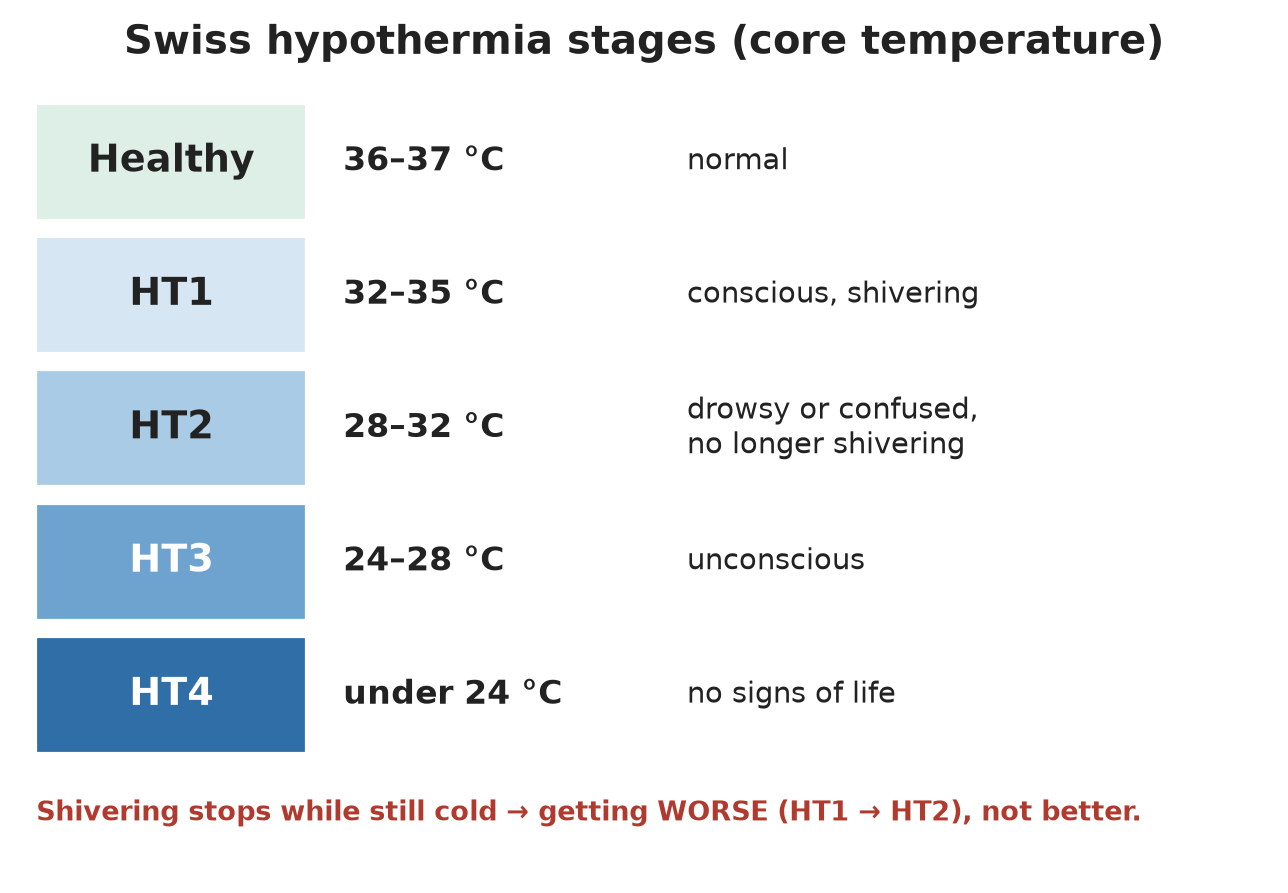
Swiss Hypothermia Classification (core temperature)
| Stage | Core temp | Signs | Treatment |
|---|---|---|---|
| Healthy | 36–37°C | Normal | None |
| HT1 | 32–35°C | Conscious, shivering | Warm place, dry clothes, warm drinks |
| HT2 | 28–32°C | Drowsy or confused, no longer shivering | Active rewarming (heat packs, warm fluids), heart monitoring, insulate the whole body |
| HT3 | 24–28°C | Unconscious | As HT2 + airway control; hospital (ECMO / bypass) |
| HT4 | under 24°C | No signs of life | Advanced life support, then as HT3 |
Shivering stops while the casualty is still cold → they are getting worse (HT1 → HT2), not better.
SCMG scale and treatment ladder
- SCMG scale (core temperature, rectal thermometer): 37° normal · 36° mild · 35° moderate · 33° grave · 31–30° severe / very severe · 28° critical · 25° probably fatal.
- The SCMG and Swiss scales use different labels. Learn both.
- Treatment ladder as it gets worse (SCMG): dry clothes → off watch, warm sweet drinks → never left alone, buddy warming, kept horizontal → contact TMAS, recovery position → prepare to evacuate → handle gently.
- Prevention: good food and fluids, limited time on deck, a heated space below deck, no alcohol, proper clothing (dry, gloves, face protection, loose boots, spares).
Assessment: Circulation and Disability
- Circulation: cold hands and feet, slow capillary refill · slow pulse with possible arrhythmia · low blood pressure · look for injuries from the rescue · cold diuresis (cold makes the kidneys produce more urine).
- Disability: agitation → confusion → coma · below 30°C pupils can be fixed and dilated, so never declare death on the pupils alone · slow, clumsy movement · blood glucose high at first, then falls.
- Breathing can slow to ~3 breaths/min with a very slow pulse. This is a hibernation-like state, not death.
- Terminal signs: paradoxical undressing (the casualty strips off) → curls into a fetal position → cardiac arrest.
- Hypothermia impairs clotting, so injuries bleed more.
Hypothermia Resuscitation and Rewarming
In short: “not dead until warm and dead”. Check longer, move gently, keep CPR going while you rewarm.
- Check longer: look, listen and feel for breathing and a pulse for up to 1 minute, not the usual 10 s. A cold pulse is slow and weak.
- In doubt → 5 rescue breaths (once out of the water), then CPR.
- Radio medical advice at once for any cardiac arrest in hypothermia.
- Move gently. Rough handling triggers fatal arrhythmias.
- CPR continues during rewarming (e.g. in a thermal protective aid).
- AED below 30°C: only 3 shocks. A cold heart does not respond to defibrillation. After 3 failed shocks, carry on with CPR, recheck the temperature after 30 min, and shock again once it is over 30°C.
- No CPR unless you are sure there is no pulse and no breathing. Keep supporting the casualty until they are over 32°C and still pulseless before declaring death (SCMG).
Passive rewarming step by step
- Position: flat. Do not raise the legs. If vomiting, turn onto the side. Some teaching material shows the legs raised 5–6 cm. The safer practice is to keep the casualty flat.
- Take off wet clothes and keep the casualty dry, but never undress them on open deck.
- Get them into a warm space.
- Insulate with blankets + space blanket or foil + a hat (the head loses a lot of heat).
- Rewarm by stage: HT1 → warm place, dry clothes, warm drinks. HT2 and worse → active rewarming (heat packs, warm fluids), heart monitoring, insulate the whole body.
Post-immersion collapse: in the water, water pressure supports the circulation. Lift the casualty out and blood pressure can crash. This is why they are kept flat and moved gently.
Cold Injuries: Chilblains, Immersion Foot and Frostbite
In short: cold injuries are non-freezing (above 0°C, cold + wet) or freezing (below 0°C). Warm and dry them, and never rub.
- Aggravating factors: cold, wet, wind chill, sweat, drugs or alcohol, seasickness, dehydration, hunger, lack of sleep, injury (SCMG).
Non-freezing injuries
- Chilblains (“sausage” fingers): red, itchy, tender lumps on fingers and toes, thickened skin, reduced feeling. Treat: keep warm and dry, pain relief. Take care with fine tasks, because the casualty drops things.
- Immersion foot / trench foot: feet cold and wet for a long time (tight boots, liferaft). First pale and cold, then swollen, purple and numb. On rewarming the foot turns red and very painful. Treat: dry, warm, elevate, do not massage. Prevent with dry socks and loose boots.
Freezing injuries: depth of damage
- Normal skin.
- Frostnip: outer skin layer only (epidermis). Cold, white, painless at first (fingers, ears, nose). Reversible with simple warming. Do not rub.
- Superficial frostbite: epidermis + dermis. White, waxy skin that blisters on rewarming.
- Deep frostbite: down to the tissue under the skin. Black, dead tissue, permanent loss.
- The deeper the freezing, the more layers are hit and the more permanent the damage. Gangrene can lead to amputation.
- Frostbite treatment (SCMG): pain relief before rewarming (it is very painful) → 40°C water bath → sterile dressing → elevate.
- Skin care: Vaseline keeps the skin moist, no scratching, no smoking (it narrows blood vessels).
Heat Exposure and Heat Stroke
In short: a castaway in the sun suffers burns and fluid loss. Heat illness runs from cramps to exhaustion to heat stroke, a life-threatening emergency.
- Hours of sun without protection can cause 1st to 3rd degree burns, depending on protection, position and exposure time.
- Keeping clothes on reduces burns. Do not look at the sun or its glare on the sea.
- Heat illness spectrum (fluid lost in sweat, worst in the tropics): 1️⃣ heat cramps (mildest) → 2️⃣ heat exhaustion → 3️⃣ heat stroke (life-threatening).
- Heat exhaustion = pale skin, heat stroke = red, dry skin.
- At risk: people not used to the heat, engine-room crew, people who drink too little.
- Heat stroke signs: rapid pulse, hot red skin with no sweating, dizziness, headache, vomiting, confusion, delirium, fits, coma, tremor or muscle rigidity, dilated pupils, a rigid posture with toes pointing down and head back.
- Heat stroke mortality is about 20%.
- Prevention: no alcohol, light clothing, limited time outside, sunscreen, drink enough, cool showers.
Heat stroke management
- DR BBCFS – ABCDE approach (Danger, Response, Breathing, Bleeding/Burns, Consciousness, Fractures, Shock). Move the casualty out of the heat.
- Airway and breathing: monitor the GCS, give oxygen, ventilate if needed.
- Cool: cold packs where large blood vessels are near the surface, at the neck, armpits and groin (and wrists). Tepid sponging works too: lukewarm water evaporates and cools without shock.
- Circulation: rectal infusion or IV line, fluids slowly: 1 L over 6 hours.
- Cooling target: 0.1°C per minute (same methods as heat exhaustion).
- Monitor urine output (risk of kidney failure). Cooling can trigger fits.
Hospital guidance names cold-water immersion as the fastest cooling method. On board: never ice and never an immersion bath. Use room-temperature water + wet sheets changed often + a fan.
- 🌡️ High fever rule (SCMG 22nd ed.): any temperature 40°C or more → cool fast until below 39°C. Leave the thermometer in for 4 min. Recheck every 30 min until it has stayed below 39°C for 1 hour.
Dehydration and Malnutrition
In short: replace lost fluid slowly. Reversing dehydration or starvation too fast can kill.
- Pinch test (skin turgor): pinch the back of the hand or forearm. Skin that stays “tented” and falls back slowly = dehydrated. Skin that snaps back = fine.
- Other signs: thirst, dry mouth and lips, dark, scanty urine, sunken eyes, hollow cheeks, dry, cracked tongue, tiredness, dizziness, confusion (severe).
- Management: replace the fluid lost while adrift, with caution. The same applies to malnutrition.
- A sudden reversal shifts fluid out of the circulation → oedema → brain swelling and coma.
- Start with oral rehydration salts (ORS) and fluids slowly, or IV fluids.
- Target: urine output about 1 L/day. This target is urine, not water drunk.
- Radio medical advice (TMAS) every time.
- Dehydrated more than 48 h → rehydrate with great caution. Even under 48 h → small amounts at a time.
- Homemade electrolyte drink: about ½ tsp sea salt per 1.5 L water + sugar + lemon. It “should taste like tears”.
- Liferaft water: 1 L per person per day, nothing in the first 24 h.
- Seasickness link: persistent vomiting → loss of potassium and calcium → heart rhythm risk. Give small sips, or fluid per rectum if nothing stays down.
- Ketones in the urine show up in starvation as well as in diabetes.
Drinking too much too fast can kill (electrolyte imbalance, low sodium).
Death at Sea: Confirming, Recording and Handling the Body
In short: confirm death carefully and never alone. Record everything with a witness, and keep the body and property intact for the inquiry (SCMG, non-survivor / life extinct).
Signs and timeline
- Death = all the biological functions that keep the body alive have stopped.
- Pallor: immediate.
- Livor mortis: blood settles by gravity in the lowest parts → purple-red patches, with pale pressure areas where the body rests. It starts ~30 min after circulation stops and is visible at ~2 h.
- Rigor mortis: muscles stiffen from ~4 h, then the stiffness slowly passes off.
- Putrefaction: after hours to days. Heat speeds it up.
- These stages help estimate the time of death.
Confirming death
- Never alone. In hospital three people check.
- Pupils dilated and not reacting to light.
- No breathing for a full 1 min. Hypothermia and drugs can mimic death.
- Stethoscope on the apex of the heart for a full 2 min.
- Bedside tests (SCMG 22nd ed.):
- 🪞 Mirror at the nose and mouth: it mists if the person is alive.
- 🧵 String tied round a finger: the tip turns blue if alive and stays white in death.
- 💅 Nail pressure: colour comes back after blanching if alive.
- 🛑 Stop CPR only when the radio medical doctor says so, or when you are physically exhausted.
Below 30°C, fixed dilated pupils and near-absent vital signs can mimic death. The casualty is “not dead until warm and dead”.
Records and the medico-legal side
- Document and sign every event leading to the death. This builds the picture of the cause. Keep the records safe for any later inquiry.
- Record what happened and how the injury or illness came about. A medico-legal inquiry may follow even when no foul play is suspected.
- 📓 Official Log Book: make the correct entries (the relevant section is at the back).
- Record everything with a witness, take photographs, follow the SCMG.
- Give correct information to the Port Authorities.
- Property: list it and log it, and keep it in safe custody.
- Body: store it correctly.
- Crew: watch the effect on the ship’s company. Debrief the crew as if they were casualties too, and take statements if needed.
Handling the body
- 🧊 Body bag + fridge or freezer only if the doctor or authorities advise it. If heat forces you to do it anyway, record the time and temperature, because this matters at the autopsy.
- 🚿 Leave the body intact: stop a running drip but leave all lines and tubes in place. If the body is soiled → photograph first, document, then clean.
- 🌊 Body found at sea: inform the authorities, mark the position, take photos and stay in range until the coastguard recovers it.
- 👕 In hospital the body is dressed within ~1 h, before rigor sets in.
Care of the dying
- There is never a stage when nothing can be done.
- Protect the patient from suffering and pain, keep people with them, and protect their dignity throughout.
- 📝 Last wishes: write them down with 1–2 witnesses. An unwitnessed note can be contested.
- 🍽️ Do not force food or drink. Give it only if asked. Keep the patient clean, warm, comfortable and in a quiet place.
Moving the Casualty
In short: make the boat steady, plan the route, then move slowly with enough people and the right stretcher.
- ⛵ Stabilise the boat first: choose the course and trim with the least movement before any procedure, such as an IV, suturing or immobilisation.
- 🗺️ Plan the route before moving a stretcher. Get enough people, and tell the crew and the casualty what will happen.
- Move slowly. A hypothermic casualty moves very slowly, because rough handling causes arrhythmia.
- 🙌 No equipment → two-person lift: one rescuer behind, supporting the head, neck and chest, and one under the thighs. Bend at the knees and lift on a clear command.
- Blanket lift: fine for an arm injury, NOT for a spinal injury (that needs 6 people and a tight blanket).
- 🦶 Suspected spinal injury: tie the feet and ankles with a figure-of-eight bandage, then apply gentle traction on the head and feet to straighten the body. Never fold the casualty. There is no rush to move.
- Stretcher: it must be rigid (Neil Robertson or basket). Plain canvas only if stiffened with cross boards.
- 🚶 Narrow spaces: fore-and-aft carry (one helper under the arms, one under the knees). Last resort: a single-rescuer drag with the casualty’s wrists tied, taking care of the rescuer’s breathing apparatus.
Helicopter Evacuation
In short: get radio medical advice, prepare the casualty and their paperwork, and prepare the vessel as set out in IAMSAR Vol. III.
- The hypothermia ladder ends in evacuation: contact TMAS → prepare to evacuate → handle gently.
Preparing the casualty
- 🛍️ Evacuation bag: passport, ID, wallet and cards, personal medicines, 1–2 changes of underwear + 1 of clothing, toiletries, a photocopy of all on-board medical records.
- 📄 Medical records + passport in a plastic envelope, which goes with the casualty (SCMG 22nd ed.).
- 💉 Tag the casualty if morphine was given (SCMG 22nd ed.).
- 🧥 Dress the casualty warmly and wrap them in a light blanket (warmth and privacy).
- 🦺 Lifejacket ON before they go into the stretcher (SCMG 22nd ed.).
Memory hook: envelope · morphine tag · lifejacket. These are the three things examiners ask about.
Preparing the vessel
- Report position, course and speed.
- Clear the deck of loose and dangerous objects.
- Radar off.
- Deck lighting (illumination).
- Wind about 30° on the port bow.
- Have a portable radio ready for the deck party.
- The procedure is in IAMSAR Vol. III. Follow the helicopter crew’s instructions.
⚡ Flashcards
Test yourself, one card at a timeQ1Several people are pulled from cold water at once. Who do you treat first?
AnswerThe one most likely to survive.
Common trapTrap: starting with the worst-looking casualty, who may already be beyond help.
Q2A cold casualty stops shivering. Better or worse?
AnswerWorse: HT1 (32–35°C, shivering) has become HT2 (28–32°C, no shivering, drowsy) (Swiss staging).
Common trapTrap: reading “no more shivering” as recovery.
Q3A hypothermic casualty looks lifeless. What changes in basic life support?
AnswerCheck breathing and pulse for up to 1 min (not 10 s). In doubt: 5 rescue breaths, then CPR while rewarming. AED below 30°C: 3 shocks max, retry when over 30°C.
Common trapTrap: rough handling. A cold heart fibrillates easily.
Q4How do you position and rewarm a rescued hypothermic casualty?
AnswerFlat (on the side if vomiting), out of wet clothes below deck, blankets + space blanket + hat. Watch for post-immersion collapse.
Common trapTrap: undressing on open deck. Leaving the water already drops core temperature about 5°C.
Q5Frostbite on board: what is the treatment?
AnswerPain relief first, then a 40°C water bath, sterile dressing, elevate (SCMG).
Common trapTrap: rubbing or massaging the frozen part.
Q6Heat exhaustion or heat stroke: how do you tell, and how do you cool?
AnswerExhaustion = pale, sweaty. Stroke = hot, red, dry skin, confusion, fits. Cool with room-temperature water, wet sheets changed often and a fan, aiming for 0.1°C/min.
Common trapTrap: ice or an immersion bath on board.
Q7A castaway has been adrift for days. How do you rehydrate?
AnswerSmall amounts, slowly (ORS), and get radio medical advice. Target = urine output about 1 L/day.
Common trapTrap: letting them drink as much as they want. Too much too fast can kill (low sodium, brain swelling).
Q8How do you confirm death on board?
AnswerNever alone: pupils fixed and dilated, no breathing for a full 1 min, no heart sounds for a full 2 min at the apex. Bedside checks: mirror, string round a finger, nail pressure (SCMG 22nd ed.).
Common trapTrap: declaring a cold casualty dead. They are “not dead until warm and dead”.
Q9After a death at sea, what must the Master record and do?
AnswerEverything with a witness and photos, logged in the Official Log Book; property listed and logged; correct body storage; correct report to the Port Authorities.
Common trapTrap: cleaning the body or removing lines before photographing and documenting.
Q10What do you do before you move a stretcher casualty?
AnswerStabilise the boat, plan the route, get enough people, tell the crew and the casualty, use a rigid stretcher for a suspected spine injury.
Common trapTrap: a blanket lift for a suspected spine injury.
Q11Name the three things that go up with a casualty in a helicopter evacuation.
AnswerPlastic envelope (medical records + passport), morphine tag if morphine was given, lifejacket ON before the stretcher (SCMG 22nd ed.).
Common trapTrap: forgetting to tag a casualty who has had morphine.
Q12How do you prepare the vessel for a helicopter?
AnswerReport position, course and speed; clear loose and dangerous objects; radar off; deck lighting; wind about 30° on the port bow; portable radio ready (IAMSAR Vol. III).
Common trapTrap: choosing your own course. The helicopter crew decides the approach.
📚 Resources
Video
- How To Treat Heat Stroke, Signs & Symptoms – First Aid Training — St John Ambulance (YouTube)
Books
- The Ship Captain’s Medical Guide, 24th edition (2024), MCA / TSO: hypothermia, cold injuries, heat illness, care of the dying and life extinct, medical evacuation. Announced in MIN 718 (M+F)
Regulations
- IAMSAR Vol. III: Mobile Facilities, carried on board; helicopter operations with ships
- MIN 718 (M+F): The Ship Captain’s Medical Guide, 24th edition
Official sites
- Hypothermia — NHS
- Heat exhaustion and heatstroke — NHS
- Hypothermia symptoms and first aid — St John Ambulance
Exam focus — MCA
Typical questions and what the examiner wants to hear
- “You recover a survivor from cold water. What do you do?” → Handle gently, keep them flat, check breathing and pulse for up to 1 min, take them below before undressing, insulate (including a hat), rewarm by stage, get radio medical advice, and watch for post-immersion collapse.
- “When is a hypothermic casualty dead?” → “Not dead until warm and dead”. Do not trust fixed pupils below 30°C, support until over 32°C, AED 3 shocks max below 30°C, stop CPR only on the doctor’s advice.
- “Heat stroke on board: how do you cool?” → Out of the heat, ABCDE, oxygen, cool the neck, armpits and groin with room-temperature water, wet sheets and a fan (no ice), slow fluids 1 L over 6 h, watch urine output and fits.
- “A crew member dies on board. What are the Master’s duties?” → Confirm death with a witness, record and photograph everything, Official Log Book entries, list the property, store the body as advised, inform the Port Authorities, look after the crew.
- “Prepare a casualty and the vessel for a helicopter.” → Envelope with records and passport, morphine tag, lifejacket on, warm clothing, evacuation bag. Vessel: report position, course and speed, clear deck, radar off, lights, wind 30° on the port bow, IAMSAR Vol. III.