Drugs, Pain Relief and Medical Stores
MedicalHow a ship keeps its medical stores under MSN 1905, handles controlled drugs, chooses medicines, assesses pain and climbs the analgesic ladder, and gives injections safely. With no doctor on board, the right drug at the right dose by the right route is the officer's job, and it is core MCA medical care exam material.
Last reviewed 1 Nov 2026 · From a professional captain's years of study notes · Organised with AI and checked against current regulations · How we write
On this page (11)
Medical Stores under MSN 1905
In short: MSN 1905 (M+F) sets the minimum medical stores a UK ship must carry. Keep them organised, in date, locked where needed, and checked on a schedule.
Managing the medicine cupboard
- Different cupboards or drawers for different groups of medicines.
- A small fridge should be available.
- A secure, locked compartment for Class A drugs (controlled drugs).
- Every Class A drug used is logged separately.
- Medicines clearly referenced per Schedule 5.
- Expiry dates checked and noted.
- Do NOT change the drugs’ containers — the label, dose and batch go with the original pack.
- Weekly or monthly inspection by the crew member in charge.
- At least one check a year by a qualified pharmacist (see the note below).
- Record and replace all equipment and medicines used.
Two sources, two wordings on the annual check. Medical-stores management guidance says a qualified pharmacist. MSN 1905 (M+F) Amendment 5 asks for a review at least annually by a competent person, does not say who, and calls it good practice for that person to be someone other than the officer responsible for the stores.
Vessel categories A, B and C
| Category | Who it covers (MSN 1905 (M+F)) |
|---|---|
| A | Sea-going ships, including fishing vessels, with no limit on voyage length |
| B | Trips of less than 150 NM from the nearest port; up to 175 NM if the vessel stays continuously within helicopter rescue range |
| C | Harbour vessels, boats and craft staying very close to shore — the UK reads this as not more than 60 NM from a safe haven |
- Ready-made medical kits are sold as Category A/B/C kits with a colour-coded inventory by drug class that matches the MSN categories.
Keeping the notice current
- MSN 1905 is amended from time to time. One printed copy in use had had 3 updates since publication, all changes to quantities only. The current version published by the MCA is Amendment 5, which follows the 24th edition of the Ship Captain’s Medical Guide.
- The minimum list can be added to or substituted by the company doctor.
Restocking
- Restock every 3 or 6 months. If you buy medicines yourself, tell the supplier so the inventory stays right.
- Medicines (except narcotics) can be shipped to the next port via the agent.
- Refilling the medical bag on a pharmacy prescription is far cheaper than buying a new pre-packed bag.
- EpiPens are often out of stock — order early.
- Liferafts carry their own anti-seasickness medicine for at least 48 h and one seasickness bag per person (LSA Code 4.1.5.1).
On the bridge
- Before a long passage, the officer in charge of medical care checks expiry dates, the fridge and the controlled-drugs register, and orders what is short while still in port.
Controlled Drugs and Narcotics
In short: strong painkillers are kept locked, every dose is signed for, and they are only bought and returned through official channels.
Storage and records
- Controlled drugs (morphine, tramadol; haloperidol is kept there too): a separate locked compartment and a countersigned log — amount, time, recipient.
- Narcotics:
- bought in the country only;
- locked in the captain’s safe;
- a separate register with a double signature (captain + patient) for every movement;
- expired stock returned against signature;
- port health may inspect.
Narcotics are the one group the agent cannot ship to the next port. Plan their supply ahead.
Fridge items
- Tetanus vaccine, tetanus immunoglobulin and oxytocin live in the medical fridge.
First-Aid Boxes and the Emergency Medical Outfit
In short: small first-aid boxes are spread around the ship so help is close to any accident. They only work if someone checks them.
Contents of a first-aid box
- Iodine solution.
- Standard dressings: 1 large + 2 medium + 4 small.
- 8 triangular bandages.
- Cotton wool, safety pins, sticking plaster, scissors.
- Pencil and paper — to note times and treatment.
Where they go and how they are checked
- One box in the medicine locker, ready to carry to an accident site; others at strategic positions on board.
- Crew must know where they are and what is inside.
- Extra boxes get used without a report or pilfered → routine content checks. A muster-station kit audit checklist works well.
- Crews of over 20 → a dedicated emergency medical outfit, readily accessible.
Choosing Medicines from the Chest
In short: know what each category is for, pick the drug that does the most good with the fewest problems, and ask TMAS when in doubt.
The categories
- Category 1 — cardiovascular / circulation: adrenaline, glyceryl trinitrate (under the tongue), ergometrine for bleeding after childbirth. The category is “circulation”, not heart only.
- Category 2 — gastrointestinal: anti-diarrhoeals and antiemetics. Domperidone for seasickness — no drowsiness, so it is safe for crew operating machinery.
- Use the MCA’s English-language guide: it lists uses, side effects and penicillin-allergy warnings.
Smart prescribing
- Use side effects on purpose: codeine for diarrhoea + abdominal pain — its constipating effect means one drug instead of two.
- Men about 50+: avoid drugs that affect urine flow (prostate, urinary retention).
- Don’t recite side effects to the casualty — the nocebo effect can bring them on.
- Fits lasting more than 5 min → risk of hypoxia → give a drug to stop the fit.
- Haloperidol → to restrain someone who is a danger to themselves or others.
One drug, two jobs. Choose medicines whose side effects help — and keep the side-effect list to yourself.
Anaphylaxis and adrenaline
- Adrenaline is stored with the cardiac drugs.
- Small local sting → cortisone cream only, NO adrenaline.
- Airway swelling or breathing trouble → adrenaline. Full doses and protocol are in the Poisoning and the MFAG topic.
Antibiotics
- Each antibiotic covers specific bacteria: “wide-spectrum” ≠ all.
- Penicillin family = most allergies. Erythromycin is the standard alternative on board; azithromycin is now preferred — a 3-day, once-daily course that people actually finish.
- Don’t overuse wide-spectrum antibiotics — they breed resistance.
Expired medicines
- About 1 month past expiry → ask the TMAS doctor whether to use it.
- Expired swabs and bandages are still usable.
Assessing Pain
In short: pain is personal. Measure it with a scale, so you can see whether treatment works.
Three tools
| Tool | Use it for | How |
|---|---|---|
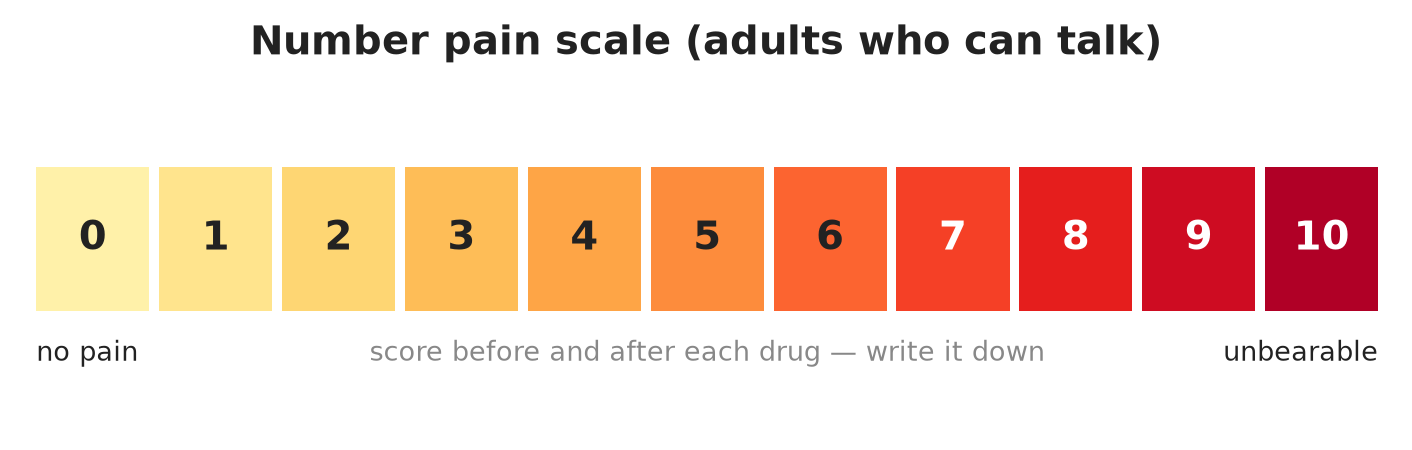
| Number scale | Adults who can talk | 0 = no pain → 10 = unbearable |
| Face scale | Language barriers | Patient points at a smiling-to-crying face |
| FLACC | Neonates and infants | Face, Legs, Activity, Cry, Consolability |
- Score the pain before and after each drug and write it down.
- Untreated pain slows healing — treat it.
The Analgesic Ladder
In short: start with the mildest painkiller that could work and step up one rung at a time, only if the pain is not controlled.
The on-board ladder
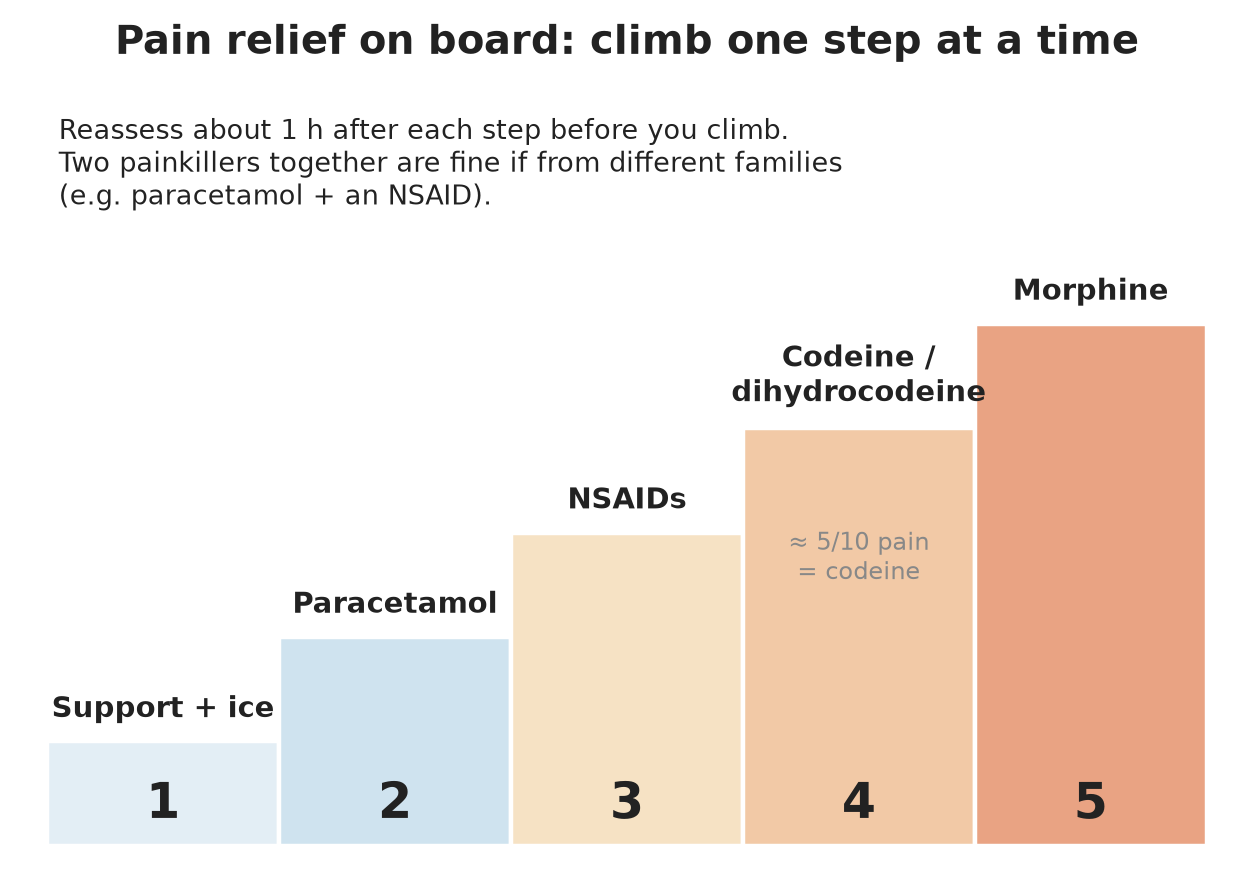
- Support + ice first.
- Paracetamol.
- NSAIDs (COX-1 or COX-2).
- Codeine / dihydrocodeine — about 5/10 pain is codeine territory.
- Morphine — last rung. The SCMG tends to reach for it too early.
- Reassess about 1 h after each step before escalating.
- Two painkillers together are fine if they are from different families (e.g. paracetamol + an NSAID).
The WHO pain ladder (1986)
| Step | Pain | Treatment |
|---|---|---|
| 1 | Mild | Non-opioid ± adjuvant |
| 2 | Mild to moderate | ‘Weak’ opioid ± non-opioid ± adjuvant |
| 3 | Moderate to severe | ‘Strong’ opioid ± non-opioid ± adjuvant |
- Patients begin at the first rung and move up rung by rung as the pain worsens — the best effect without jumping to strong treatment.
RICE for muscle and joint pain
- Rest · Ice · Compression of the limb or joint · Elevation.
- It reduces swelling (inflammation) → it reduces pain.
On the bridge: a rib fracture
- Paracetamol → a short NSAID course → codeine. Not straight to morphine.
- Treat the pain properly: a casualty who breathes shallowly to avoid pain can develop a chest infection.
Climb the ladder, don’t jump it — one rung at a time, reassess before stepping up.
NSAID and Opioid Safety
In short: NSAIDs hurt the stomach and slow bone healing; opioids can stop breathing. Know the limits of both.
NSAIDs
- NSAIDs (e.g. diclofenac, naproxen) only work on inflammatory pain. Avoid in asthma.
- COX-1 NSAIDs (e.g. diclofenac, ketoprofen, dexketoprofen) → stomach ulcers and raised BP. Avoid if over 60 or with a stomach history.
- COX-2 NSAIDs (e.g. Celebrex, Arcoxia) are kinder to the stomach.
- Add PPI stomach protection to any NSAID course. Ibuprofen is the mildest.
- NSAIDs delay fracture healing — use for about 7 days at most with a fracture.
- Diclofenac suppositories for renal colic or a patient who is vomiting.
Morphine and other opioids
- The SCMG gives 10 mg. Medical trainers warn that 10 mg can cause fatal respiratory depression in a person not used to opioids — titrate low instead (see Injections below).
- Always by injection and with an antiemetic.
- Naloxone, the antidote, is carried on board.
- Overdose signs: drowsy, pinpoint pupils, breathing slowing down → stop, support the airway.
Morphine: low dose first, antiemetic with it, naloxone ready, and watch the breathing and the pupils.
Injections and Drug Administration
In short: pick the route, angle and site, draw up the right dose, aspirate, and record what you gave and where.
Routes and angles
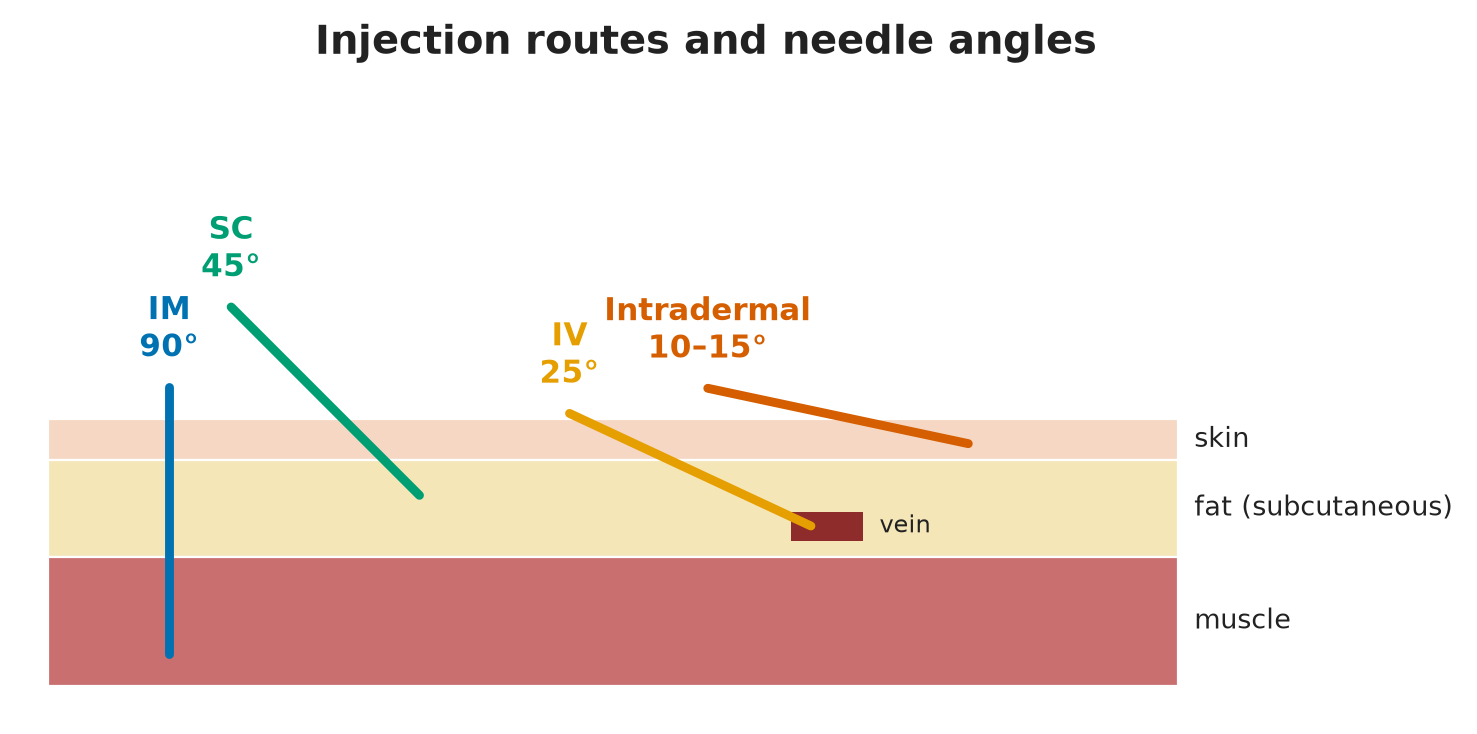
| Route | Needle angle |
|---|---|
| IM (intramuscular) | 90° |
| SC (subcutaneous) | 45° |
| IV (intravenous) | 25° |
| Intradermal | 10–15° |
Step by step: IM or SC injection
- Choose the route and angle.
- Choose the site: deltoid (max 2–3 ml) · buttock, upper-outer quadrant (keeps clear of the sciatic nerve) · thigh.
- Reconstitute if needed: 1 g vial + 10 ml → 500 mg = 5 ml. Expel the air bubbles.
- Oily injections (e.g. benzathine penicillin): put a warm wet cloth on the site first.
- Insert the needle, leaving a little of it outside the skin — so you can pull it out if it breaks.
- Always aspirate. Blood → discard and restart.
- Insulin-type syringes are graded in UNITS and are for SC only.
Worked example: morphine
- Ampoule: 10 mg in 1 ml.
- Dilute to 10 ml → now 1 mg per ml.
- Give 3 ml (3 mg) first, then titrate up against the pain score.
- Prepare naloxone BEFORE you give the morphine.
Intraosseous (IO) access
- When no vein can be found: the proximal tibia, on the bump below the knee, with a spring-loaded device — SCMG p. 226.
⚡ Flashcards
Test yourself, one card at a timeQ1How must the ship's medicine cupboard be organised under MSN 1905?
AnswerSeparate cupboards or drawers per drug group · a small fridge · Class A (controlled) drugs locked away and logged separately · every medicine referenced to Schedule 5 · expiry dates checked and noted.
Common trapTrap: moving tablets into another container — never change the drugs’ containers.
Q2How often are the medical stores checked, and by whom?
AnswerWeekly or monthly by the crew member in charge, plus at least one check a year by a qualified pharmacist. Record and replace everything used.
Common trapTrap: MSN 1905 (M+F) Amendment 5 only asks for an annual review by a competent person — it does not say a pharmacist.
Q3What are medical stores Categories A, B and C?
AnswerA = sea-going, no limit on voyage length · B = trips under 150 NM from the nearest port (175 NM if always in helicopter range) · C = harbour vessels and craft very close to shore (UK: not more than 60 NM from a safe haven) — MSN 1905 (M+F).
Common trapTrap: B is not “coastal” in general — the figure is 150 NM.
Q4How are narcotics such as morphine bought, stored and recorded?
AnswerBought in-country only · locked in the captain’s safe · separate register, double signature (captain + patient) for every movement · expired stock returned against signature. Port health may inspect.
Common trapTrap: narcotics cannot be shipped to the next port by the agent — other medicines can.
Q5What is in a first-aid box, and where are the boxes kept?
AnswerIodine solution, 1 large + 2 medium + 4 small dressings, 8 triangular bandages, cotton wool, safety pins, plaster, scissors, pencil and paper. One in the medicine locker, others at strategic points. Crew over 20 → an emergency medical outfit.
Common trapTrap: spare boxes get used or pilfered without a report — check contents routinely.
Q6Which seasickness drug suits a crew member who must keep working, and why?
AnswerDomperidone — no drowsiness, safe for crew running machinery. Pick drugs whose side effects help (codeine: pain + diarrhoea).
Common trapTrap: reading the side effects aloud to the casualty — the nocebo effect.
Q7A crew member is allergic to penicillin. Which antibiotic, and can you use an expired drug?
AnswerErythromycin is the standard alternative; azithromycin is now preferred (3-day, once-daily course). About 1 month past expiry → ask the TMAS doctor.
Common trapTrap: “wide-spectrum” does not mean it covers all bacteria — and overuse breeds resistance.
Q8How do you measure pain in an adult, a non-English speaker and a baby?
AnswerAdult: number scale 0–10 · language barrier: face scale · neonate or infant: FLACC (Face, Legs, Activity, Cry, Consolability).
Common trapTrap: assuming everyone feels the same injury the same way — pain varies between patients.
Q9What is the analgesic ladder?
AnswerParacetamol → NSAIDs → codeine/dihydrocodeine → morphine. Start on the first rung, step up only if pain is not controlled, reassess about 1 h after each step. WHO ladder (1986): 3 steps.
Common trapTrap: jumping straight to morphine — climb, don’t jump.
Q10When should you avoid an NSAID such as diclofenac?
AnswerIn asthma, over 60 or with a stomach history (COX-1 → ulcers, raised BP); with fractures no more than about 7 days. Add a PPI with any course; ibuprofen is the mildest.
Common trapTrap: NSAIDs only work on inflammatory pain.
Q11How do you give morphine safely on board?
AnswerTitrate low: 10 mg/1 ml ampoule → dilute to 10 ml, give 3 ml (3 mg) first, then step up. By injection, with an antiemetic; have naloxone ready first.
Common trapTrap: the SCMG’s 10 mg can cause fatal breathing depression in someone not used to opioids. Watch for pinpoint pupils.
Q12What needle angle and site do you use for an IM injection, and what must you always do?
AnswerIM 90° (SC 45°, IV 25°, intradermal 10–15°). Deltoid max 2–3 ml, buttock upper-outer quadrant, or thigh. Always aspirate.
Common trapTrap: blood in the syringe → discard and restart, never inject.
📚 Resources
Books
- The Ship Captain’s Medical Guide — Maritime and Coastguard Agency, 24th edition (2024); medicines, doses and the medical stores lists
- International Medical Guide for Ships — WHO on behalf of ILO, IMO and WHO, 3rd edition, including the ship’s medicine chest
Regulations
- MSN 1905 (M+F) Amendment 5 — ships’ medical stores — vessel categories A, B and C, minimum stores, controlled drugs register, annual review
- MIN 718 (M+F) — The Ship Captain’s Medical Guide 24th edition — what changed in the new edition
- WHO three-step analgesic ladder (1986) — consult in the WHO pain-management guidance
Exam focus — MCA
Typical questions: “How do you manage the medical stores on your vessel?” · “What is a Category B vessel?” · “How do you store and record morphine?” · “A crew member has a broken rib — how do you control the pain?” · “Show me how you give an IM injection, and how you would draw up 3 mg of morphine.”
What examiners want: MSN 1905 by name; separate cupboards, fridge, locked Class A drugs with a separate log, original containers, expiry checks, weekly/monthly checks + annual review, record and replace; Category B = under 150 NM; narcotics in the captain’s safe with a double-signed register; pain scored on a 0–10 scale, then the ladder one rung at a time, reassessed after about 1 h; NSAID cautions (asthma, over 60, stomach, fractures); morphine titrated low with an antiemetic and naloxone ready; IM 90°, deltoid max 2–3 ml, upper-outer buttock, always aspirate.