Emergency Response, Radio Medical Advice and Medical Records
MedicalHow to take charge of a medical emergency on board: scene safety, the primary and secondary surveys, ongoing care with the R's, a PAN-PAN radio medical advice call in ISBAR order, and the medical report. Getting this sequence right protects the casualty at sea and is the backbone of the MCA medical care scenario.
Last reviewed 1 Nov 2026 · From a professional captain's years of study notes · Organised with AI and checked against current regulations · How we write
On this page (11)
Initial response and the primary survey
In short: make the scene safe, find and fix what kills first, call for help early — then go round again.
- Three first priorities: scene safety → patient assessment → call for help from the Telemedical Assistance Service (TMAS).
- Know your kit before you need it. Every crew member must know where the first-aid kits are (bridge, galley, other strategic points) and where the AED is (usually the bridge). The Chief Mate or medical officer briefs new crew on joining.
- Primary survey goal: find and treat immediately life-threatening problems in priority order. Fast, always the same order. Do not move on until each step is managed.
- DRSABC:
- D — Danger: is it safe for you, bystanders and the casualty?
- R — Response: use AVPU — Alert · responds to Voice · responds to Pain · Unresponsive.
- S — Shout for help.
- A — Airway: head tilt–chin lift, clear any obstruction; use an adjunct (Guedel/OPA or NPA) if needed.
- B — Breathing: look, listen and feel for up to 10 s. Not breathing normally → CPR.
- C — Circulation: signs of circulation; catastrophic bleeding is controlled at once.
- Repeat the survey after every intervention or change in condition.
- DRSABC or DRABC? Same sequence. Some schemes write the “S” (Shout for help), some leave it out.
- On the bridge: a crew member collapses in the engine room. The OOW sends help, but the first person on scene checks for running machinery, fumes or electrical danger before touching the casualty.
The B.B.C. Foreign Service Routine (DR BBCFS)
In short: an older UK maritime mnemonic for the primary survey that adds bleeding, burns, fractures and shock to the checklist.
- Danger — is it safe to approach?
- Response — is the casualty responsive?
- B — Breathing
- B — Bleeding / Burns
- C — Consciousness
- F — Fractures
- S — Shock
- It is an alternative to ABCDE. DR BBCFS, plus the signs, symptoms and history, forms the assessment base for everything that follows (the R’s, the report, the radio call).
- The same routine is adapted to special cases — e.g. for an electrical injury, Danger includes “is the power off?” and Breathing includes possible cardiac arrest.
The secondary survey
In short: once the casualty is stable, search head to toe for everything the primary survey missed, take a history and a baseline set of vital signs.
- Only after the primary survey — life threats managed, casualty stable.
- Structure — ABCDE: Airway · Breathing · Circulation · Disability (consciousness — AVPU/GCS) · Everything else (skin, bones — full exposure).
- Head-to-toe, front and back: head, neck, chest, abdomen, pelvis, limbs. Look for bleeding, deformity, swelling, bruising, tenderness. Compare left with right; move limbs one at a time.
- Fractures: arteries run over the long bones and lie closest to the skin near joints → always check circulation beyond a fracture (distal pulse, CRT).
- Chest: wheeze on breathing out → asthma/anaphylaxis · gurgling → fluid · uneven movement → partial or total lung collapse · flail chest = ribs broken in more than one place, segment moves paradoxically.
- Abdomen (percussion): hollow/sharp = air · dull = fluid or solid · rigid (“hot belly”) = problem.
- Pelvis (always after a fall from height): gentle sideways push only. Any give = fracture = critical. Compare leg lengths.
- Look for medical bracelets or necklaces; always record right vs left.
- History — SAMPLE: Signs & symptoms · Allergies · Medications · Past medical history · Last meal/drink · Events leading up to it.
- Vital signs (baseline, then repeat): breathing rate, pulse, SpO₂, temperature, skin colour, AVPU, pupils.
- Capillary refill time (CRT): press the fingertip/nail for 5 s until white, release → colour back within 2 s = normal; over 2 s = poor perfusion (shock, bleeding, dehydration). Cold slows refill even in healthy people — test a warm area or the sternum.
- Disability — what to look for: abnormal gait or behaviour · weakness of a limb or the face (floppy and/or uneven) · speech problems · pupils and eyesight.
- Pupils unequal → raised pressure inside the skull · one fixed (no light reaction) → pressure on that optic nerve · both pinpoint and sluggish → opioid/drug poisoning.
- Quick tests: heel-to-toe walk, a two-part command (“stick your tongue out AND touch your nose”), one-sided weakness, slurred speech.
- Exposure — history of the injury: mechanism, time, injuries and aftermath. For a head injury: when? remembers everything? loss of consciousness? nausea/vomiting? headache? fits, blurred vision, speech or movement problems? discharge from nose or ears? witnessed?
- Examine the relevant areas, then keep reassessing: monitor vitals, keep the charts up to date.
- Finish with Radio Medical Advice and record everything — you need it for the call and for handover.
- Full method for history taking and system examination: see the related topic Patient Assessment: History Taking and Examination.
Adrenaline masks bleeding. Deep cuts may not bleed until the casualty’s adrenaline wears off — that is why the secondary survey must be thorough.
- Red flags: hiccups lasting 2 h or more after abdominal trauma = possible internal (spleen) bleed · bruising behind the ears and around both eyes, or clear fluid (CSF) from nose, ear or mouth = base-of-skull fracture.
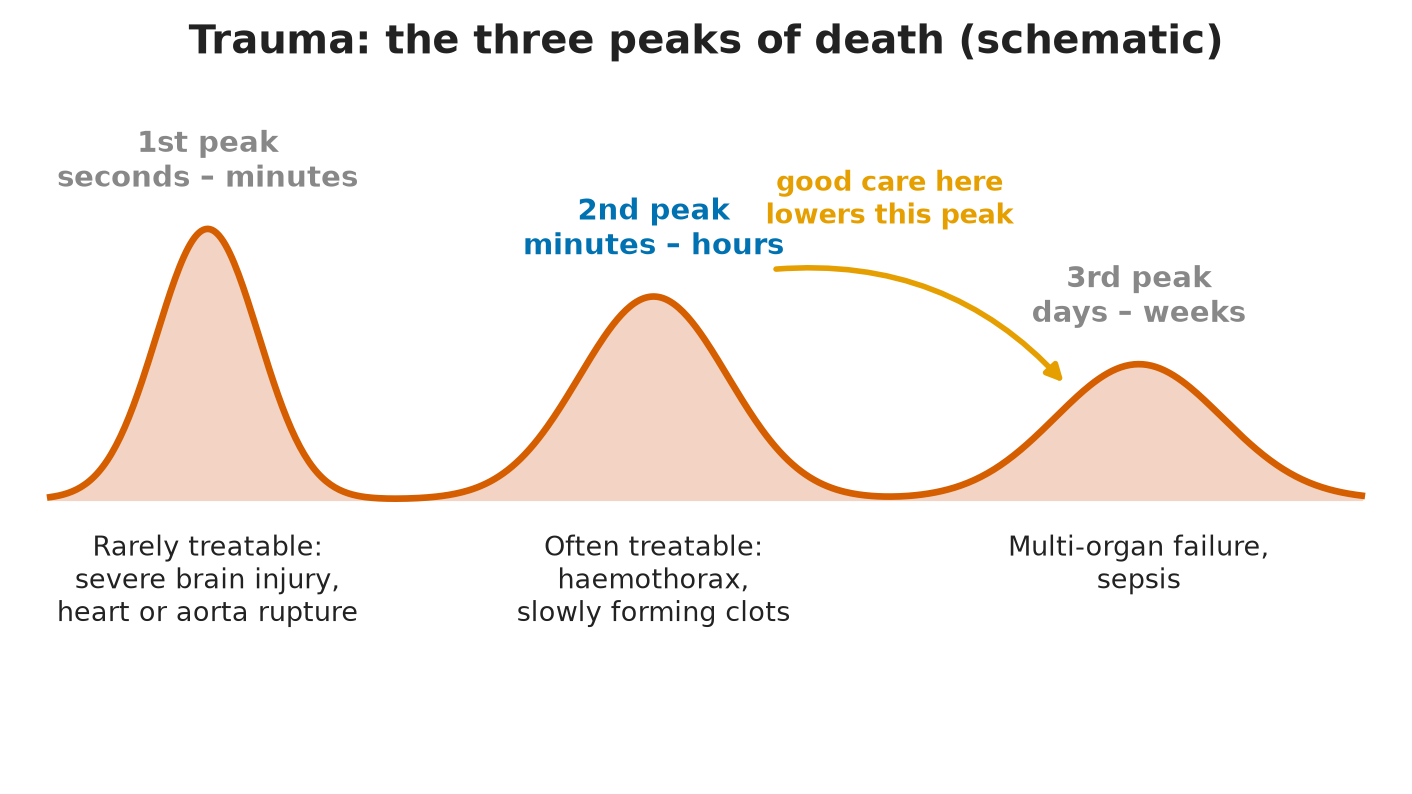
Trauma: the three peaks of death
In short: trauma deaths come in three waves; what you do in the first hours decides the third.
- Major trauma = physical injury that can cause prolonged disability. Traumatic injury = injury from an external force that does not reach the level of major trauma.
- 1st peak — seconds to minutes: instantly fatal, rarely treatable. Severe brain injury; high spinal cord injury → stops breathing; heart rupture; aortic or major vessel rupture → massive blood loss.
- 2nd peak — minutes to hours: often treatable with early, rapid assessment and treatment. Haemothorax → poor ventilation; head injury → subdural/extradural haematoma (slowly forming blood clots).
- 3rd peak — days to weeks: multi-organ failure, severe infection/sepsis. The outcome reflects the care given before this peak; it is much reduced by continuous assessment and treatment during the 2nd peak.
- Aims of initial management:
- Recognise the injuries.
- Monitor the condition so problems are spotted early.
- Treat the active problem and prevent further damage.
- Give pain relief.
The R’s of medical care and nursing on board
In short: after first aid comes medical care — a checklist of R’s that keeps the casualty safe, watched and documented until hand-over ashore.
- The R’s:
- Rest — nursing position, nursing area.
- Reassure — critical in the golden hour and until stable → set up a crew watch system.
- Recovery position? — if appropriate.
- Report — in the Ship’s Official Logbook, then Radio Medical Advice if needed.
- Record — the observations list (see Medical records below).
- Responses — how the casualty responds to treatment.
- Reassess!
- Refer — to the Ship Captain’s Medical Guide (SCMG) and the medical stores rules (MSN 1905 (M+F); Malta: MLC S.L.234.51, Schedule 5).
- Radio Medical Advice.
- Sources differ on the stores reference: the R’s checklist cites MSN 1905 (M+F) and MSN 145 Schedule 5; the report form cites Schedule 5 / MSN 1768. MSN 1905 is the notice that replaced MSN 1768 — use the current one.
- Hygiene: full or assisted bed care, toileting, light sponge bed-wash, check for bedsores.
- Nutrition: nil by mouth? No smoking, alcohol or red meat. Easily digested food: clear soup first, then small portions (chicken, mashed potato). Nil by mouth if surgery is possible. After 2–3 days on board consider IV fluids (saline/Ringer-type — volume only, it “mimics plasma”).
- Vomiting or dehydrated: small, frequent sips (straw, every few minutes) — never a full glass.
- Nursing checks: reassure, insulate, watch for sweating, hot/cold and colour.
- Prolonged care = nursing care: prevent pressure sores, help mobility, watch for deterioration.
- Nursing care plan (until evacuation): minimise exertion · assist (don’t just allow) trips to the toilet · fluids in/out chart · pressure-area checks (redness) · hygiene · O₂ by face mask · call bell.
- Scenario method: write the signs and symptoms → immediate actions → ongoing nursing care plan.
Dose range rule: given a range (e.g. 6–20 mg), start low or middle. You cannot take back a dose, but you can always add more.
Route rule: never give an IM preparation IV, or an IV preparation IM — check the vial label.
- Trust the look: a casualty who “looks sick” with normal readings is sick — the body compensates until late. Keep a low threshold for Radio Medical Advice.
Radio Medical Advice: PAN-PAN or MAYDAY
In short: most medical calls are urgency (PAN-PAN); MAYDAY is only for an imminent threat to life.
- In the UK, the master or skipper calls HM Coastguard first; the Coastguard connects the ship to a TMAS doctor (MGN 623 (M+F) Amendment 1). TMAS was formerly called radio medical advice.
| Call | When | Examples |
|---|---|---|
| PAN-PAN (urgency) | You need medical advice or assistance; a TMAS doctor guides you by radio | Most medical cases · amputation with bleeding controlled (needs hospital, but you have time) |
| MAYDAY (distress) | Imminent risk to life | Cardiac arrest in progress · pelvic fracture (can kill in minutes) |
- Needing a medevac does not, by itself, make it a MAYDAY. The imminent threat to life does.
- Follow-up calls: always quote the TMAS case number.
Making the call: ISBAR
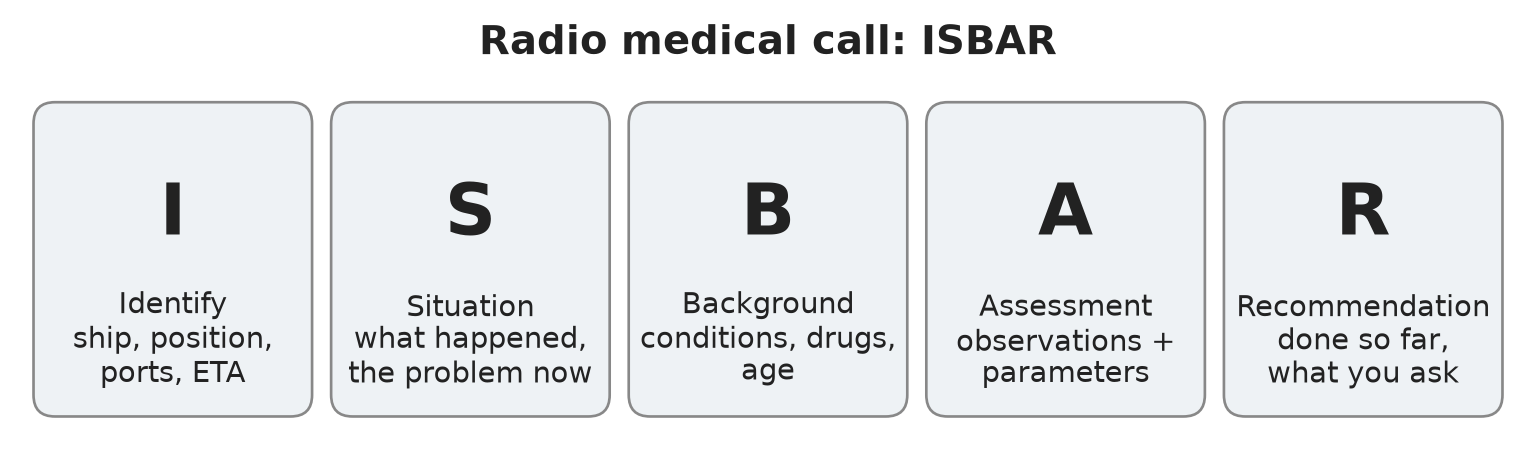
In short: assess first, then give the doctor a short, ordered picture — Identify, Situation, Background, Assessment, Recommendation.
- Assess first. Before calling, complete a proper assessment and have parameters taken as early as possible — the baseline shows whether the casualty is getting worse.
- Choose the call: PAN-PAN for most cases; MAYDAY only with imminent risk to life.
- I — Identify: ship, call sign, position, last port, next port and ETA. The doctor weighs how far you are from help.
- S — Situation: what happened and what the problem is now.
- B — Background: medical conditions, medications, age, ethnicity (some drugs act differently — e.g. salbutamol/Ventolin vs albuterol — and pain thresholds differ). Abdominal pain in a man of about 50+ → say so: it could be the aorta.
- A — Assessment: your observations (conscious? in pain? deteriorating?) plus the parameters.
- R — Recommendation: what you have done so far (position, drugs given…) and what you are asking for.
- Keep pen and paper by the radio; write the instructions down and read them back before ending the call.
- Follow-up calls → quote the case number.
- On the bridge: a crew member treated with antibiotics after a first TMAS call two days ago now has a higher fever, a worse cough and more breathlessness. Call again, quote the case number, and give the new readings against the old baseline in ISBAR order.
Medical records and the medical report
In short: the record feeds the radio call, protects you legally and travels with the patient — if it is not written, it was not done.
- Why it matters: basis for the TMAS call · legal evidence of the care given (it can protect you years later) · handover document when the patient reaches professional care.
- Minimum record — every case:
- Date and time
- Patient’s name, age and DOB, nationality
- Ship’s name and owner, ship’s position
- Assessment, findings and treatment
- Medication given, with times
- Precautions taken on board
- Radio Medical Advice received and action taken
- Identify the case fully: date and time, position, ship and owner, patient’s name, ID (Seafarer’s Registration No.), age, ethnicity, rank/position on board, and your own identification.
- Everyone should be able to fill it in — the casualty might be the Master.
- Mechanism of injury points the doctor to hidden injuries (“fracture after a 2 m fall”). Write what you actually see.
Report form — page 1: the initial report
- Patient’s name, DOB, ship, date, position.
- Mechanism of injury and the reported problem.
- History — check allergies; past problems and anything linked to today’s complaint.
- Signs (what you see) vs symptoms (what the patient feels).
- Rest — move to the nursing area, nursing position.
- Reassure at all times = set up a crew watch.
Report form — page 2: the ongoing record
- Observations every 15 min / 1 h / 24 h: temperature, pulse, respiration, blood pressure, pain __/10, Glasgow Coma Scale (eyes L/R, verbal, movement), urine and faeces checks, fluid chart in/out.
- Report in the ship’s logbook.
- Refer to the SCMG (note the page number) and the medical stores list.
- Radio Medical Advice.
- Medication log: ref · drug · given for · dose · route.
- Hygiene (toilet, wash, sheets, bedsores) · nutrition (by mouth, isotonic fluids, bland food — soup, rice, fish, chicken) · nursing checks (reassure, insulate, sweating, hot/cold, colour) and what to watch for.
Writing rules
- Name and surname on every sheet; entries in time order with date and time.
- Write the history in a linear, detailed way (not summarised), under headings: PC (presenting complaint), HOPC (history of presenting complaint), PMH (past medical history). Bullet points are fine if clear.
- Record positives and negatives; keep signs vs symptoms apart; note the source of information (e.g. “per husband”).
- Stick-man diagram for injury sites; fluid-balance chart whenever an IV is running (all in vs all out).
- Drugs: log the SCMG category (e.g. adrenaline = 1A), dose, route and injection site; cite the page of the book used.
- Medications signed by the Master plus one other person in charge of medical care; record the crew-watch rotation.
- IV cannula: record the gauge.
“What is not written was not done.”
⚡ Flashcards
Test yourself, one card at a timeQ1What are your first three priorities at any medical emergency on board?
AnswerScene safety → assess the casualty → call for help (TMAS, via the Coastguard).
Common trapTrap: rushing in before checking the danger to yourself.
Q2What does DRSABC stand for, and when do you go through it again?
AnswerDanger · Response (AVPU) · Shout for help · Airway · Breathing (max 10 s) · Circulation. Repeat after every intervention or any change in the casualty.
Common trapTrap: thinking DRABC is a different system — it is the same, the S is just not always written.
Q3What is the B.B.C. Foreign Service Routine?
AnswerDR BBCFS: Danger · Response · Breathing · Bleeding/Burns · Consciousness · Fractures · Shock. An older UK maritime primary-survey mnemonic, still used as the assessment base.
Q4When do you start the secondary survey, and what does SAMPLE mean?
AnswerOnly when life threats are managed. Head-to-toe, front and back, ABCDE. SAMPLE = Signs/symptoms · Allergies · Medications · Past history · Last meal/drink · Events.
Common trapTrap: trusting a wound that is not bleeding — adrenaline masks bleeding.
Q5What is a normal capillary refill time and how do you test it?
AnswerPress the nail 5 s, release: colour back in 2 s or less. Longer = poor perfusion (shock, bleeding, dehydration).
Common trapTrap: testing cold fingers — use a warm area or the sternum.
Q6What are the three peaks of death after trauma?
Answer1st seconds–minutes (rarely treatable) · 2nd minutes–hours (treatable: fast assessment) · 3rd days–weeks (multi-organ failure, sepsis). Good care in the 2nd peak shrinks the 3rd.
Q7Name the R's of ongoing medical care.
AnswerRest · Reassure · Recovery position? · Report · Record · Responses · Reassess · Refer · Radio Medical Advice.
Common trapTrap: forgetting to set up a crew watch — reassurance must be continuous.
Q8PAN-PAN or MAYDAY for a medical case?
AnswerPAN-PAN for most cases. MAYDAY only with imminent risk to life (cardiac arrest in progress, pelvic fracture).
Common trapTrap: a medevac on its own does not make it a MAYDAY; a controlled amputation is PAN-PAN.
Q9In what order do you pass information to the TMAS doctor?
AnswerISBAR: Identify · Situation · Background · Assessment · Recommendation. Pen and paper by the radio, read the advice back, quote the case number on follow-ups.
Q10What must every medical report contain?
AnswerDate/time · patient name, age, DOB, nationality · ship, owner, position · assessment, findings, treatment · drugs and times · precautions · radio advice and action taken.
Common trapTrap: “I’ll write it later” — what is not written was not done.
Q11How often do you record observations, and where do you report the case?
AnswerEvery 15 min / 1 h / 24 h as the case needs: temp, pulse, resp, BP, pain /10, GCS, urine, fluid in/out. Report in the Ship’s Official Logbook.
📚 Resources
Video
- ISBAR Patient Safety — Janet Beer (YouTube): the ISBAR handover structure in a clinical setting.
Books
- The Ship Captain’s Medical Guide, 24th edition (2024), Maritime and Coastguard Agency — see MIN 718 (M+F) The ship captain’s medical guide 24th edition.
- International Medical Guide for Ships, 3rd edition (2007), World Health Organization (with ILO and IMO).
Regulations
- MGN 623 (M+F) Amendment 1: Telemedical Advice Service (TMAS) for ships at sea — how to get medical advice at sea via HM Coastguard.
- MSN 1905 (M+F) Amendment 5: ships’ medical stores — the minimum medical stores to carry.
- Malta: MLC S.L.234.51, Schedule 5 (medical stores).
Exam focus — MCA
Typical questions: “You find a crew member collapsed — talk me through your actions” (scene safety, DRSABC or DR BBCFS, then the secondary survey). “Is this a PAN-PAN or a MAYDAY?” (imminent threat to life only for MAYDAY; a medevac alone is not enough). “What will you tell the TMAS doctor?” (ISBAR, with position, ETA and baseline parameters). “What goes in the medical report and the logbook?” (the minimum record, observations every 15 min / 1 h / 24 h, drugs with SCMG category, dose and route). Examiners want a fixed order, early help, repeated reassessment and written records. The written scenario is solved with the Ship Captain’s Medical Guide and a medical report form — practise filling one in.