CPR, AED and Choking
MedicalAdult, child and infant CPR, AED use and shockable rhythms, adrenaline in advanced life support, and choking treatment for every age group. These are the first-response skills that keep a casualty alive at sea until radio medical advice or evacuation, and a core part of the MCA medical exam.
Last reviewed 1 Nov 2026 · From a professional captain's years of study notes · Organised with AI and checked against current regulations · How we write
On this page (13)
Starting CPR — the DRSABC checks
In short: make the scene safe, check response, open the airway, check breathing for 10 s — not breathing normally means CPR and the AED.
- D — Danger: make the scene safe. The only treatment that comes before CPR is catastrophic bleeding: compressions push blood out of a major bleed, so stop it first.
- R — Response (AVPU): give a command first (“open your eyes”, “squeeze my hand”), then a pain stimulus — trapezius squeeze or sternal rub. Never test on an injured side: you would misread the response. Shout for help.
- Infant (under 1 year): they cannot answer — stimulate the sole of the foot and watch for the reflex. No reaction = unconscious.
- A — Airway: head tilt–chin lift. Suspected spine injury → jaw thrust instead. After opening the airway, always re-check breathing and don’t let go of the head tilt.
- Finger sweep only if you can see the object: come in from the side, get behind it and scoop it out. Never push straight down.
- B — Breathing: look-listen-feel for 10 s; expect at least 2 breaths (normal adult rate 12–20/min).
- Agonal breaths are brainstem gasps — wide apart, chest does not rise. They are not breathing: start CPR.
- Drowning, hypothermia and drug overdose can look like death → check breathing for 1 full minute before deciding.
- C — Not breathing: send someone for the AED and call for help. Alone and the AED is far away → start CPR and send someone else as soon as you can.
| Age | Normal breathing rate |
|---|---|
| Newborn | about 50/min |
| 1 year | about 30–35/min |
| Toddler | about 25–30/min |
| From about 8 years | close to adult (12–20/min) |
Adult CPR technique
In short: 30 hard, fast compressions, 2 breaths, repeat — with as few pauses as possible until the AED arrives.
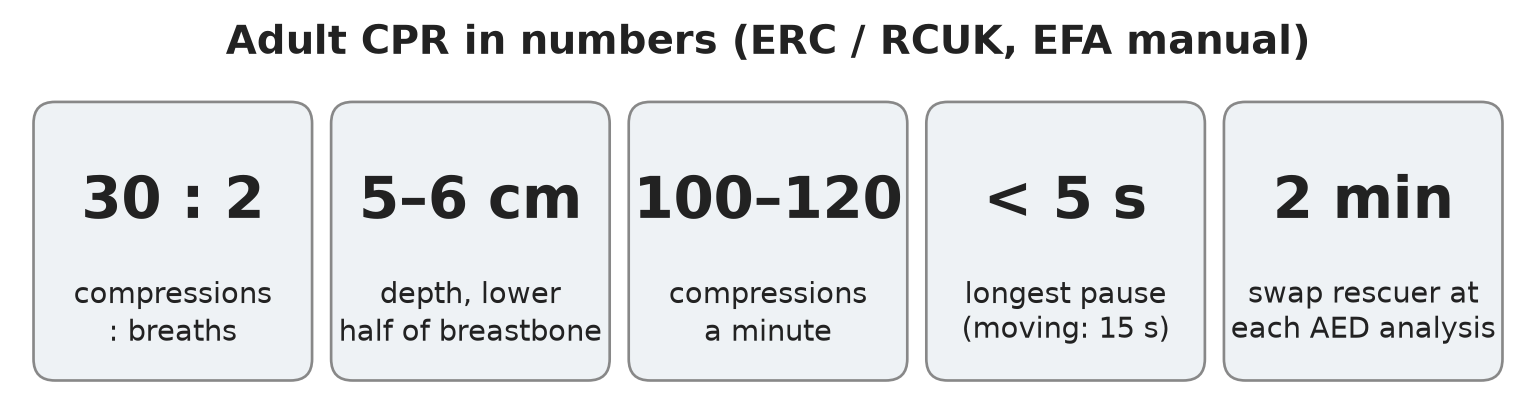
- 30 compressions: two hands interlocked on the centre of the chest (lower half of the breastbone), arms straight, shoulders over your hands. Depth 5–6 cm, rate 100–120/min (ERC/RCUK adult BLS).
- 2 ventilations with a pocket mask or bag-valve-mask; add O2 at 15 L/min + reservoir if available.
- Can’t ventilate? Do compressions-only without stopping while someone else sorts out the airway. Never stop and wait.
- Never interrupt CPR for more than 5 s. Only exception: moving the casualty — max 15 s per interruption (EFA manual V1.3).
- Why speed matters: after a cardiac arrest the pupils dilate within 45–60 s (fixed, no reaction to light); brain damage is possible after 4–6 min without oxygen and very likely beyond 6 min (EFA manual V1.3).
- About 80% of cardiac arrests are caused by heart disease.
- Vomit during compressions (air forced into the stomach): clear the mouth — finger sweep or suction pump — before the next breaths.
- Water in the lungs does not change the CPR method.
- After ROSC (return of spontaneous circulation): the casualty can easily re-arrest → keep monitoring and leave the AED pads on. Re-check the body: cuts start bleeding again once pressure returns. Paramedics’ first move would be IV access.
- When to stop CPR: only when the radio medical doctor says so, or when you are physically too exhausted to continue. Otherwise keep going until the casualty recovers or help takes over.
- Practical tip: with enough crew, swap the person doing compressions at each 2-min AED analysis — tired rescuers give shallow compressions.
Child and infant CPR
In short: children usually arrest because of a breathing problem, so give oxygen first — 5 rescue breaths — then compress more gently.
- Why different: in children and infants the cause is usually respiratory, so ventilations come first.
- Memory hook: CPR starts 30:2 — but drowning and children start with 5 rescue breaths.
- Infant airway: keep the head neutral. A big tongue, large tonsils and almost no neck mean a full head tilt closes the airway. Child: normal head tilt–chin lift.
- Breathing check: 10 s, same as an adult.
- 5 initial rescue breaths. Infant: cover mouth AND nose together and give only the air in your cheeks — gentle puffs. Over-inflating damages the lungs.
- Compressions, 100–120/min:
- Child (1 year – puberty): heel of one hand, centre of the chest, about 5 cm. Add the second hand only if you can’t reach the depth — full adult weight can crack a child’s ribs.
- Infant (under 1 year): two fingers on the lower breastbone, just below the nipple line, about 4 cm — or the two-thumb encircling technique (hands round the chest, thumbs compress), now encouraged.
- Ratio: 30:2 if you are alone, 15:2 with two rescuers. Sources differ here: some teach 15:2 straight after the 5 rescue breaths, whatever the number of rescuers (the healthcare-provider ratio).
- Alone? Give 1 minute of CPR before leaving to call for help.
- AED, child 1–8 years: paediatric pads or mode if available; otherwise adult pads — one on the front centre of the chest, one on the back.
Ventilation and oxygen during CPR
In short: a casualty who is not breathing needs air pushed in — a pocket mask or bag-valve-mask — and oxygen makes those breaths richer.
- O2 is no substitute for ventilation: if the casualty is not breathing you need a bag-valve-mask (AMBU), not just an oxygen mask.
- Resuscitation O2: 15 L/min with BVM + reservoir → about 90% O2, the highest you can deliver on board.
- Pocket mask: kept in the AED pouch with 2 sets of gloves, scissors, a shaver and a swab. One-way valve; needs a complete seal — press down and keep the head tilt. Don’t remove it between compressions.
- Two rescuers with a BVM: the ventilator kneels behind the head. Never ventilate during a compression — talk to each other and count aloud.
- When to give O2: hypoxia (SpO2 below 94%) — cardiac arrest/resuscitation, respiratory distress, severe asthma, anaphylaxis, shock, major trauma, drowning.
- Always 100%: CO poisoning and smoke inhalation (the pulse oximeter reads carboxyhaemoglobin as oxygen → falsely normal reading), decompression illness in divers.
- Target SpO2 94–98%. Exception, chronic COPD: 88–92% — CO2 retention can depress breathing, so titrate the flow.
- Practical flows: standard therapy 4–6 L/min; resuscitation 15 L/min with BVM + reservoir; nasal prongs for non-critical casualties or when a mask isn’t tolerated (or hold the mask just off the face).
| Flow (simple mask) | Approx. O2 | Typical use |
|---|---|---|
| 2 L/min | 28% | |
| 4 L/min | 40% | |
| 6 L/min | 53% | Breathing casualty with low O2 |
| 8 L/min | 60% | |
| 10 L/min | 67% | CPR |
| 12 L/min | 75% | |
| 15 L/min | just under 100% |
Oxygen hazards and cylinder care on board
- 🔥 Fire: O2 supports combustion — no grease or oil on fittings, no naked flames, ventilate the space.
- ⏳ Limited supply: work out cylinder endurance = pressure × volume ÷ flow.
- 💨 Dry gas: dries the mucous membranes with prolonged use → humidify.
- Kit: oxygen D cylinder + multiflow regulator.
- Identification: medical O2 cylinders are black with white shoulders — never use any other colour. Don’t trust cylinder colours abroad (the US and India use different codes).
- Maintenance: checks monthly on board; hydraulic test every 5 years; service every 3 years; O2 refilled annually.
- Fitting the regulator: crack (flush) the valve briefly first to clear debris; check for dents, rust and leaks; hand-tighten only, no spanners; carry about 6 spare Bodok washers.
- Defective cylinder: empty it slowly outdoors, never refill it; keep empties apart from full ones.
- Pin Index system (legacy): older cylinder–regulator connection with an oxygen-specific two-pin connector (pin positions differ for each gas, so the wrong regulator cannot fit) plus a Bodok seal (washer between cylinder valve and regulator yoke). Still found on older cylinders.
Airway adjuncts — OPA (Guedel) and NPA
In short: adjuncts hold the airway open behind the tongue; the rigid OPA is for the deeply unconscious, the soft NPA for those who still gag.
Oropharyngeal airway (OPA, Guedel)
- What: rigid curved tube in the mouth; keeps the tongue off the back of the throat (posterior pharyngeal wall).
- When: ONLY on a completely unconscious casualty with no gag reflex. Reacts, coughs or gags → remove at once (risk of vomiting, laryngospasm, aspiration).
- Gagging = not fully unconscious → stop. Spitting it out = regaining consciousness.
- Sizing: hold it against the cheek — corner of the mouth to the angle of the jaw. Wrong size makes things worse: too short pushes the tongue back, too long can trigger laryngospasm.
- Insertion, adult: in upside down (concave side to the palate), then rotate 180° as it reaches the soft palate. Push until the flange rests on the teeth; secure with ribbons tied loosely.
- Insertion, child: straight in, in the final position, using a tongue depressor (the palate is more delicate).
- On board: often only 2 sizes — 6 (red) and 7 (yellow), the commonest adult sizes — not the full set.
Nasopharyngeal airway (NPA)
- What: soft, flexible tube through the nostril down to the pharynx; keeps the airway open behind the tongue. Trumpet flange (or a safety pin through it) stops it slipping into the nose.
- Key advantage: tolerated by semi-conscious casualties with a gag reflex — clenched jaw, trismus, mouth injuries. Use it when an OPA cannot be used.
- Choose it when airway swelling is expected — e.g. facial burns or blast injury: dramatic swelling within about 10 min.
- Sizing: length from the nostril to the tragus of the ear; diameter roughly the casualty’s little finger. Average adult male ≈ size 7. Comes with its own lubricant.
- Insertion: lubricate well; right nostril first, bevel towards the septum; advance gently with a slight twist along the floor of the nose (straight back, NOT upwards). Resistance → try the other nostril; never force.
- Contraindication: suspected basal skull fracture — head injury with CSF/blood from the nose or ears, raccoon eyes, Battle’s sign — the tube could enter the skull. Caution with nasal fractures and bleeding disorders.
- Risks: nosebleed is the commonest complication; too long a tube can cause gagging or vomiting.
- Neither OPA nor NPA protects against aspiration of vomit → an unconscious breathing casualty goes in the recovery position with continuous monitoring.
- Adjuncts only keep the airway open — no O2 attaches to them; suction through them if blocked.
- Supraglottic airways (i-gel type) exist and some yachts carry them.
The heart’s electrical system and shockable rhythms
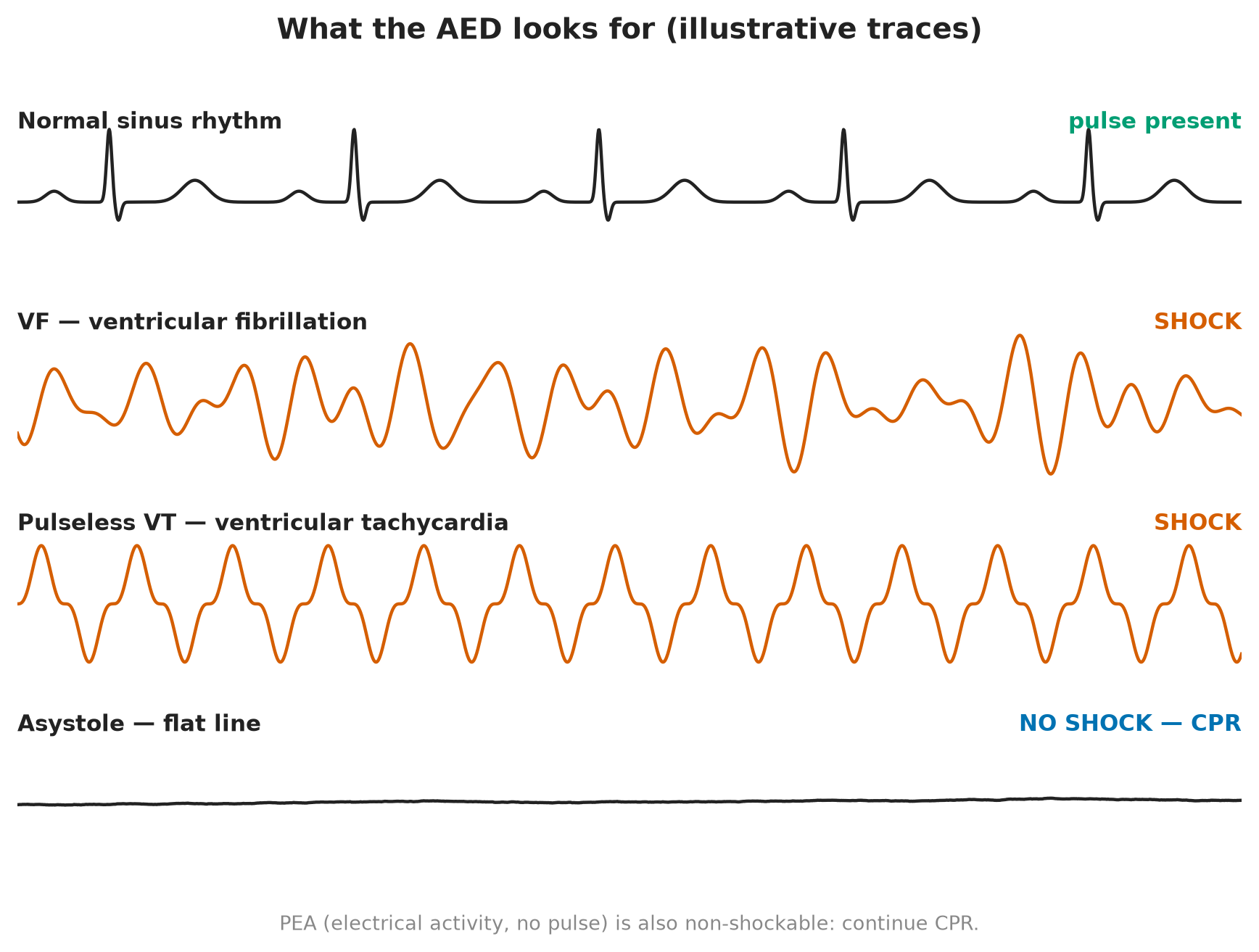
In short: an AED can only fix an electrical rhythm that is chaotic (VF) or too fast to pump (pulseless VT); a flat line needs CPR, not a shock.
- Conduction path: SA node (sinoatrial — the natural pacemaker, in the right atrium) fires → atria contract → AV node → bundle of His / Purkinje fibres → ventricles contract.
- Normal: sinus rhythm, 60–100 bpm at rest; ECG shows regular, evenly spaced complexes.
- Cardiac arrest = the electrical system fails and the heart no longer pumps blood effectively.
- Shockable rhythms:
- VF — ventricular fibrillation: chaotic activity, the heart quivers instead of pumping. Commonest rhythm in sudden cardiac arrest. ECG: irregular, chaotic wavy line.
- Pulseless VT — ventricular tachycardia: ventricles beat too fast to fill and pump. ECG: fast, regular, wide “sawtooth” waves. VT can degrade into VF.
- Non-shockable (AED says “no shock advised” → continue CPR):
- Asystole: no electrical activity — flatline.
- PEA — pulseless electrical activity (also called electro-mechanical dissociation, EMD): electrical activity but no pulse.
- What the shock does: it does NOT “restart” the heart. It stops the chaotic activity so the SA node can take over again.
- Survival = speed of CPR + defibrillation. Chance of survival drops about 10% per minute without defibrillation → get the AED on as early as possible.
- Heart sounds are the valves closing; an extra sound is a murmur (a valve not closing properly).
Using the AED on board
In short: switch it on, follow the voice, keep CPR going while the pads go on, and make sure nobody touches the casualty during analysis and shock.
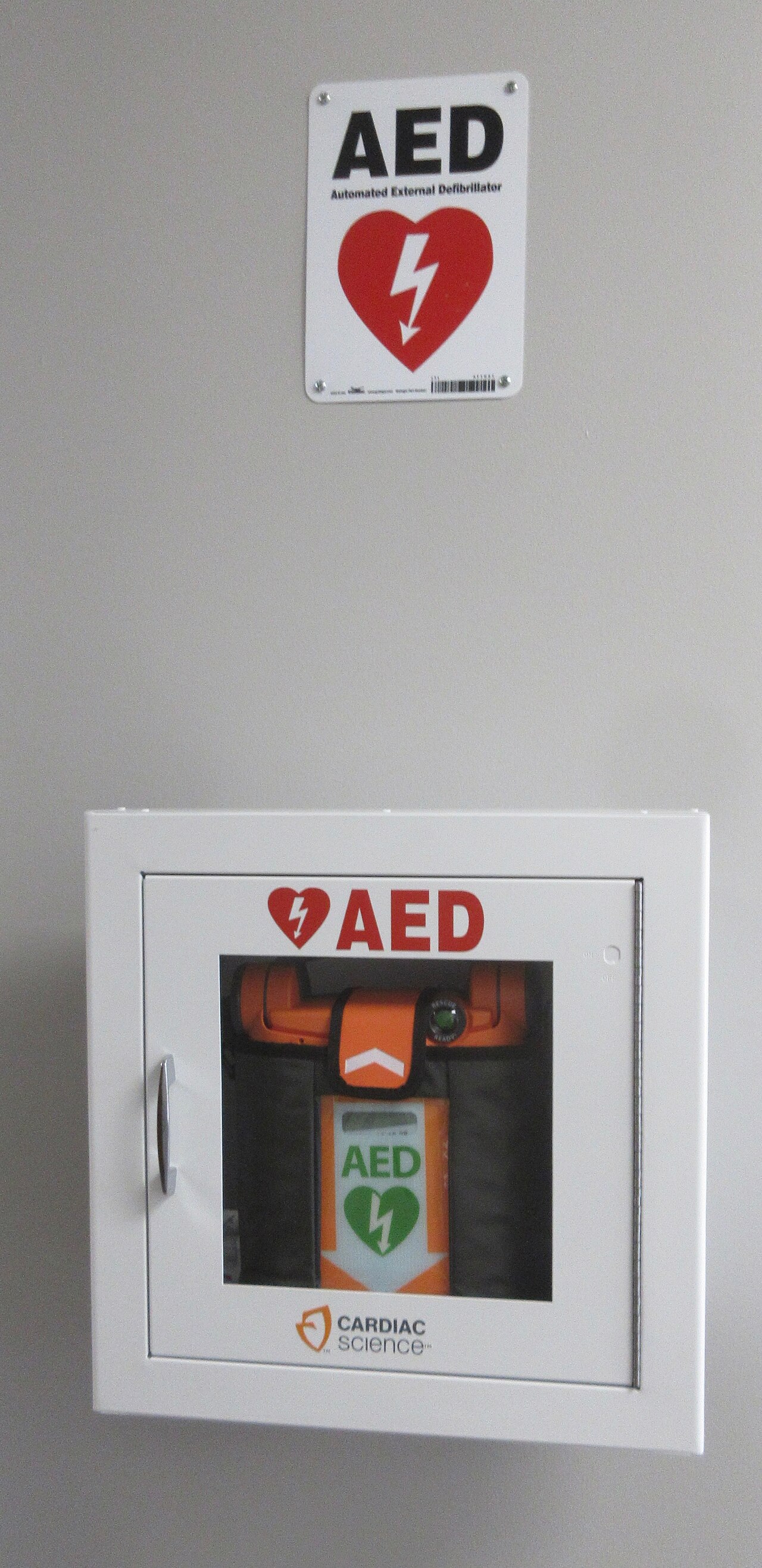
- Automated External Defibrillator: it analyses the rhythm itself and decides whether to shock — you cannot shock someone by mistake. “No shock advised” means either a normal rhythm OR asystole. Follow the prompts.
- Never attach it to a conscious or breathing person. But once it is on during an arrest, leave it on after ROSC.
- Switch on and follow the voice prompts. Continue CPR while the pads go on.
- Expose the chest, dry it if wet, shave dense chest hair (razor in the kit).
- Apply the pads as shown on the pads themselves: one below the right collarbone, one on the left side below the armpit — the current then crosses the heart diagonally.
- “Analysing” → nobody touches the casualty.
- Shock advised → shout “Stand clear!”, check nobody is touching, press the shock button.
- Resume CPR for 2 min at once; the AED re-analyses. Repeat until the casualty recovers or help takes over.
Before the shock — safety checks
- Jewellery and clothing off the pad areas.
- Medication patches (e.g. GTN): remove and wipe the skin.
- Pacemaker or implanted defibrillator (visible lump under the skin): pad at least about 8 cm away.
- Chest hair shaved under the pads; wet or clammy skin dried.
- Water: move the casualty out of water or puddles and dry the chest — current can arc across wet skin.
- Metal deck: safe, as long as nobody touches the casualty during the shock.
- Oxygen: move the mask/source away from the chest during the shock (fire risk).
- Areas where a defibrillator must not be used are marked with a heart-with-cross sticker.
Advanced life support — adrenaline IV
In short: on board, ALS means oxygen, an IV line and adrenaline — given IV only, because nothing is absorbed from muscle when the heart has stopped.
- ALS on board = oxygen by mask + IV access + adrenaline IV.
- When: after the 3rd shock with no response → adrenaline 1 mg IV, repeated every 3–5 min while CPR continues.
- Dose vs EpiPen: often described as a smaller dose than an EpiPen. Check this against the SCMG: an adult EpiPen is 0.3 mg IM, so it is the arrest concentration that is weaker, not the total dose.
- Why IV, not intramuscular: in arrest there is no circulation → nothing is absorbed from muscle. IV goes straight into the bloodstream and CPR circulates it. Adrenaline in arrest = IV ONLY.
- How: pre-mixed with saline, injected at a slow, constant rate — pushing it in one go can make the vein spasm or blow.
- Get IV access early — veins collapse as the casualty deteriorates (see bleeding, shock and IV fluids).
- SCMG is colour-coded: resuscitation is in the red emergency section (contents at the front and back of the book).
Special situations — drowning, hypothermia, pregnancy
In short: drowning and cold change the checks and the shocks, but the CPR technique stays the same.
Drowning
- Mechanisms: laryngospasm — “dry” drowning, the airway closes and little water enters the lungs — vs breath-hold blackout, where low O2/high CO2 forces a breath underwater.
- Cold-water shock can trigger fatal fast or irregular heart rhythms within minutes, before any actual drowning.
- Start with 5 rescue breaths, then CPR. Water in the lungs does not change the method.
- Problems to expect: airway/breathing, water inhalation, head and spinal injury, hypothermia.
- Manage hypothermia during CPR: foil blanket, expose only the chest.
- Once the casualty has been aboard 2 h or more, watch for secondary drowning: increasing breathing difficulty, gurgling, falling SpO2.
Hypothermic cardiac arrest
- No CPR unless you are sure there is no pulse or breathing — a cold heart handled roughly goes into VF. Move gently.
- Look-listen-feel for up to 1 min (the pulse is slow and weak).
- In doubt → 5 breaths, then CPR.
- CPR continues while rewarming.
- AED below 30 °C: only 3 shocks (a cold heart doesn’t respond to defibrillation). After 3 failed shocks, continue CPR, recheck the temperature after 30 min, and shock again once above 30 °C.
Pregnancy and spine injury
- Late pregnancy: tilt the casualty slightly to the left (or push the bump to the left) so the uterus doesn’t press on the vena cava.
- Suspected spine injury: jaw thrust instead of head tilt–chin lift.
Choking — the Heimlich manoeuvre and its variations
In short: if they can cough, let them; if they can’t, alternate 5 back blows with 5 thrusts — and adapt the thrusts to the casualty.
Recognition
- Mild obstruction — effective cough: can speak, cough and breathe → encourage coughing, do NOT intervene, watch closely.
- Severe obstruction — ineffective cough: silent cough, can’t speak or breathe, hands at the throat (universal choking sign), turning blue → act at once.
Adults and children over 1 year
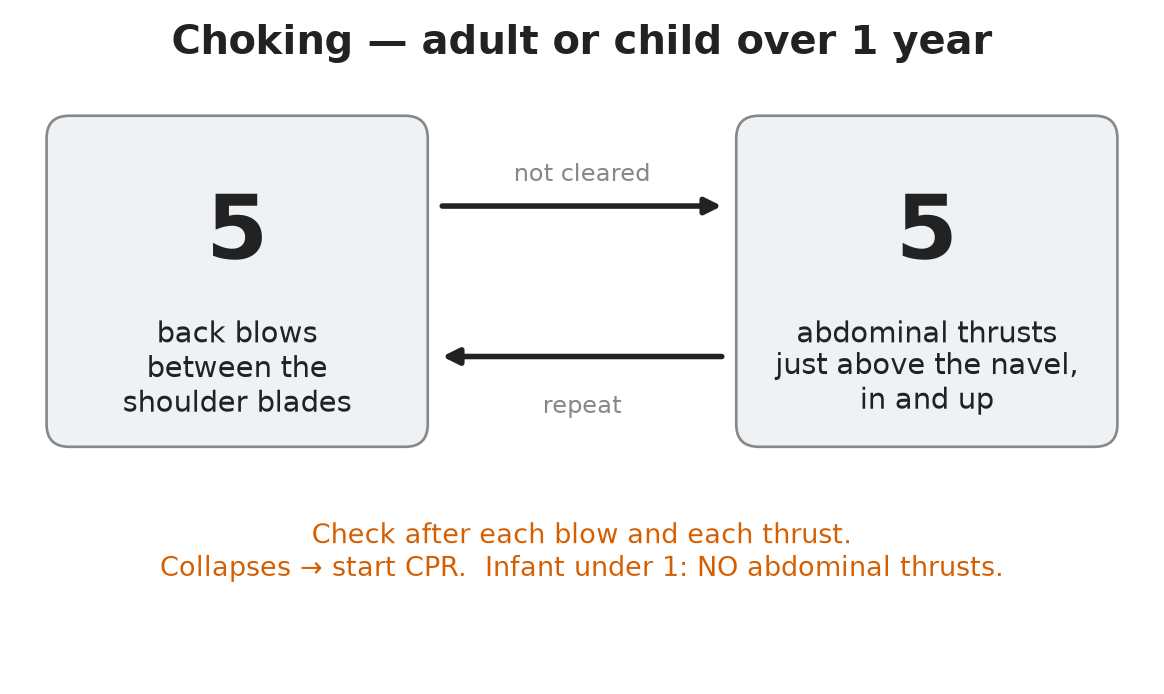
- 5 back blows: lean them forward, chest supported; heel of the hand, sliding movement between the shoulder blades. Check after each blow.
- 5 abdominal thrusts (Heimlich): stand behind, fist between the navel and the breastbone (just above the navel), grasp it with the other hand, pull sharply inwards and upwards. Check after each thrust.
- Alternate 5 + 5 until the object clears or the casualty collapses.
- Why back blows first: the blockage is usually higher up, and abdominal thrusts risk liver, stomach or spleen injury and broken ribs.
- Child (1 year – puberty): same sequence, gentler — kneel behind the child to be at their height.
- Anyone who received abdominal thrusts must be examined by a doctor afterwards (internal injury risk).
Infants (under 1 year) — NO abdominal thrusts
- Abdominal thrusts can injure the liver and internal organs.
- Lay the infant face down along your forearm, head lower than the body, supporting the jaw → 5 back blows between the shoulder blades with the heel of the hand.
- Turn face up, head still low → 5 chest thrusts with two fingers on the lower breastbone — same point as CPR, but sharper, slower, with a sliding-up movement.
- Alternate 5 + 5, checking the mouth. Remove the object only if you see it — no blind finger sweeps.
- Infant becomes unconscious → CPR starting with 5 rescue breaths.
Pregnant, obese and wheelchair casualties — chest thrusts
- NO abdominal thrusts — risk to the uterus and foetus, or you can’t get your arms round the abdomen.
- Chest thrusts from behind: arms under the armpits, fist on the centre of the breastbone (the CPR point), pull sharply backwards and upwards.
- The 5 back blows don’t change. Alternate 5 back blows / 5 chest thrusts.
- Unconscious → CPR as usual; in late pregnancy, tilt to the left.
If the casualty collapses
- Lower them to the floor and reassess breathing — never assume they have stopped: the muscles relax and air may now pass.
- Not breathing → CPR starting with compressions — compressions can dislodge the object.
- Check the mouth before each set of breaths — food can come up.
⚡ Flashcards
Test yourself, one card at a timeQ1What is the only thing you deal with before starting CPR on a casualty who is not breathing?
AnswerCatastrophic bleeding — stop it first; every compression pumps blood out of a major bleed.
Common trapTrap: wasting time on minor wounds or a full survey first.
Q2How long do you check breathing, and do agonal gasps count?
AnswerLook-listen-feel 10 s, expect at least 2 breaths. Drowning, hypothermia or overdose → check for 1 full minute.
Common trapAgonal gasps are not breathing → start CPR.
Q3Adult CPR: ratio, depth and rate?
Answer30:2, depth 5–6 cm, 100–120/min, two hands on the lower half of the breastbone.
Common trapNever pause CPR for more than 5 s (max 15 s only to move the casualty).
Q4How does CPR change for a child or an infant?
Answer5 rescue breaths first (cause usually respiratory), then 30:2 alone / 15:2 with two rescuers. Child: one hand, about 5 cm. Infant: two fingers or two thumbs, about 4 cm, head neutral.
Common trapAlone? Do 1 min of CPR before leaving to call for help.
Q5What O2 flow do you use during resuscitation, and with what?
Answer15 L/min through a bag-valve-mask + reservoir → about 90% O2.
Common trapO2 by mask is no substitute for ventilation if the casualty is not breathing.
Q6When can you insert a Guedel (OPA), and when do you choose an NPA?
AnswerOPA only if fully unconscious, no gag reflex. NPA if semi-conscious, jaw clenched or airway swelling expected.
Common trapNPA is contraindicated with a suspected basal skull fracture.
Q7Which rhythms can an AED shock?
AnswerVF and pulseless VT (shockable). Asystole and PEA are non-shockable → continue CPR.
Common trapThe shock does not “restart” the heart — it stops the chaos so the SA node can take over.
Q8Where do the adult AED pads go, and what do you check first?
AnswerOne below the right collarbone, one on the left side below the armpit. Dry, shaved chest; patches and jewellery off; pad about 8 cm from a pacemaker; O2 away.
Common trapStop CPR only while the AED analyses or shocks — keep going while the pads go on.
Q9When and how is adrenaline given in a cardiac arrest on board?
AnswerAfter the 3rd shock with no response: 1 mg IV, repeated every 3–5 min while CPR continues.
Common trapNot intramuscular — with no circulation, nothing is absorbed from muscle.
Q10Hypothermic casualty in cardiac arrest — how many AED shocks?
AnswerBelow 30 °C: 3 shocks only, keep CPR going while rewarming, retry once above 30 °C.
Common trapRough handling of a cold heart can trigger VF — move gently.
Q11Adult choking with an ineffective cough — what is the sequence?
Answer5 back blows, then 5 abdominal thrusts, alternate until clear. Collapses → CPR starting with compressions.
Common trapEffective cough → just encourage coughing, don’t intervene.
Q12Who must NOT get abdominal thrusts, and what do you do instead?
AnswerInfants: 5 back blows + 5 chest thrusts (two fingers). Pregnant, obese, wheelchair users: chest thrusts from behind, fist on the centre of the breastbone.
Common trapAfter abdominal thrusts, everyone needs a doctor’s check (internal injury).
📚 Resources
Books
- The Ship Captain’s Medical Guide (SCMG) — Maritime and Coastguard Agency, 24th edition (TSO). Resuscitation is in the red emergency section.
Regulations
- MIN 718 (M+F) — The Ship Captain’s Medical Guide, 24th edition — replaces MIN 600 (23rd edition)
- STCW A-VI/4 — standards for medical first aid and medical care on board
Official sites
- European Resuscitation Council — Guidelines 2025 — adult and paediatric basic life support
- St John Ambulance — How to do CPR
- St John Ambulance — Choking
- British Heart Foundation — Defibrillators
Exam focus — MCA
Typical questions:
- A crew member collapses on deck and is not breathing normally — talk me through what you do, from danger to AED. They want DRSABC in order, 10 s breathing check, agonal gasps = not breathing, 30:2, 5–6 cm, 100–120/min, minimal pauses.
- How does CPR differ for a child and an infant? 5 rescue breaths first (respiratory cause), one hand / two fingers or two thumbs, about 5 cm / 4 cm, neutral head for infants, 1 min of CPR before going for help if alone.
- What does an AED shock, and what must you check before using it on board? VF and pulseless VT only; dry chest, patches, pacemaker 8 cm, O2 away, wet vs metal deck, “stand clear”.
- When is adrenaline given in an arrest and why IV? After the 3rd shock, 1 mg IV every 3–5 min; no absorption from muscle without circulation.
- A pregnant passenger is choking — what do you do? Back blows, then chest thrusts (not abdominal), CPR with a left tilt if she collapses, doctor’s check afterwards.