Medical Conditions on Board
MedicalThe everyday and emergency illnesses met at sea: chest pain and heart problems, the acute abdomen, diabetes, urinary, sexual and gynaecological problems, infections and sepsis, eyes, ENT, teeth, skin and mental health. Spotting the danger signs and starting treatment keeps a crew member safe until radio medical advice or evacuation, and it is core MCA medical care exam material.
Last reviewed 1 Nov 2026 · From a professional captain's years of study notes · Organised with AI and checked against current regulations · How we write
On this page (15)
Chest Pain, Heart Failure and Arrhythmias
In short: chest pain can be anything from heartburn to a heart attack. A structured history sorts most cases. Treat a suspected heart attack as unstable and call radio medical advice.
Where the pain comes from
- Rule of thumb: pain the casualty points to with one finger → usually the chest wall. Vague, spread-out pain → usually an internal organ.
| System | Causes |
|---|---|
| Gut | Gallstones · peptic ulcer · reflux (heartburn) · pancreatitis |
| Heart and vessels | Acute coronary syndrome (ACS) · pericarditis · aortic stenosis · aortic dissection |
| Chest wall | Shingles (herpes zoster) · costochondritis · rib fractures · anxiety · trapped nerve |
| Lungs | Spontaneous pneumothorax · pulmonary embolism · pneumonia · pleurisy |
- Pericarditis: often viral, in young people; central pain eased by leaning forward. Not every chest pain is a heart attack.
- Shingles: the painful band always follows a nerve as a semicircle and never crosses the midline.
History: SOCRATES
- Site — one finger, or all over?
- Onset — when, and doing what?
- Character — crushing, compressing, burning, tingling, piercing, sharp.
- Radiation — to the shoulder, neck, back or abdomen?
- Associated symptoms — sweating, nausea or vomiting, shortness of breath, palpitations, fever.
- Time — how long? First time? Compare with earlier episodes.
- Exacerbating or relieving factors — position, exercise, deep breaths.
- Severity — the casualty scores it 1/10 to 10/10.
ACS, angina and heart attack
- ACS: a coronary artery narrows with atherosclerosis (plaque). A blood clot on the plaque blocks the artery → the heart muscle beyond it dies (infarction).
- Angina: brought on by exertion, eased by rest.
- Heart attack (MI): constant, nothing eases it — “a vice round the chest”.
- Atypical MI:
- an infarct at the tip of the heart can feel like indigestion;
- pain between the shoulder blades or in the jaw;
- silent MI in diabetics (damaged nerves) → sudden collapse or extreme tiredness;
- a cold sweat soaking the shirt.
Suspected heart attack: what to do
- History (SOCRATES) and examination. Separate angina (exertion, eased by rest) from MI (constant).
- Sit the casualty in the W position — sitting up, knees bent. It lowers the work of the heart.
- GTN — the casualty’s own or the ship’s.
- Aspirin — ask about allergy first. If allergic, clopidogrel is the usual alternative (confirm with radio medical advice).
- Morphine IM + an anti-emetic. On board the IM route is preferred over IV.
- Monitor the vital signs, treat as unstable → radio medical advice.
On the bridge: the chief engineer, a diabetic, says they are “just very tired” and is grey and sweating after a hot shift. Think silent MI — start observations and call radio medical advice.
Congestive heart failure (CHF)
- Typical history: shortness of breath · swollen feet and legs · constant lack of energy · poor sleep because of breathing · swollen or tender abdomen with poor appetite · cough with frothy sputum · passing urine more at night · confusion or poor memory.
- Why it happens: damaged heart muscle thickens — bigger but less efficient — so fluid backs up: first ankle swelling, later frothy sputum.
- End stage: cannot lie flat, sleeps in an armchair, needs oxygen. This matters when judging an elderly guest’s fitness to sail.
Arrhythmias
- Abnormal heartbeat, sometimes coming and going (paroxysms).
- Tachycardia: over 100/min · bradycardia: under 60/min.
- Triggers: caffeine, stress, some medicines, thyroid disease (example: 160–170 bpm at rest).
- Palpitations may be atrial fibrillation (AF), which can turn into ventricular fibrillation (VF) and cardiac arrest. Never ignore them: remove the trigger, rest, take the vital signs, radio medical advice.
- An AED does not restart the heart — it stops the fibrillation so the normal rhythm can reset. Survival depends on the speed of CPR + defibrillation (see CPR, AED and Choking).
- A vagal (parasympathetic) stimulus can sometimes convert AF.
The Acute Abdomen
In short: where it hurts points to the organ. Take a careful history, examine with look–feel–listen, give pain relief early, and call radio medical advice for anything that is unstable or not settling.
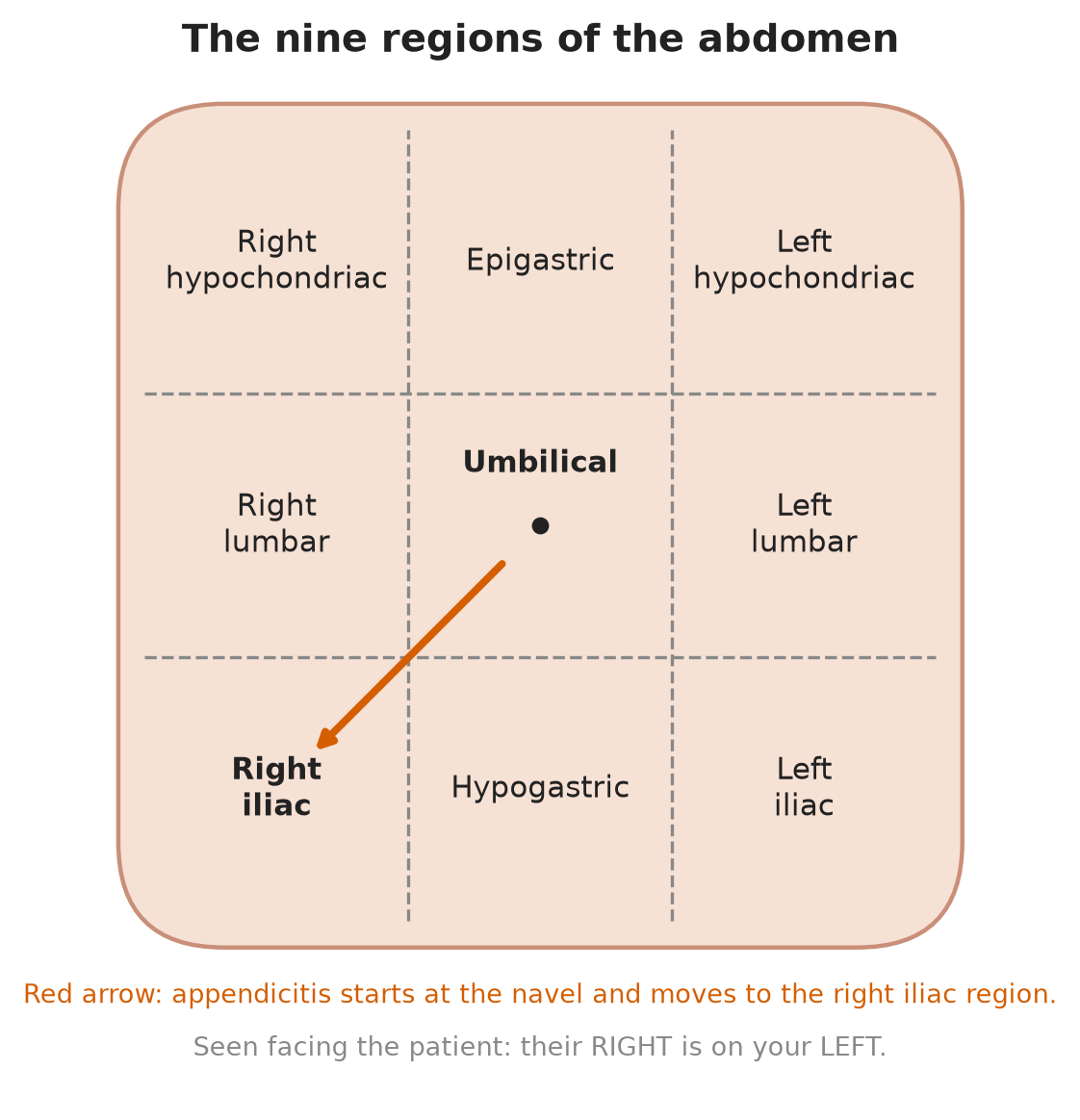
Where it hurts: quadrants and nine regions
- Four quadrants (navel = centre):
- Right upper: liver, gallbladder and bile ducts, head of pancreas, right kidney.
- Left upper: stomach, spleen, body and tail of pancreas, left kidney.
- Right lower: caecum + appendix, right ovary and tube, right ureter.
- Left lower: descending and sigmoid colon, left ovary and tube, left ureter.
- Midline: epigastrium (stomach, duodenum, pancreas) · umbilical (aorta, small intestine) · suprapubic (bladder, uterus).
| Region | Likely causes |
|---|---|
| Epigastric | Oesophagitis · peptic or perforated ulcer · pancreatitis |
| Right hypochondriac | Gallstones · cholangitis · hepatitis · liver abscess (also heart or lung) |
| Left hypochondriac | Spleen — abscess, enlargement, rupture |
| Umbilical | Early appendicitis · mesenteric lymphadenitis · Meckel’s diverticulitis · lymphoma |
| Right / left lumbar | Ureteric colic · pyelonephritis |
| Right iliac | Late appendicitis · Crohn’s · ectopic pregnancy · ovarian cyst · hernia |
| Left iliac | Diverticulitis · ulcerative colitis · constipation · ovarian cyst · hernia |
| Hypogastric | Testicular torsion · urinary retention · cystitis · placental abruption |
- Classic pattern: appendicitis starts at the navel and moves to the right iliac region.
History
- Symptoms to ask about: pain · change in bowel habit (constipation, diarrhoea) · nausea and vomiting · weight loss · anorexia (loss of appetite) · difficulty swallowing.
- Checklist: past abdominal problems · trauma · signs of internal bleeding · temperature · recorded observations (log).
- Vomiting: how often? What does it look like?
- food / yellowish · bilious (green-yellow = bile) · coffee grounds (= old, digested blood) · fresh blood = active ulcer · faeculent (smells of faeces) = obstruction.
- Vomiting after the pain started → likely a surgical cause. Before the pain → usually not surgical.
- Urine: dark and scanty = dehydration · very dark or brown = blood or liver problem · none = kidney red flag.
- Stool colour and texture:
| Stool | Meaning |
|---|---|
| Black, tarry, sticky (melaena) | Upper-gut bleed (iron, bismuth or spinach also blacken it) |
| Bright red | Lower-gut bleed |
| Blood mixed in / on the surface | Lower tract (colitis, diverticulitis, cancer) / haemorrhoids |
| Pale, clay | Blocked bile duct (gallstones) |
| Greasy yellow, floats | Fat not absorbed (pancreas, coeliac) |
| Watery | Diarrhoea → replace fluids |
- Record quantity and frequency on the in/out fluid chart.
- Other clues: right-shoulder pain = referred from liver, gallbladder or duodenal ulcer · jaundice shows first in the whites of the eyes, with itchy skin · mouth ulcers are not a stomach problem (stress, medicines).
Examination: look, feel, listen
- Look: swelling (normal for them?) · scars from old operations · swollen hernia openings.
- Feel: all nine regions for tenderness · guarding and rebound tenderness · the kidneys · hernia openings · a full bladder.
- Percuss: tenderness over the whole abdomen = peritonitis.
- Listen: bowel sounds, normal 3–5/min, present and not raised. In obstruction they are loud at first, then absent.
- Always: urine dipstick; women of child-bearing age → pregnancy test.
Pitfalls
- Obesity, steroids and NSAIDs can hide the signs.
- No fever does not rule out infection — especially in the old, the very ill and the immunocompromised.
- Pain out of proportion to what you find → think of aortic rupture, ovarian torsion, mesenteric ischaemia (loss of blood to the gut) and pancreatitis.
- In women always think gynaecological and exclude pregnancy — an ectopic is life-threatening.
General treatment (TMAS approach)
- Unstable (abnormal vital signs) → act at once.
- Very sick or low BP → IV fluids.
- Reassess often with a NEWS chart and in/out charting.
- Pain relief early. “Painkillers hide the signs” is incorrect and cruel. But avoid NSAIDs in undiagnosed abdominal pain (bleeding risk, masks inflammation) unless the doctor orders them.
- Radio medical advice.
- Colicky pain = stone; constant pain = inflammation.
- Hyoscine butylbromide (antispasmodic) stops colicky pain — kidney, gallbladder or period pain.
- Organs worked by stomach acid (pancreas, duodenum) → add an antacid to rest them.
Peritonitis
- Signs: severe generalised pain + fever, worse on movement → casualty lies still · nausea and vomiting · rigid, board-like abdomen · absent bowel sounds · pain on coughing or bending the hips · rebound tenderness (also on the opposite side) · shallow breathing, will not cough · dehydration → shock.
- Vital signs: fast pulse, raised BP, fever of 100 °F (about 38 °C) or more, raised white cell count (blood test).
- Causes:
- perforation — gastric or duodenal ulcer, burst appendix, Meckel’s diverticulum, trauma and penetrating wounds;
- inflammation — pancreatitis, diverticulitis, salpingitis, PID from an ascending STD in women;
- obstruction or colic — biliary colic, bowel obstruction;
- gynaecological — ruptured ovarian cyst, twisted ovary, ectopic pregnancy;
- recent abdominal surgery.
- Treatment (SCMG): O2 · IV access + fluids: low BP → 500 ml bolus and reassess, BP stable → 1 L over 6 h · pain relief · in/out charting · nil by mouth · antibiotics — check for penicillin allergy first.
Appendicitis
- Pain round the navel, moving down and right (right iliac fossa) · nausea and vomiting · mild fever.
- Management (SCMG): pain relief by pain score · anti-emetic · nil by mouth · IV fluids with in/out charting · radio medical advice.
- No antibiotics unless rupture or peritonitis is suspected — it is inflammation, not infection. Put in an IV cannula, flush it and keep it open.
Pancreatitis
- Severe epigastric pain going through to the back — a “pain out of proportion” case.
- Causes — GETSMASHED: Gallstones · Ethanol (alcohol) · Trauma · Steroids · Mumps and other viruses · Autoimmune · Scorpion bites · High cholesterol and Hypothermia · Embolism · Drugs.
- Examination: lies still if peritonitis · tender upper abdomen, maybe guarding · normal bowel sounds.
- Treatment: O2 · IV access, fluids if BP is low · pain relief (often morphine) · anti-emetic · antacid (less gastric juice) · radio medical advice.
Indigestion, gastritis and peptic ulcer
- Indigestion: discomfort after eating — bloating, belching, heartburn, nausea. Keeps coming back → suspect a stomach problem underneath.
- Gastritis: inflamed stomach wall → can become a peptic ulcer → perforation → peritonitis.
- Peptic ulcer: an open sore in the stomach or duodenum, eating through mucosa → submucosa → muscle. Risks: bleeding and perforation.
- Duodenal: burning, gnawing pain eased by eating, wakes them at night; belching, bloating, nausea.
- Gastric: worse with food. Triggers: spicy food, fizzy drinks.
- Bleeding ulcer — DR BBCFS / ABCDE (blood loss can starve the brain and threaten airway and breathing):
- Bed rest, O2.
- IV access: low BP → 500 ml, aim for systolic about 90 mmHg. BP normal → give fluid to match urine output, target over 30 ml/h.
- Antacid by mouth, pain relief, anti-emetic (vomiting can dislodge the clot).
- Nil by mouth, reassess with NEWS (it may perforate), radio medical advice.
Aortic aneurysm and dissection
- Abdominal aortic aneurysm (AAA): the aortic wall balloons. If it ruptures → massive internal bleeding. A “pain out of proportion” case.
- Aortic dissection: blood tracks inside the wall of the artery, between its layers — not the same as a rupture.
Gallstones and the bile ducts
- Bile is made in the liver, stored in the gallbladder and released into the duodenum. Gallstones can block the ducts; a stone near the pancreatic duct can cause pancreatitis. Common in middle-aged and older women.
- Spectrum: biliary colic → cholecystitis → obstructive jaundice → ascending cholangitis.
- Biliary colic: colicky right-upper pain going to the back, after fatty or heavy meals, nausea, no fever. Treatment (TMAS · SCMG): paracetamol 1 g · hyoscine butylbromide · anti-emetic · avoid fatty meals · if it settles, see a doctor in port.
- Cholecystitis: a stone stuck in the cystic duct → inflamed gallbladder → constant right-upper pain + fever. Treatment (SCMG): IV access + fluids · paracetamol 1 g QDS · morphine 2 mg IM titrated · prochlorperazine 12.5 mg IM · antibiotics · radio medical advice.
- Ascending cholangitis: bacteria from the duodenum infect blocked bile ducts.
- Charcot’s triad: jaundice · right-upper pain · fever.
- With pus (suppurative) → Reynold’s pentad = triad + low BP + confusion.
- Treat as cholecystitis.
- Dose shorthand: BD = 2×/day · TDS = 3× · QDS = 4× · PRN = as needed.
Bowel obstruction and hernias
- Obstruction — causes: adhesions / scar tissue · colon cancer · hernia · intussusception (bowel telescopes into itself) · volvulus (bowel twists).
- Treatment (SCMG): bed rest + nil by mouth · shock → high-flow O2 + IV fluids (bolus, then by urine output) · pain relief titrated · prochlorperazine 12.5 mg IM — avoid pro-kinetic anti-emetics (they can make it worse) · radio medical advice.
- Hernia: tissue pushing through a weak spot — epigastric · umbilical · inguinal (most common) · femoral.
- Reducible: breathe in and push gently → it goes back.
- Strangulated: trapped bowel loses its blood supply → obstruction, faeculent vomiting, shock → surgery at once.
- Old surgical scars → adhesions → obstruction: report scars to TMAS.
- Hiatus hernia: part of the stomach slides up through the diaphragm → heartburn and reflux, not obstruction.
Lower bowel and back passage
- Diverticular disease: small pouches in the colon wall (mostly sigmoid). Diverticulitis = inflamed or infected → left-lower pain, fever, maybe bleeding. Meckel’s diverticulum = a pouch in the small intestine present from birth.
- Irritable bowel syndrome (IBS): erratic spasms → diarrhoea alternating with constipation, bloating, wind. Long-term, not a surgical emergency.
- Bleeding from the back passage — causes: haemorrhoids, anal fissure, fistula · diverticular disease · inflammatory bowel disease (ulcerative colitis, Crohn’s) · polyps (can turn into cancer).
- Haemorrhoids — four degrees:
| Degree | What you see |
|---|---|
| 1st | No prolapse, just prominent vessels |
| 2nd | Prolapse on straining, goes back by itself |
| 3rd | Prolapse, needs pushing back by hand |
| 4th | Prolapsed, cannot be pushed back |
- Treatment: haemorrhoid cream (e.g. Proctosedyl) + warm salt baths.
- Pruritus ani (anal itching): poor hygiene, fissure or haemorrhoids, contact dermatitis, STDs → good hygiene + hydrocortisone ointment.
- Anal abscess: painful, red, hot swelling near the anus. Sites: perianal (most common), ischiorectal, intersphincteric, supralevator. Salt baths + antibiotics at once; often needs surgical drainage.
Diabetic Emergencies
In short: diabetes means too little insulin, so sugar stays in the blood and the cells starve. A hypo kills in minutes but is easy to treat — do it yourself, now. A hyper builds over days — use that time to get radio medical advice.
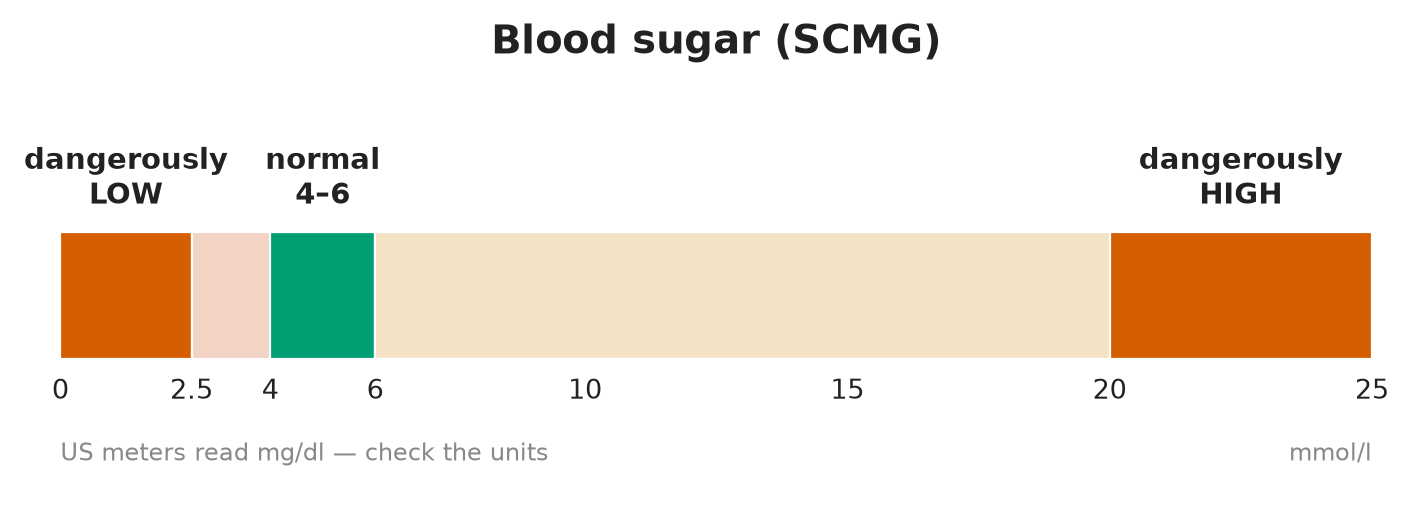
The numbers (SCMG Ch. 13, pp. 36–37)
| Blood sugar | Meaning |
|---|---|
| 4–6 mmol/l | Normal |
| Below 2.5 mmol/l | Dangerously low (hypo) |
| Above 20 mmol/l | Dangerously high (hyper) |
- US meters read in mg/dl — check the units.
Recognising low and high sugar
| Low (hypo) | High (hyper) | |
|---|---|---|
| Speed | Minutes | Days to weeks |
| Signs | Sweating · hungry · confused or agitated · slurred speech · aggressive, seems drunk · fitting · drowsy | Lethargic · always thirsty · fast breathing · passing lots of urine · drowsy · ketone breath (acetone / nail polish) |
- Collapsed or unconscious → ABCDE first, then test the blood sugar.
Treating a hypo
- Oxygen, IV access.
- Conscious: biscuit, sugary drink or 40% dextrose gel (GlucoGel) under the tongue or rubbed into the cheek.
- Unconscious: 50 ml of 50% dextrose IV/IO + glucagon 1 mg IM (shoulder or front of thigh; IV also possible). Never put food in the mouth — it can be inhaled.
- A low GCS caused by low sugar should improve within 10 min.
- No IV dextrose on board → sugar dissolved in water, given rectally. “Glucose by any route: IV, IM, oral, rectal.”
- After recovery → a full meal with protein and fat, so the sugar does not drop again.
- Causes of a hypo: too much insulin or tablets with too little food · hard work or exercise · skipped meals · heat. Alcohol magnifies insulin — 20 units can act like 60. In a non-diabetic a hypo is unusual: think drugs, alcohol, malaria or a dosing mistake.
- Keep the glucagon pen in the fridge.
Treating a hyper
- SCMG flowchart: oxygen · insulin 20 units IM · conscious → oral electrolyte fluids · normal saline IV 1000 ml · then insulin 10 units IM every hour until sugar is below 15 · IV fluid 500 ml/h for 4–6 h · switch to IV dextrose once below 15.
- Ongoing care: GCS, pulse, BP, breathing rate, temperature · test urine for ketones · fluid balance chart · blood sugar every hour · find the cause (drugs, infection, other illness) · contact TMAS and prepare for evacuation.
- Look for the trigger: chest infection (crackles), urine dipstick, and festering wounds on numb diabetic feet or in skin folds. Ketones in urine also appear in starvation (castaways).
Practical advice differs from the SCMG flowchart, which makes treating very high sugar look easy. Insulin and fluids on board are complex and risky — always contact TMAS / radio medical advice first.
Control, testing and history
- Three ways to control diabetes: restricted-carbohydrate diet → tablets → insulin injections (in that order as it progresses).
- Crew on insulin are fit only for a very limited range of duties at sea.
- Test: prick the fingertip → drop on the strip → read the meter. A urine dipstick shows high sugar but not low.
- History: last insulin dose and last meal. Not a known diabetic → has it happened before? Drugs or illness? Contact TMAS, monitor until stable.
- Mnemonic: a diabetic is a lithium battery with a broken BMS (the pancreas). Giving insulin by hand is balancing the cells without telemetry — easy to overshoot into deep discharge (a hypo, the irreversible damage). TMAS is the technician who reads the data first.
Urinary and Male Genital Problems
In short: most urinary problems are infections, stones or a blocked outflow. Two are time-critical: testicular torsion (about 6 h) and paraphimosis.
Anatomy
- Kidneys → ureters → bladder → urethra. The prostate (men) wraps round the urethra below the bladder.
- The female urethra is much shorter → bacteria get in more easily → urinary infections are commoner in women.
- Any abdominal pain → urine dipstick; women of child-bearing age → pregnancy test too.
Cystitis and kidney infection
- Cystitis (bladder infection, the commonest UTI):
- dull pain over the pubic bone (into the loin if it is spreading up);
- frequency — small amounts, many times · dysuria — burning · hesitancy — urge but nothing comes;
- foul, cloudy urine · blood in the urine · fever with an ascending infection · positive dipstick.
- Examination: ABCDE; most mild cases have no general upset; tender over the pubic bone.
- Untreated → pyelonephritis (kidney infection): fever, flank pain, positive renal punch.
- Renal punch test: a gentle fist tap on the flank, below the last rib at the back. Sharp pain = positive → kidney stone or kidney infection.
- Treatment: “We treat the symptoms” — on board you rarely have a firm diagnosis, so manage what you see, support the casualty and get radio medical advice. Cystitis: always antibiotics + fluids; sugar-free cranberry juice.
Renal colic (kidney stones)
- A stone is silent in the kidney. It hurts when it moves down the ureter: severe colicky loin-to-groin pain in waves, cannot keep still, nausea, blood in the urine, positive renal punch.
- Treatment (SCMG – TMAS):
- Put the casualty to bed.
- Pain relief is the priority — NSAIDs work best: diclofenac 75 mg IM or 100 mg PR, or diclofenac 50 mg by mouth, or ibuprofen 600 mg. Not enough → morphine 5 mg IM.
- Fluids by mouth or IV.
- Monitor urine output and collect it to catch the stone.
- Radio medical advice.
- Never combine diclofenac and ibuprofen — both are NSAIDs. Diclofenac suppositories suit a vomiting casualty.
Acute urinary retention and catheterisation
- Cannot pass urine despite a full, painful bladder. Causes: enlarged prostate (older men — squeezes the urethra, the bladder wall thickens) · urethral stricture · stones. Relief = a catheter.
- Never catheterise with signs of infection (fever, blood or protein on the dipstick) — it pushes the infection up.
- Procedure:
- Kit: 14F catheter, forceps, sterile gloves, sterile swabs, container. The bladder is a sterile cavity — more preparation than suturing.
- Wash the genital area with soap and water first, then antiseptic (chlorhexidine). Women: clean front to back.
- Casualty lying down and relaxed; expose from navel to knees, cover for dignity; sterile gloves on.
- Anaesthetic gel for men only (wait a few minutes) — optional; it can sting more than the catheter.
- Women: short, straight urethra. Men: hold the penis upright; expect resistance at the prostate. Never force it. A male catheter works in a woman; a female catheter is too short for a man.
- Fill the balloon with the volume printed on the catheter.
- Drain in stages: about 200 ml → clamp 15 min → about 300 ml…; after the first litre release slowly. Emptying 1.5 L at once can cause shock or death.
- Tape the tube along the leg; bag below bladder level.
- Afterwards: antibiotics after any catheterisation on board (non-sterile setting). While it stays in: trimethoprim 200 mg every 12 h (SCMG 22nd ed.). On-board reasons for a catheter: spinal injury, unconscious + long evacuation.
- Removal: deflate the balloon fully and check the volume.
Testicular torsion and epididymitis
| Torsion | Epididymitis | |
|---|---|---|
| What | Spermatic cord twists → blood supply cut | Infected, inflamed epididymis (often UTI or STD) |
| Onset | Sudden, severe, one side, swelling, nausea | Gradual (hours to days), warmth, fever or burning |
| Testicle | Rides higher | Swollen, tender |
| Cremasteric reflex | Absent | Present |
| Action | Emergency — dies in about 6 h | Antibiotics, rest, scrotal support, pain relief |
- Cremasteric reflex: stroke the inner thigh. Testicle rises = reflex present → more likely inflammation. No movement → suspect torsion.
- Torsion on board (SCMG): paracetamol 1 g, NSAIDs, morphine 5 mg IM + anti-emetic · radio medical advice within the 6-hour window · evacuation.
- Untwisting (if advised): give morphine + anti-emetic first. Rotate towards the thumb (opposite to the twist). If the pain gets worse, try the other way. It may need more than one full turn. Success = pain drops sharply.
Phimosis and paraphimosis
- Phimosis: foreskin too tight to pull back — hygiene and infection problems, usually not urgent.
- Paraphimosis: a pulled-back foreskin stuck behind the glans acts like a tourniquet → emergency.
- Treatment: ice packs or a sugary / dextrose solution on the glans (draws fluid out by osmosis) · pain relief · thumbs press the glans down while the fingers pull the foreskin forward.
Sexually Transmitted Diseases
In short: STDs are rising again since COVID (especially gonorrhoea and syphilis). Many give no symptoms. Know the ulcer split, the syphilis stages and the doses, and always trace partners.
The seven to know
- Chlamydia · gonorrhoea · genital herpes · genital warts (HPV) · HIV → AIDS · syphilis · hepatitis.
Prevention
- CDC: about 20 million new cases a year in the USA.
- Abstinence — the only 100% method · fewer partners · talk and get tested together · condoms, correctly, every time · vaccines (HPV, hepatitis B) · get tested — many STDs have no symptoms; positive = treatable, tell partners.
- Condom use: most failures are user errors. Check the expiry · open carefully (no teeth or scissors) · pinch the tip (no air) · roll on the right way · withdraw holding the base · tie and bin — never reuse.
Genital ulcers
| Multiple and painful | Single and painless |
|---|---|
| Herpes simplex (EU, USA) · chancroid (Africa, SE Asia) · scabies · secondary syphilis — highly infective | Primary syphilis — a smooth, clean chancre |
Syphilis
| Stage | When | Signs |
|---|---|---|
| Primary | Incubation about 3 weeks | Smooth, clean chancre • enlarged lymph node nearby |
| Secondary | 6–10 weeks | Painful lymph nodes (also neck) · rash on genitals, palms and soles · mild fever, malaise, headache, sore throat · settles by itself, can recur about 6 weeks later |
| Tertiary | 10–30 years later, untreated | Rare but very serious — organ damage, death |
- Treatment: doxycycline 100 mg BD × 14 days (early) · 100 mg BD × 28 days (later stage).
Urethritis and genital warts
- Urethritis: burning on passing urine + discharge. Mild discharge = mild gonorrhoea or non-specific urethritis; pus = severe gonorrhoea.
- Genital warts (HPV): painless cauliflower-like growths; vaccine-preventable; some strains cause cervical and other cancers, and throat and mouth cancers are rising.
Practical points
- A modern first choice for STD ulcers is an azithromycin 3-day treatment if not allergic; the drug in the ship’s medical guide is still valid. Confirm with radio medical advice.
- Partner tracing and treatment are mandatory; testing at a sexual health (GU) clinic is confidential.
- Herpes can also spread by non-sexual contact.
- HIV can be silent for years.
Seasickness, Vomiting and Diarrhoea
In short: seasickness is mostly a nuisance, but prolonged vomiting dehydrates. When the mouth is useless, give an anti-emetic by injection and fluids by IV or rectally.
Seasickness
- Symptoms: nausea · vomiting · loss of appetite · dizziness.
- Prevention: anti-seasickness medicine — it is carried in the Category C stores of the liferaft. The SOLAS liferaft pack holds enough for at least 48 h plus one sick bag per person; issuing it is one of the immediate actions in the raft.
- Medicine (Schedule 5): domperidone.
- Acute seasickness / dehydration: watch the colour of the vomit · consider an anti-emetic injection · fluid replacement in extreme cases · rectal infusion or IV when the oral route is useless.
Choosing an anti-emetic
- By injection: only cyclizine or promethazine. Cyclizine is preferred with morphine — they can be mixed.
- Ondansetron can also be injected — avoid in migraine sufferers.
- Hyoscine → urinary retention: avoid in older men with prostate problems.
- Choose by job: duty crew versus guest (drowsiness). Read the drug leaflet.
- Use side effects as a second drug: a constipating anti-emetic for someone with vomiting and diarrhoea.
- Anti-sickness drugs: stores book p. 41 §2B.
Rectal fluid infusion
- Kit: graduated container + tubing + soft red rectal tube. The fluid runs in by gravity and the bowel absorbs it. Very easy.
- Fluid: water, or water + sugar + salt. It does not need to be sterile. Control the flow with a drip set or the height of the bag.
- Ask the casualty not to push the tube out (a normal first reflex).
- Two versions — use the ship’s guide you carry:
| Basic method | SCMG 22nd ed. | |
|---|---|---|
| Position | Left side | Left side, buttocks raised on two pillows |
| Tube | Soft rectal tube with lubricant (Vaseline) | 26 Ch catheter, lubricated |
| Depth | About 5 cm | About 23 cm |
| Fixing | — | Tape + spigot |
- Old constipation enema: water + 1 tbsp oil + ½ tsp soap.
Diarrhoea
- Causes: food poisoning · change of diet · contaminated food · unwashed hands.
- Watch the colour of the stool.
- Often let it settle by itself — it flushes out the bacteria. Replace fluids.
Sepsis and Infectious Diseases
In short: suspect sepsis early and treat within the first hour. For any infection, the drug depends on the germ family — antibiotics kill bacteria only. Isolate according to how the disease spreads, and warn the port.
Recognising sepsis
- NHS red flags (children): suspected infection and one of:
- core temperature below 36 °C or 38.5 °C and above;
- fast breathing;
- fast pulse that does not fit (PEWS chart);
- altered mental state — sleepy, irritable, lethargic, floppy;
- slow capillary refill.
- Lower threshold: under 3 months old · chronic disease · recent surgery · immunocompromised.
- UK Sepsis Trust: Does the casualty look ill? Are they triggering NEWS? Any signs of infection? → this could be sepsis.
- Exposure: check the temperature (fever or low temperature) and the skin. Glass test: press a glass on a rash — if it does not fade, it is a red flag (e.g. meningitis).
- Sepsis without fever exists: the body can shut down cold to touch, BP falls slowly, confusion appears. Trust your instincts.
- Child with fever → urine test (hidden UTI).
Treating sepsis — the first hour
- High risk of death → start as soon as possible. “Sepsis Six” within the first hour:
- high-flow O2;
- IV fluids;
- IM broad-spectrum antibiotics;
- urine and in/out charting.
- Non-blanching rash = always bacterial → antibiotics at once. Broad spectrum: ciprofloxacin (stores p. 46); erythromycin if allergic to penicillin.
Four families of germs
| Family | Examples | What works |
|---|---|---|
| Viruses — not cells; they hijack your cells | Coronavirus · cold and flu · gastroenteritis · measles, mumps · chickenpox · polio · Zika · Ebola | Antibiotics useless. Vaccines, antivirals (slow it down). On board: supportive — symptoms, fluids, isolation |
| Bacteria — living cells | Pneumonia · UTI · meningitis · TB · cholera · dysentery · typhus | Antibiotics |
| Protozoa / metazoa — parasites | Malaria · amoebic dysentery · tapeworm | Antiparasitics |
| Fungi — love warm and damp | Ringworm · athlete’s foot | Antifungals |
General care and notification
- Many communicable diseases do not respond to medicines → treat the symptoms.
- Fever: paracetamol 1 g QDS + NSAIDs · tepid sponging and a fan.
- Diet: sugar and energy; with nausea and fever → lemon juice with sugar, black tea with honey.
- Fluids to prevent dehydration · nurse in bed, no hard work.
- Seriously ill or any doubt → radio medical advice at once.
- Infectious disease on board and approaching port → radio the port so the health authorities can assess. Meningitis is a notifiable disease.
Isolation, TB and vaccines
- Isolation is graded by how it spreads:
- droplet diseases → full isolation;
- athlete’s foot → flip-flops + clean the shower;
- malaria → none;
- HIV → blood precautions only.
- Isolation set-up: cabin with its own bathroom · disposable plates · PPE · the casualty takes their own temperature.
- TB: rising again; 6 months of several antibiotics; night sweats; Mantoux skin test → BCG vaccine.
- Vaccines that work after exposure: rabies (can lie dormant up to 12 months — vaccinate within about 15 days of the bite) and a tetanus booster.
- Hepatitis vaccines exist for A and B only (none for C). Meningitis vaccines: A and B.
- Chickenpox itch: baths in oat-soaked water.
Eye Problems
In short: protect the good eye, flush with plenty of water — except for welder’s flash — and never pull out an impaled object.
Structure of the eye
- Cornea — clear front window, first focusing.
- Iris — coloured muscle that sets the pupil size.
- Lens — fine focusing onto the retina (the image is upside down).
- Retina → optic nerve → brain.
- Sclera — white outer coat · conjunctiva — thin membrane over the sclera and inside the eyelids.
Eye injuries — general care
- Expect severe pain and loss of sight.
- Protect the unaffected eye.
- Flush with plenty of water.
Welder’s flash (arc eye)
- UV burn of the cornea from a welding arc without eye protection. Severe discomfort.
- Do NOT flush with water — the exception to the rule.
- Lubricating eye gel · mild pain relief · dark room · hospital at once.
- Prevention: good sunglasses at sea (UV also causes cataracts).
Foreign body in the eye
- Always DR BBCFS / ABCDE first, then the eye.
- Superficial or loose:
- Anaesthetic eye drops.
- Fluorescein drops or strips — the dye shows corneal damage (strips: stores p. 51, required on board).
- Turn the eyelid out and lift the object off with a cotton bud soaked in sterile saline.
- Antibiotic eye ointment or drops. Take great care.
- Embedded, penetrating or impaled (e.g. a pencil in the eye socket, a fish hook in the eye) → do NOT remove · stabilise · cover both eyes · evacuate.
Red eye (conjunctivitis)
- Very contagious → strict hygiene: wash hands, own towel and pillow.
- Bacterial: thick yellow-green pus, lids stuck together in the morning, often starts in one eye → antibiotic drops or ointment. Treat both eyes. Opened drops or ointment: one casualty only, throw away after 7 days. Ointment = a thin line inside the lower lid — warn that it blurs vision.
- Viral: watery, gritty or burning, often both eyes + cold symptoms → no antibiotics, clears by itself, the most contagious.
Ears, Nose, Throat and Teeth
In short: outer-ear infections get drops, middle-ear infections get tablets. Nosebleeds follow a clock. Never poke around in a throat. Keep a knocked-out tooth in milk.
Ears
- Structure: outer ear → ear canal → eardrum · middle ear: hammer, anvil, stirrup · inner ear: cochlea (hearing) + semicircular canals (balance) · Eustachian tube to the throat (equalises pressure).
- Outer-ear infection: touching or pulling the ear hurts badly (the key sign) · itching, pus, pain, deafness, redness · may be a boil or abscess.
- Treatment: paracetamol · warm compress · antibiotic ear DROPS · radio medical advice — it can spread inwards.
- Middle-ear infection: blocked feeling · sharp, stabbing pain · deafness · high temperature · tinnitus · nausea → antibiotic TABLETS. A decongestant opens the Eustachian tube.
- Middle and inner ear: viral or bacterial. Hard to treat (bony, poor blood supply) → longer antibiotic treatment if bacterial. Viral → a few days’ rest in the bunk, infected ear DOWN, keep it warm.
- Middle / inner ear symptoms: pain · deafness (high tones) · tinnitus · giddiness, loss of balance, vomiting · nystagmus (jerky eye movements).
- Rule: nausea and dizziness → inner ear; discharge → outer ear.
- Ear drops: pull the ear out, up and back (adult) or out and down (child under 3); stay on the side about 1 min. Olive oil drops only if there is wax.
Nose and nosebleeds
- The nose: rich blood supply warms the air · moistens it · tiny hairs (cilia) filter it · sense of smell. A blow can fracture the nasal bone or cartilage, a sinus or the bony plate.
- Anterior bleed (front, common) vs posterior (back, worse — blood runs into the throat and mouth).
- Timeline (EFA manual V1.3):
- Head forward over a basin, pinch the soft part for 10 min.
- Let go slowly and check. Still dripping → another 10 min.
- Still bleeding at 20 min → pack the nose: a 1-inch gauze strip, the first part coated in Vaseline, built up in layers, free end left outside for removal.
- Bleeding over 30 min suggests a posterior bleed → medical help.
- No nose-blowing for 4 h; no hard blowing for 2 days.
- Nose drops: head forward and down, put the drops in, then tilt back.
Throat
- Key question: a minor infection, or part of something serious?
- Viral → throat red, no spots. Bacterial → white spots (pus on the tonsils).
- Disorders: pharyngitis (maybe fever) · hoarseness (overuse, cold, flu) · laryngitis (→ loss of voice) · tonsillitis · quinsy (pus round a tonsil) · benign growths — polyps, cysts, nodules (affect speech) · cancer of the pharynx or larynx (risk: smoking + alcohol; signs: hoarseness, long-lasting sore throat, bleeding).
- Anatomy: epiglottis · voice box (larynx) with vocal cords · windpipe (trachea).
- On board: proper examination · temperature · history · do NOT poke around for objects · refer to the SCMG · radio medical advice.
- Tips: a child refusing food → check the throat · salt-water gargles or mouthwash · honey + warm water · stuck fishbone: torch + spatula, never fingers. Tonsils are no longer routinely removed — they are a barrier to bacteria.
Teeth
- Anatomy: crown · neck · root. Layers: enamel → dentine → pulp (nerve and vessels), root canal, cement, gum, bone. Types: incisors, canines, premolars, molars.
- Knocked-out tooth (avulsion): the ligament fibres holding it have torn. Find the tooth. Putting it back on board is hard (getting it the right way round) → store it in MILK and get to a dentist. Broken pieces also go in milk — a dentist can bond them within hours.
- If you do re-implant: align it, push firmly into the socket, hold for 5 min; then no biting on it for 12–24 h.
- Lost filling (SCMG – TMAS): often decay round the old filling. Pain-free → dentist in port. Sensitive: dry the hole with a cotton pellet, then a drop of oil of cloves on cotton pressed in, 2–3 times a day.
- Dentanurse Dental Emergency Repair Kit: re-fixes fillings, crowns and bridges — mirror, spatula, multi-tool, mixing tray, base paste + catalyst paste (mixed = temporary filling). Check the bite after smoothing.
- Bleeding after an extraction: clean with sterile saline, put a rolled gauze pad on the socket and have the casualty bite down.
- Healing: a clot fills the socket, then bone and new gum. Dry socket = the clot fails, falls out or gets infected → inflammation → alert the dentist.
- Tooth decay: plaque acids eat the enamel → dentine → cavities → the pulp → pain, possible abscess and a dead tooth. Spreading infection → dentist + antibiotics.
- Trench mouth: severe ulcerating gum infection from poor hygiene — the First World War disease; today seen mainly with drug addiction.
Skin Disorders
In short: describe a rash carefully and photograph it for radio medical advice. Know which rashes are bacterial, fungal, parasitic or viral — the treatment follows.
Structure and assessment
- Layers: epidermis → dermis → fat layer; hair, pores, oil (sebaceous) and sweat glands, vessels, nerves.
- Assess: colour · swelling · itching · flaking · rash. Infection → cellulitis.
- Describing a rash (words are hard — use a checklist and photos):
- where is it, and is it all over?
- warm? redness round it?
- edges — sharp or blurred?
- blanching or not (glass test — non-blanching = possible meningitis).
- A rash can be part of a whole-body disease (e.g. the butterfly rash of lupus). Always photograph it and note where it started.
Bacterial skin infections
- Folliculitis: infected hair follicles — red spots with a pus head round a hair, single or in clusters.
- Cellulitis: infection spreading under the skin, maybe with no visible entry point, often from a bite or sting. Red, swollen (pitting oedema), tender + fever, malaise, fast pulse.
- Mark the edge with a pen and watch it.
- Clean + topical antibiotic cream (e.g. Fucidin, Bactroban) 2–3×/day.
- Spreads past the line → oral antibiotics.
- Impetigo (contagious): non-bullous = golden-yellow crusts round the mouth and nose · bullous = blisters that burst into raw red patches. Dry the affected area last; use the towel once, then wash it.
Irritation and allergy
- Urticaria (hives): raised, itchy, pink-red wheals that merge — allergic or contact reaction.
- Chaps (xeroderma): cracks on hands, feet, ears and lips from cold wind and salt water — a classic at sea. Keep warm + petroleum jelly.
- Contact dermatitis: red, itchy, raised rash in the exact shape of the contact (e.g. a henna tattoo). On board think chemicals, detergents, gloves, resins.
Fungal infections
- Athlete’s foot: between the toes — white, soggy, flaking skin, red cracks, itching; loves warm, damp boots and shared showers. Keep feet clean and DRY · antifungal cream or powder · change socks · treat the shoes too (miconazole spray).
- Ringworm: a fungus, not a worm — round, scaly patch with a raised edge and a clearer centre; spreads by skin contact, animals, towels. Miconazole cream on DRY rash only — never on weeping skin; long treatment.
Parasites: lice and scabies
- Lice: itchy red bites in clusters, very contagious through bedding and clothing (crew cabins). Medicated lotion or shampoo · hot-wash bedding. Lice, fleas and bed bugs bite in lines. Repeat the treatment within 7 days (eggs survive); hot-wash or bin the bedding + 2 days in the sun.
- Scabies: a mite burrows under the skin — genitals, wrists, armpits, between the fingers, waist. Grey scaly burrows, rash, scabs; intense itching, worse at night. Very contagious — the whole cabin or crew may need treating. Scabicide over the whole body + hot-wash all bedding and clothes.
Shingles (herpes zoster)
- Chickenpox virus waking up in a nerve.
- Painful blistering band on ONE side — always a semicircle, never crosses the midline. Tingling often before the rash.
- Face or eye involved → medical advice (serious). It can also hit internal nerves (bladder, mouth, urethra).
- Blister fluid infects people who never had chickenpox.
- Antivirals early · pain relief · keep the rash covered and dry.
Gynaecological Problems and Pregnancy
In short: in any woman with abdominal pain ask about the last period and test for pregnancy. Infections climb upwards. Ectopic pregnancy, toxic shock and heavy bleeding can kill — treat shock and get radio medical advice.
Anatomy and the cycle
- Ovaries → fallopian tubes → uterus → cervix → vagina. The uterus sits between the bladder (front) and the rectum (back).
- Infections spread upwards: vagina → uterus → tubes → pelvis and abdomen (the tubes open into the abdominal cavity).
- Cycle: about 28 days (day 1 = first day of bleeding) · follicular phase days 1–14 · ovulation about day 14 (most fertile) · luteal phase days 14–28 → no pregnancy → period.
Taking the history
- Ask permission first and warn that the questions are personal.
- Problem: abdominal pain · pain during sex (possible infection or tumour — never dismiss it) · discharge.
- Periods: date of the last period (LMP) · cycle length · bleeding · bleeding between periods.
- Sexual history: partners and type of sex · contraception · last contact · past STDs.
- Smear test: last date and result.
- Ask about an IUD / Mirena coil (lasts 5 years, often stops periods) and tell the radio medical doctor.
- No internal examination on board — ever.
- The pill + antibiotics = risk of contraceptive failure → extra precautions for 7 days.
Pelvic inflammatory disease (PID)
- Infection climbs to the uterus, tubes and ovaries, maybe the peritoneum → peritonitis. Mild and long-lasting to acute and severe; abscess possible.
- Symptoms: lower abdominal pain (starts above the pubic bone and moves up) · discharge · fever over 38 °C · bleeding between periods · pain during sex.
- Causes: 90% follow an STD (especially younger women), 10% gynaecological procedures.
- Complications: ectopic pregnancy risk × 5 · infertility · peritonitis · septic shock (the real danger).
- Examination (DR BBCFS / ABCDE): fast breathing and pulse, fever, rigid abdomen · lower-abdominal guarding and rebound · normal bowel sounds.
- Management: shock or peritonitis → IV fluids + high-flow O2 · otherwise reassess the vital signs · metronidazole 400 mg by mouth BD × 14 days (SCMG); the doctor may add doxycycline or amoxicillin · radio medical advice always.
Vaginal bleeding
- After the menopause = RED FLAG (possible cancer) — always investigate.
- Spontaneous (from the uterus) vs after sex (cervix or injury).
- Heavy periods (menorrhagia) — causes: dysfunctional bleeding · fibroids · endometriosis · coil (IUCD) · polyps · vaginal cancer.
- Management: DR BBCFS / ABCDE · usually stops by itself · treat any shock · see a gynaecologist ashore.
Toxic shock syndrome (TSS)
- Bacterial toxins spread round the body; classic cause: an infected or forgotten tampon.
- Starts like bad flu — easy to miss.
- Signs: high fever 39–40.5 °C · headache · confusion · sore throat · conjunctivitis · vomiting · profuse watery diarrhoea · sunburn-like rash · peeling palms and soles on days 3–7.
- Rapid — 48 h: low BP → fainting → shock.
- Management: DR BBCFS / ABCDE · remove the tampon · support airway and breathing · IV fluids + O2 · early broad-spectrum antibiotic: ceftriaxone 2 g IM (SCMG) · evacuate.
Vaginal discharge
| Cause | Discharge | Treatment |
|---|---|---|
| Thrush (candida) — yeast; tight jeans, hygiene, often after antibiotics | White, cottage-cheese, itchy red vulva | Miconazole nitrate 2% vaginal cream (SCMG) — pessaries or washes, not oral antibiotics |
| Trichomoniasis — sexually transmitted parasite | Foul, yellow-green, FOAMY | Metronidazole 500 mg BD × 7 days |
| Bacterial vaginosis — natural bacteria upset | Grey, foamy, FISHY | Metronidazole 500 mg BD × 7 days; no better → doxycycline 100 mg BD × 7 days (SCMG) |
- Untreated infections — especially bacterial vaginosis — can lead to PID.
Bleeding in pregnancy
- Miscarriage:
- Bed rest, no hard work; NEWS charting all the time.
- Bleeding goes on → inevitable miscarriage. A large clot passed may be the pregnancy tissue.
- Radio medical advice.
- Unstable (pulse up or BP down) → ergometrine 0.5 mg IM (SCMG TMAS) — it narrows the vessels of the uterus.
- Keep everything passed in a bag for the hospital — it is medical evidence, and a retained placenta causes bleeding and infection.
- Bleeding after 6 months: possible labour or an abnormally placed placenta · radio medical advice · treat shock · no drugs except paracetamol.
Ectopic pregnancy
- The fertilised egg implants outside the uterus, usually in a fallopian tube. Risk × 5 after PID (scarred tubes).
- It may show as pure shock with little visible bleeding.
- Management (SCMG): needs urgent surgery ashore · high-flow O2 · IV cannula → 500 ml bolus · reassess regularly · radio medical advice.
Childbirth
- Privacy and dignity. Hygiene: wash hands, gloves, sterilised scissors.
- Support the perineum to limit tearing.
- Cord: clamp on both sides and cut between, only after it stops pulsing. Cord round the neck → slip it over the head as the head crowns — never cut it there.
- Keep the placenta for examination.
- Bleeding after birth: rub the top of the uterus (fundal massage) + put the baby to the breast (suckling contracts the uterus).
- Problems: cord round the neck · breech (bottom or feet first) · placenta praevia (placenta covers the cervix → caesarean ashore) → radio medical advice + SCMG.
Mental Health
In short: mental health problems are common at sea and often hidden. Notice the change, ask, listen, keep the person safe and connect them to professional help.
Scope and authority
- Covers stress and fatigue · mood swings · self-harm and harm to others · delirium tremens · psychosis.
- The Master’s power of reasonable restraint: the legal authority to restrain a person who is a danger to themselves or others.
Mental health first aid
- Help for someone developing a problem or in crisis, given until proper treatment or support arrives or the crisis passes.
- It is not a substitute for counselling, medical care, peer support or treatment.
- Why it matters: problems are common · stigma · professional help is not at hand · people do not ask · many do not know how to respond.
- 24/7 helplines: ISWAN (International Seafarers’ Welfare and Assistance Network) and YachtCrewHelp — free, confidential, about 5 free counselling sessions.
Causes and warning signs
- Causes: periods or menopause · isolation and loneliness · a different culture · big life events · location · poor diet · poor rest · bullying · personality · conflicts · money · stress · drugs and alcohol.
- What helps: a safe space to talk · asking agencies for help.
- Warning signs: change in behaviour · overreacting · substance abuse · withdrawing · neglect of clothes, hygiene or work.
ALGEE and how to approach
- A — Assess the risk of suicide or harm.
- L — Listen without judging.
- G — Give reassurance and information.
- E — Encourage professional help.
- E — Encourage self-help and other support.
- Opening: “Are you OK? I’ve noticed…” — never “I understand”. Listen more than you talk (Kevin Briggs, Golden Gate Bridge: survivors said “you listened”).
- Self-harm: repeated scars, typically on the forearms.
- Suicide warning signs: giving away prized possessions · sudden calm after depression. Ask directly: “Are you thinking of hurting yourself?”
- Psychologist (talking therapy) vs psychiatrist (prescribes) — start with a psychologist.
Alcohol and dependency
- Alcohol + altered mental state = critical condition.
- A drunk casualty feels no pain → hidden injuries: do a full head-to-toe check. Alcohol also brings hypothermia, arrhythmias and inhaled vomit.
- Dependency: the body adapts and needs the substance to work normally. Without it come withdrawal signs (fits, agitation) that settle when the substance is taken again.
⚡ Flashcards
Test yourself, one card at a timeQ1Chest pain: how do you tell angina from a heart attack, and what do you do on board?
AnswerAngina comes on with exertion and eases with rest. MI is constant and nothing eases it (“a vice round the chest”). SOCRATES history → W position → GTN → aspirin (ask about allergy first) → morphine IM + anti-emetic → radio medical advice.
Common trapTrap: diabetics can have a silent MI (sudden collapse, extreme tiredness). Central pain eased by leaning forward in a young person = pericarditis, not MI.
Q2Acute abdomen: which signs mean peritonitis, and what are your first actions?
AnswerSevere generalised pain + fever, lies still, board-like abdomen, rebound tenderness, no bowel sounds (normal 3–5/min). O2 · IV: low BP → 500 ml bolus and reassess, stable → 1 L over 6 h · early pain relief · nil by mouth · antibiotics (check penicillin allergy) · radio medical advice.
Common trapTrap: “no painkillers, they hide the signs” is wrong and cruel — but avoid NSAIDs in undiagnosed abdominal pain.
Q3Diabetes: what are the key blood sugar numbers, and how do you treat a hypo?
AnswerNormal 4–6 mmol/l · dangerously low below 2.5 · dangerously high above 20. Conscious hypo → sugary drink or 40% dextrose gel. Unconscious → 50 ml of 50% dextrose IV/IO + glucagon 1 mg IM; GCS should improve within 10 min.
Common trapTrap: never put food in an unconscious casualty’s mouth. A hypo kills in minutes — treat it now; a hyper builds over days — call TMAS before giving insulin.
Q4Sudden severe pain in one testicle: torsion or epididymitis, and how long do you have?
AnswerTorsion: sudden pain, testicle rides higher, cremasteric reflex absent. The testicle dies in about 6 h → pain relief + anti-emetic, radio medical advice, evacuation. Epididymitis: gradual onset, reflex present, fever or burning → antibiotics.
Common trapTrap: never treat sudden scrotal pain as “just an infection” — no reflex = torsion until proved otherwise.
Q5A crew member has a genital ulcer. What does single and painless suggest, and what does multiple and painful suggest?
AnswerSingle, painless chancre = primary syphilis. Multiple, painful = herpes (EU/USA), chancroid (Africa, SE Asia), scabies, secondary syphilis (highly infective). Syphilis: doxycycline 100 mg BD × 14 days (early), × 28 days (later).
Common trapTrap: many STDs give no symptoms — partners must still be traced and treated.
Q6Severe seasickness: how do you replace fluids when the casualty cannot keep anything down?
AnswerAnti-emetic injection (cyclizine or promethazine), then fluids by IV or rectal infusion — water, or water + sugar + salt; it need not be sterile. Watch the colour of the vomit.
Common trapTrap: hyoscine can cause urinary retention — avoid it in older men with prostate trouble.
Q7When do you suspect sepsis, and what are the "Sepsis Six" actions on board?
AnswerLooks ill + triggering NEWS + signs of infection = could be sepsis. Within the first hour: high-flow O2 · IV fluids · broad-spectrum IM antibiotics · urine and in/out charting.
Common trapTrap: sepsis can come without fever — the casualty may be cold to touch. A non-blanching rash = bacterial → antibiotics at once.
Q8Which eye injury must you NOT flush with water, and what do you do instead?
AnswerWelder’s flash (arc eye): lubricating gel, mild pain relief, dark room, hospital at once. All other injuries: protect the good eye, flush with plenty of water.
Common trapTrap: an impaled object (pencil, fish hook) is never pulled out — stabilise it, cover both eyes, evacuate.
Q9A nosebleed will not stop. What is your timeline?
AnswerHead forward, pinch the soft part 10 min → again 10 min → still bleeding at 20 min: pack the nose. Over 30 min suggests a posterior bleed → medical help. No nose-blowing for 4 h.
Common trapTrap: blood running into the throat means a posterior bleed — pinching alone will not stop it.
Q10Cellulitis: how do you recognise it and follow it on board?
AnswerBacterial, spreading red, swollen (pitting), tender skin, often from a bite or sting, with fever, malaise, fast pulse. Mark the edge with a pen; topical antibiotic cream 2–3×/day; spreads past the line → oral antibiotics.
Common trapTrap: ringworm is a fungus, not a worm — miconazole only on dry skin. Shingles never crosses the midline.
Q11A female crew member has lower abdominal pain. What must you always ask, and which cause can kill?
Answer“When was your last period?” + urine dipstick + pregnancy test. Ectopic pregnancy can show as pure shock with little bleeding → high-flow O2, IV 500 ml bolus, radio medical advice, urgent surgery ashore.
Common trapTrap: no internal examination on board — ever. Risk of ectopic is ×5 after PID.
Q12Mental health crisis: what is the ALGEE action plan?
AnswerAssess the risk of suicide or harm · Listen without judging · Give reassurance and information · Encourage professional help · Encourage self-help and support. Open with “Are you OK? I’ve noticed…” and ask directly about suicide.
Common trapTrap: never say “I understand”. Alcohol + altered mental state = critical — the casualty feels no pain, so check head to toe.
📚 Resources
Video
- Heart Attack Symptoms & How to Treat a Heart Attack - First Aid Training - St John Ambulance — St John Ambulance
- Symptoms & How to Treat an Angina Attack - First Aid Training - St John Ambulance — St John Ambulance
Books
- The Ship Captain’s Medical Guide — Maritime and Coastguard Agency, 24th edition (2024): all the conditions on this page, with TMAS doses
- International Medical Guide for Ships — World Health Organization, 3rd edition
Regulations
- MIN 718 (M+F) The ship captain’s medical guide 24th edition — MCA notice introducing the current SCMG
Official sites
- Sepsis — NHS
- Low blood sugar (hypoglycaemia) — NHS
- YachtCrewHelp — ISWAN, 24/7 free support line for yacht crew
Exam focus — MCA
Typical questions: “A guest has crushing central chest pain at anchor — talk me through it.” · “A deckhand has abdominal pain that started at the navel and is now low on the right — what is it and what do you do?” · “A diabetic crew member is aggressive and confused — what do you check and give?” · “How do you tell testicular torsion from epididymitis?” · “A stewardess has lower abdominal pain and is pale with a fast pulse — what must you think of?” · “Which eye injury do you not flush?” · “A crew member has changed and is giving away their things — how do you approach them?”
What examiners want: a structured history (SOCRATES) and ABCDE / DR BBCFS before any treatment; radio medical advice for anything serious; MI care — W position, GTN, aspirin after allergy check, morphine IM + anti-emetic; peritonitis signs and early pain relief (no NSAIDs in undiagnosed pain), fluid boluses of 500 ml; the diabetes numbers 4–6 / below 2.5 / above 20 and the hypo treatment, with TMAS before insulin; torsion = 6 h, cremasteric reflex; LMP + pregnancy test, ectopic as shock; the Sepsis Six in the first hour; welder’s flash not flushed, impaled objects left in; nosebleed 10–10–20–30 min; ALGEE and a direct question about suicide.