Poisoning and the MFAG
MedicalHow poisons enter the body and how to treat them on board: the core poisoning drill, chemicals on the skin, the IMDG Code, MSDS and MFAG, the methanol antidote, anaphylaxis and asthma. With no doctor on board, knowing where to look and what to give buys time until evacuation, and it is core MCA medical care exam material.
Last reviewed 1 Nov 2026 · From a professional captain's years of study notes · Organised with AI and checked against current regulations · How we write
On this page (12)
Poisons on Board: Routes, Effects and Stages
In short: a ship carries fuels, cleaners, paints and cargoes that can poison. Whatever the route in, the first-aid drill is the same.
Three routes into the body
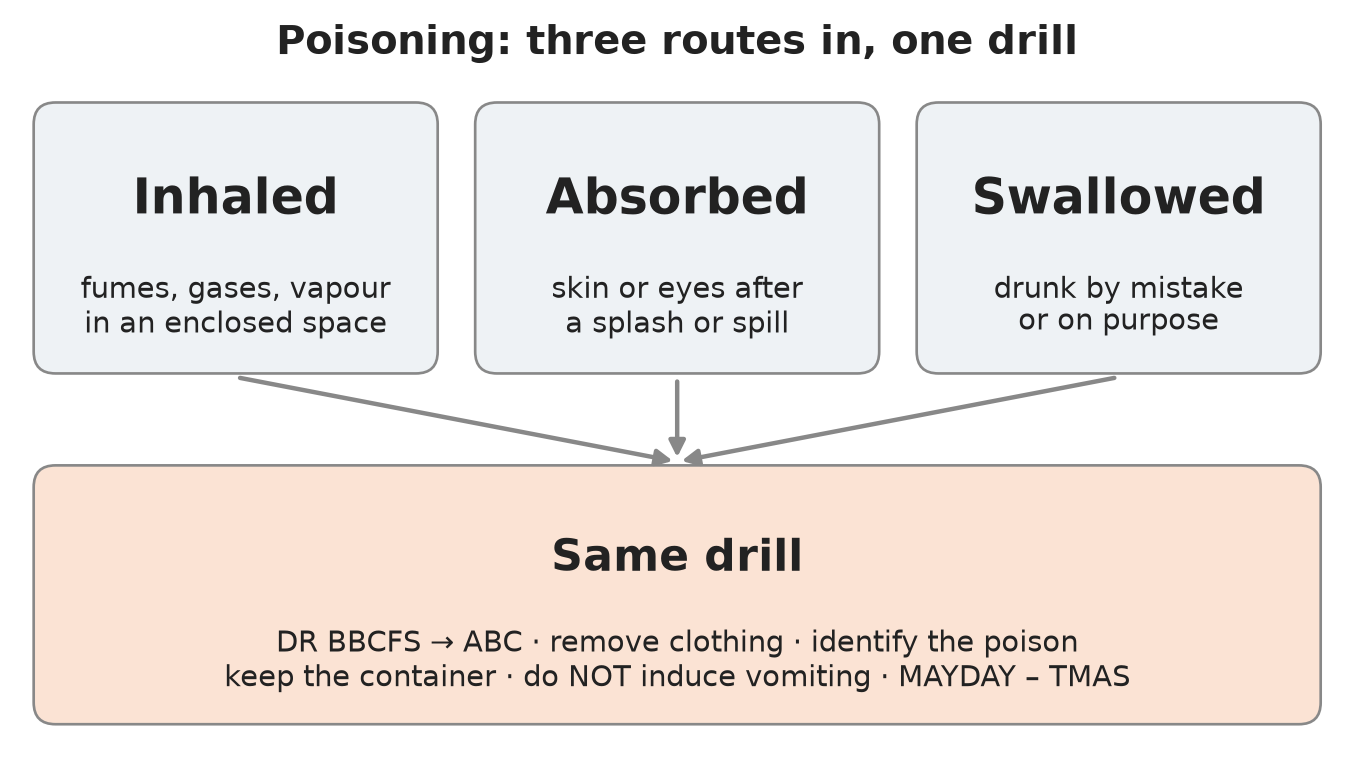
- Inhaled — fumes, gases, vapour in an enclosed space.
- Absorbed — through the skin or eyes after a splash or spill.
- Swallowed — drunk by mistake or on purpose.
- The core management is the same for all three (see the next section).
What a toxic substance can do
- The MFAG lists three main harms: burns, anaphylaxis and asphyxia.
- Poisoning has three stages: latent (no or few signs yet), active (the poison is working) and late (after-effects).
The latent stage fools people: a casualty who looks well can still be seriously poisoned. Methanol is the classic example.
First Response to Poisoning
In short: make it safe, check ABC, stop more poison getting in, find out what it was, and get radio medical advice.
The drill — inhaled, absorbed or swallowed
- DR BBCFS → ABC — Danger, Response, Breathing, Bleeding/Burns, Consciousness, Fractures, Shock; then airway, breathing, circulation.
- Remove any contaminated clothing.
- Identify the poison if you can — ask the casualty early, in case they become unconscious.
- Collect samples, and send the container with the casualty to hospital.
- Monitor closely.
- Not breathing → resuscitate with a BVM (bag-valve-mask).
- Do NOT induce vomiting.
- Swab the mouth if it is burning.
- MAYDAY – TMAS.
Never make the casualty vomit. A corrosive burns twice on the way back up, and a drowsy casualty can choke.
On the bridge
- A crew member is found dizzy in a store after using a cleaner. Get them into fresh air without becoming a second casualty, then run the drill.
- Bring the can or bottle to the radio: TMAS will ask what is in it.
Chemical on the Skin
In short: clothing off first, then lots of running water. Dilution is the answer for both acids and alkalis.
Step by step
- Remove the contaminated clothing FIRST — soaked cloth keeps the chemical against the skin.
- Then prolonged running water. Acid or alkali, dilution is the answer.
- The MSDS goes with the casualty, or is scanned to TMAS.
Know your kit
- Tip: open an expired chemical first-aid kit and learn what is inside before you need it.
Dangerous Goods: the IMDG Code and Hazard Classes
In short: the IMDG Code is the rulebook for carrying dangerous goods by sea. Its class number tells you at a glance what kind of hazard a substance is.
What the IMDG Code is for
- IMDG Code = International Maritime Dangerous Goods Code. Its key aims:
- protect human life;
- prevent marine pollution;
- allow the free movement of dangerous goods.
The nine hazard classes
| Class | Hazard |
|---|---|
| 1 | Explosives |
| 2 | Gases |
| 3 | Flammable liquids |
| 4 | Flammable solids |
| 5 | Oxidizers (5.1) and organic peroxides (5.2) |
| 6 | Toxic (poison) and infectious substances |
| 7 | Radioactive |
| 8 | Corrosives |
| 9 | Miscellaneous |
- Class 6 is the poison class — but gases (2), corrosives (8) and many others can also poison or burn.
The MSDS (Material Safety Data Sheet)
In short: every chemical on board has a data sheet. In an emergency go straight to section 8 — first aid.
The nine sections
| Section | Contents |
|---|---|
| 1 | Product information |
| 2 | Hazardous ingredients |
| 3 | Physical data |
| 4 | Fire and explosion data |
| 5 | Reactivity |
| 6 | Toxicological properties — exposure limits, effects on the body |
| 7 | Preventive measures — PPE, ventilation, spills |
| 8 | First aid measures |
| 9 | Preparation information |
- Section 8 usually ends with “contact a doctor”. At sea, that means TMAS (radio medical advice).
- Section 2 gives you the ingredient — the name you need for the MFAG.
The MSDS goes with the casualty, or is scanned and sent to TMAS.
Using the MFAG and the Ship Captain’s Medical Guide
In short: the MFAG gives the first aid for each dangerous substance. Search it by ingredient, never by trade name.
What the MFAG is
- MFAG = Medical First Aid Guide for Use in Accidents Involving Dangerous Goods — an IMO/WHO/ILO guide, printed in the IMDG Code Supplement.
- It has poison tables by ingredient: signs, symptoms and treatment for each.
How to look a substance up
- Read the label or the MSDS for the ingredient.
- Find that ingredient in the MFAG — not the trade name. Example: a degreaser contains methanol, so look up methanol.
- Follow the table, and get radio medical advice (RMA).
- Cross-check the Ship Captain’s Medical Guide (SCMG): methanol and ethylene glycol are on p. 178; the allergy section is around p. 42 (5.15).
- Practise finding answers in the SCMG before an emergency: in a real case you have no time to learn the book.
Methanol and Ethylene Glycol
In short: methanol (found in degreasers) is highly toxic and acts late. Ethanol is the antidote: it blocks methanol uptake and buys time until evacuation.
Why it is dangerous
- Highly toxic, with a delayed effect.
- The casualty can look fine at first. Don’t wait for symptoms — treat on the history.
The antidote — two sources, two doses
| Source | Treatment |
|---|---|
| MFAG (methanol table) | RMA always, plus 20 ml ethyl alcohol 99.5% in 250–300 ml water or soft drink |
| SCMG p. 178 (methanol / ethylene glycol) | 150 ml spirit (gin or vodka), repeat every 3 h until evacuation |
- Both work the same way: ethanol blocks methanol uptake and buys time.
- The doses differ between the two books: follow the one TMAS tells you to use.
Ethanol is the methanol antidote. It does not cure — it holds the poison back until the casualty reaches hospital.
Anaphylaxis
In short: a severe, fast allergic reaction that closes the airway and drops the blood pressure. Adrenaline first, then antihistamine and steroid, and keep treating for days.
Recognise it
- Example: a guest takes one bite of a clam and soon shows signs of shock, difficulty breathing and a rapid loss of consciousness.
- Airway swelling or breathing trouble → adrenaline.
- Small local sting → cortisone cream only, NO adrenaline.
Treatment step by step
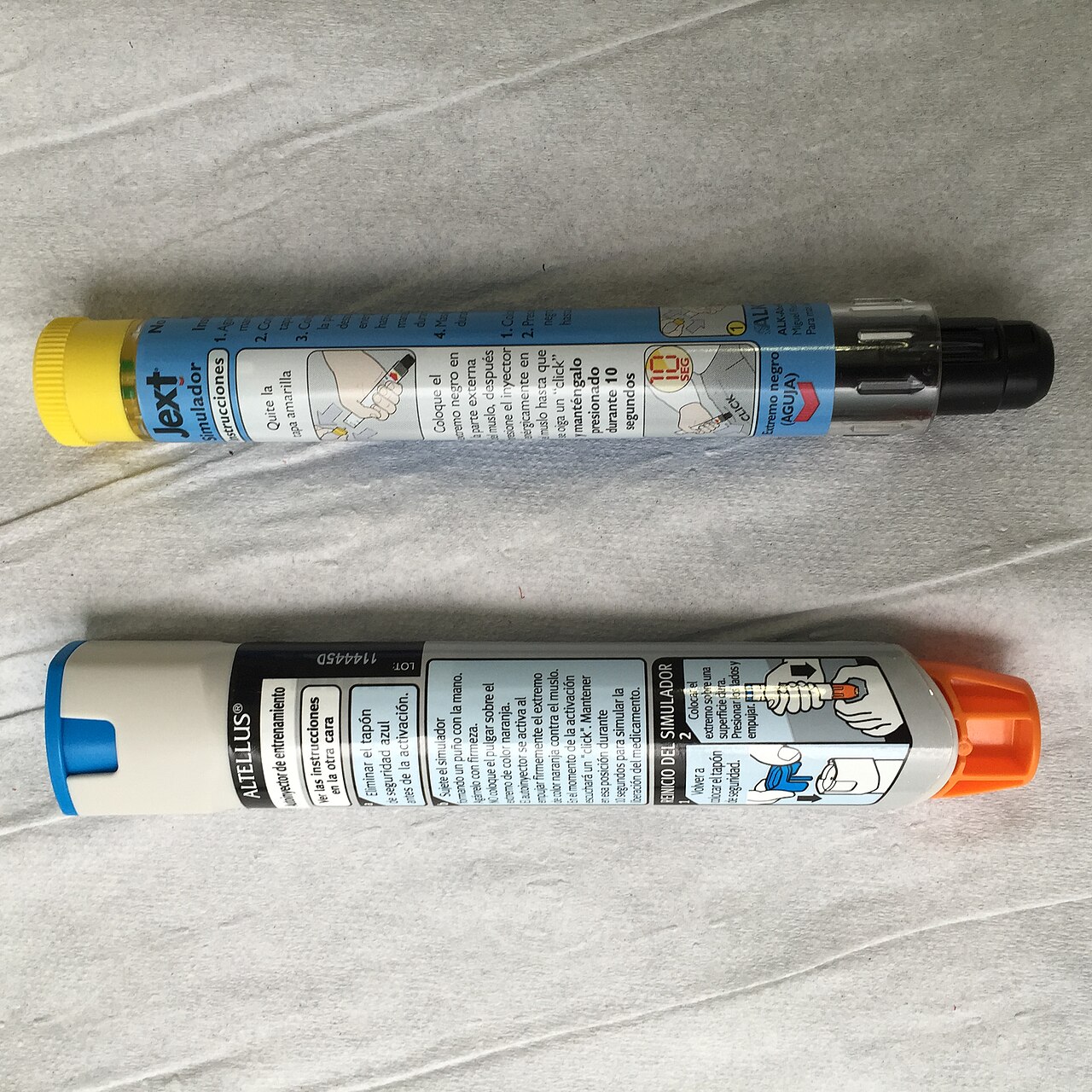
- Adrenaline IM: 0.5 mg adult / 0.3 mg child. Repeat every 5–10 min if there is no improvement.
- EpiPen: take the blue cap off → press into the upper outer thigh, through clothing → hold 10 s. For repeat doses alternate thighs and record which side.
- Shock position + oxygen; IV fluids if the blood pressure stays low.
- Then give both an antihistamine (stops the reaction) and a steroid (clears the inflammation already there). Salbutamol only if wheezing.
- Continue treatment for 4–7 days, or the allergy can rebound worse. SCMG allergy section ≈ p. 42 (5.15).
Adrenaline in the medical stores
- Adrenaline is kept with the cardiac drugs.
- Ampoules are 1 mg in 1 ml. IM and IV preparations differ — dilute to draw up the dose accurately.
Don’t stop at adrenaline. Give antihistamine and steroid, and keep treating for 4–7 days.
Asthma and Inhalers
In short: in asthma the airway muscles tighten. An inhaler relaxes them and usually eases the breathing.
Reliever and preventer
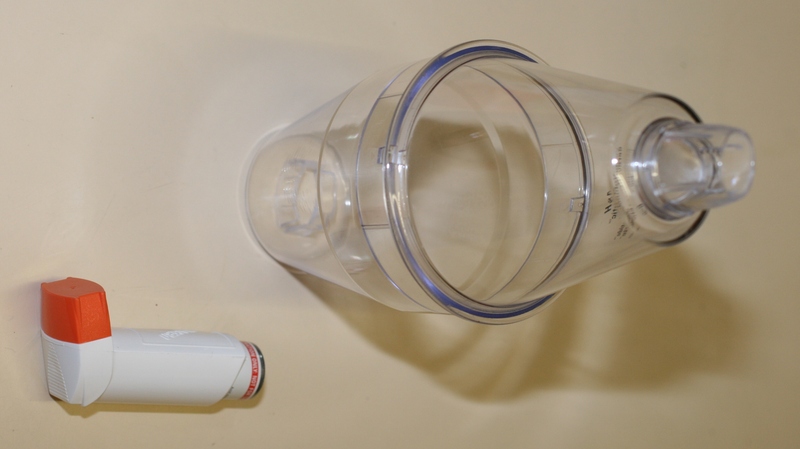
- An inhaler relaxes the muscles in the airway walls — usually effective for breathing difficulty in asthma.
- Reliever = Ventolin (salbutamol) — for the attack.
- Preventer = a daily steroid inhaler — keeps attacks away; it does not stop one in progress.
- Severe asthma in hospital: continuous nebulised salbutamol + IV magnesium sulfate (hospital care, beyond on-board treatment).
- Asthma and allergy overlap: in anaphylaxis, salbutamol is added only if there is wheezing.
⚡ Flashcards
Test yourself, one card at a timeQ1How can a poison get into the body, and what harm can a toxic substance do?
AnswerThree routes: inhaled, absorbed or swallowed. Toxic substances can cause burns, anaphylaxis or asphyxia. Poisoning runs in three stages: latent → active → late.
Common trapTrap: a quiet latent stage does not mean the casualty is safe.
Q2What is the first-aid drill for any poisoning on board?
AnswerDR BBCFS → ABC · remove contaminated clothing · identify the poison · keep samples and the container · monitor · not breathing → BVM · swab a burning mouth · MAYDAY – TMAS.
Common trapTrap: never induce vomiting.
Q3Why must you ask what the casualty took as early as possible?
AnswerThey may lose consciousness — then nobody can tell you. Send the container and samples with them to hospital.
Common trapTrap: waiting for symptoms before asking.
Q4A chemical splashes onto a deckhand's skin and overalls. What do you do first?
AnswerRemove the contaminated clothing first, then prolonged running water. Acid or alkali, dilution is the answer.
Common trapTrap: hosing them down with the soaked clothes still on.
Q5What are the aims of the IMDG Code, and which class is poisons?
AnswerProtect human life, prevent marine pollution, allow the free movement of dangerous goods. Nine classes; Class 6 = toxic (poison) and infectious substances.
Common trapTrap: Class 8 is corrosives, not poisons.
Q6Which part of the MSDS do you need in an emergency, and where does the sheet go?
AnswerSection 8 — first aid measures (of 9 sections). The MSDS goes with the casualty, or is scanned to TMAS.
Common trapTrap: section 8 usually ends with “contact a doctor” — at sea that means TMAS.
Q7How do you find the right treatment in the MFAG?
AnswerLook up the ingredient, not the trade name — e.g. a degreaser → look up methanol.
Common trapTrap: searching for the brand name on the can.
Q8A crew member has swallowed a methanol degreaser. What do you give?
AnswerEthanol is the antidote. MFAG: RMA always + 20 ml ethyl alcohol 99.5% in 250–300 ml water or soft drink. SCMG p. 178: 150 ml spirit (gin/vodka), repeat every 3 h until evacuation.
Common trapTrap: methanol has a delayed effect — the casualty can look fine at first.
Q9Anaphylaxis: which drug, what dose, and how do you use an EpiPen?
AnswerAdrenaline IM 0.5 mg adult / 0.3 mg child, repeat every 5–10 min if no better. EpiPen: blue cap off → upper outer thigh, through clothing, hold 10 s; alternate thighs and record the side.
Common trapTrap: a small local sting needs cortisone cream only — no adrenaline.
Q10After the adrenaline, how do you carry on treating anaphylaxis?
AnswerShock position + oxygen; IV fluids if BP stays low. Then antihistamine + steroid — both; salbutamol only if wheezing. Keep treating 4–7 days.
Common trapTrap: stopping at adrenaline — the allergy can rebound worse.
Q11How does an inhaler help in asthma, and which is the reliever?
AnswerIt relaxes the muscles in the airway walls. Reliever = Ventolin (salbutamol); preventer = a daily steroid inhaler.
Common trapTrap: the steroid preventer will not stop an attack in progress.
📚 Resources
Video
- First aid for severe allergic reactions — First aid training online — British Red Cross
- How to Treat an Asthma Attack - First Aid Training - St John Ambulance — St John Ambulance
Books
- The Ship Captain’s Medical Guide — Maritime and Coastguard Agency, 24th edition (2024); methanol and ethylene glycol, and the allergy section
- Medical First Aid Guide for Use in Accidents Involving Dangerous Goods (MFAG) — IMO/WHO/ILO, printed in the IMDG Code Supplement
Regulations
- The International Maritime Dangerous Goods (IMDG) Code — IMO
- MSN 1905 (M+F) Amendment 5 — ships’ medical stores — section 4 covers medicines for ships carrying dangerous cargoes and refers to the MFAG
Official sites
- Poisoning — NHS
- Anaphylaxis — NHS
Exam focus — MCA
Typical questions: “A crew member has drunk degreaser from a water bottle — what do you do?” · “How do you find the treatment for a chemical in the MFAG?” · “Which section of the MSDS do you need, and what happens to the sheet?” · “A guest collapses after eating shellfish — talk me through your treatment, with doses.” · “Name the IMDG hazard classes and the aims of the Code.”
What examiners want: DR BBCFS → ABC, contaminated clothing off, identify the poison early, keep the container, no vomiting, MAYDAY – TMAS; look up the ingredient, not the trade name; MSDS section 8 and the sheet travelling with the casualty; ethanol as the methanol antidote (MFAG 20 ml 99.5% in 250–300 ml; SCMG 150 ml spirit every 3 h) and its delayed effect; anaphylaxis adrenaline 0.5 mg IM adult / 0.3 mg child every 5–10 min, EpiPen in the outer thigh for 10 s, then antihistamine + steroid for 4–7 days.